

 Back
Back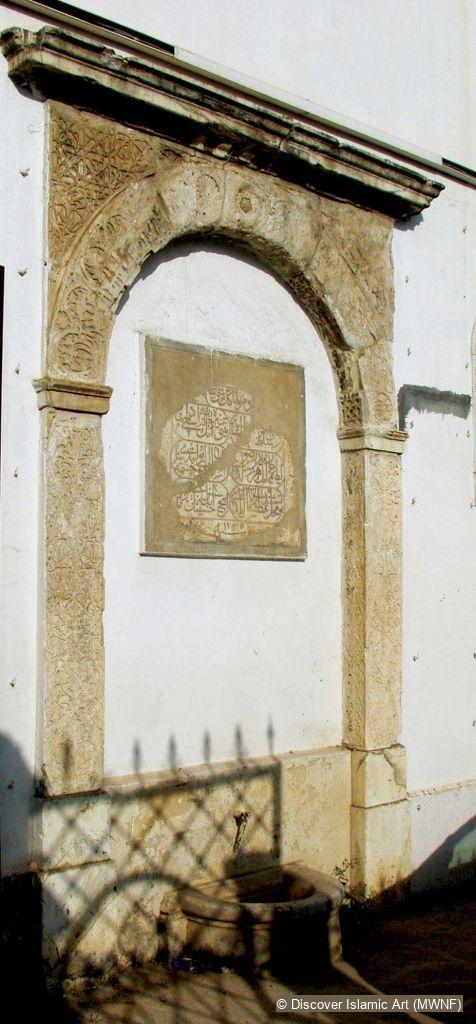
Name of Monument:
Public fountains
Location:
Algiers, Algeria
Date of Monument:
Hegira 1235 / AD 1820
Period / Dynasty:
Ottoman
Description:
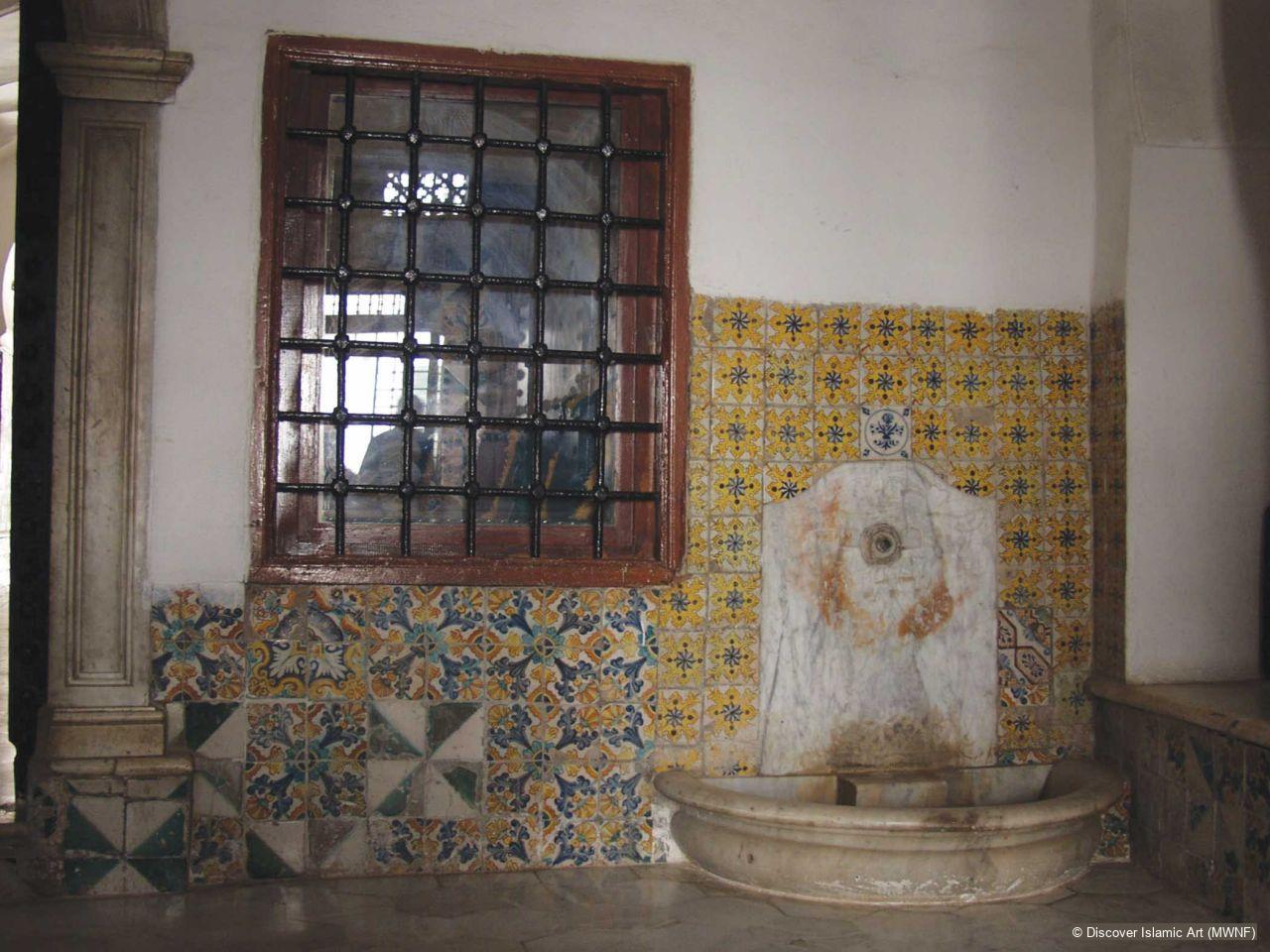
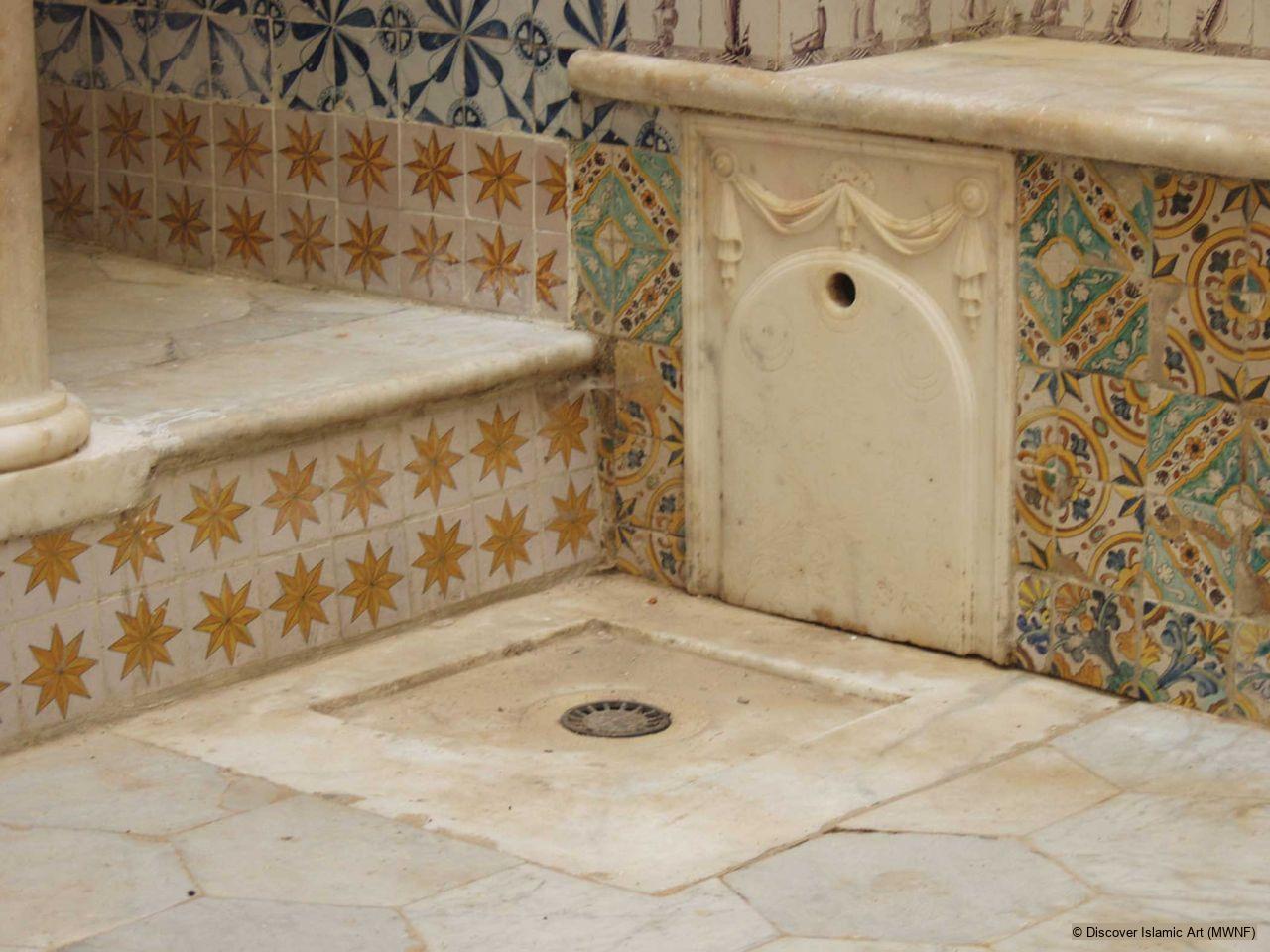
Al-Djazaïr and its fahs (rural surroundings) possessed a large number of fountains. Their number, for the walled town, varied from seven according to Haëdo in the AH 10th / AD 16th century, to 125 according to the knight of Arvieux in 1674–5, and to 'seventy-three as recorded in 1840' (S. Missoum, Alger à l'époque ottomane – see Bibliography). A large number of these fountains were built during the AH 12th / AD 18th century by deys.
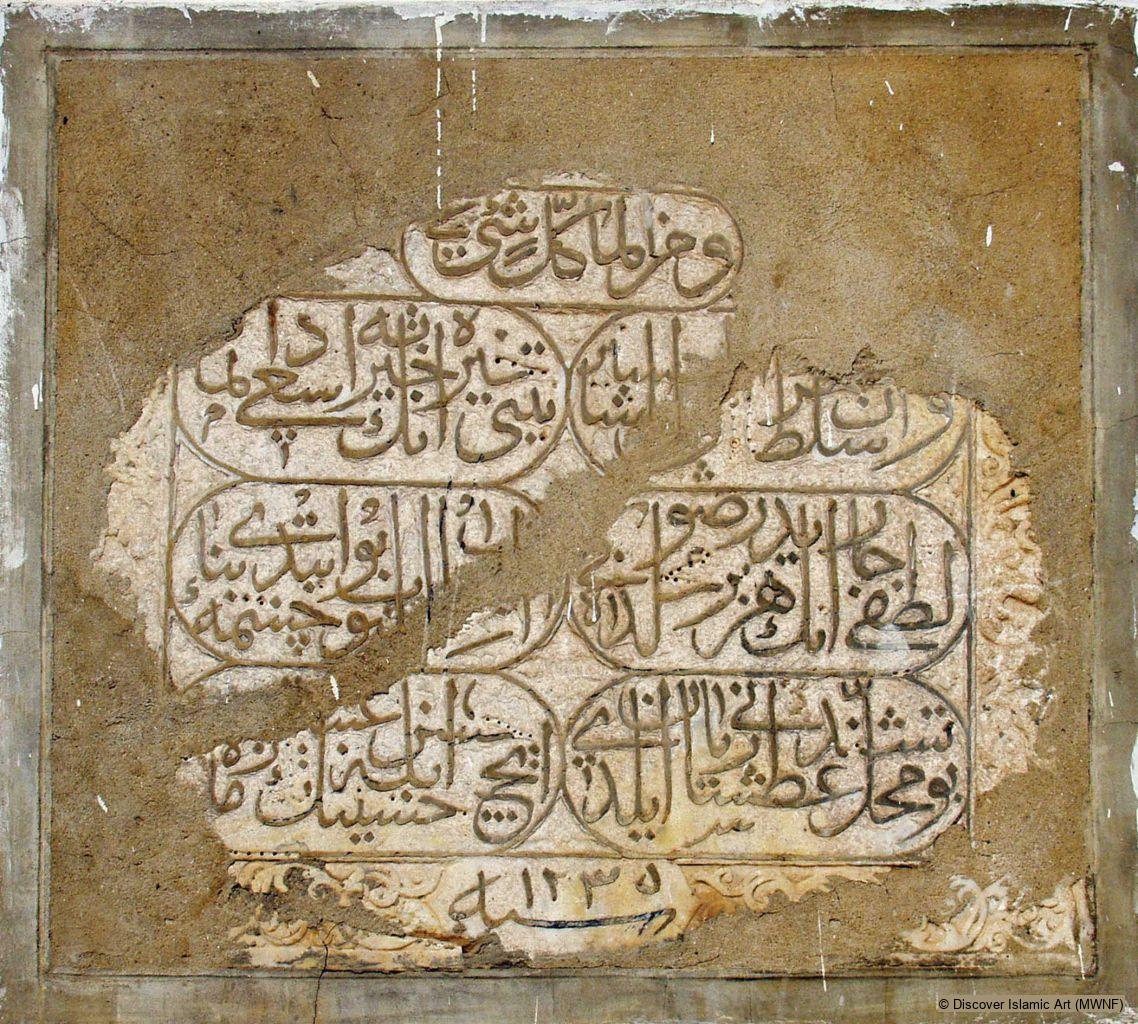
Benefactors were responsible for the creation of these fountains. Attached to each one, on a plaque of marble or shale, in Arabic or Ottoman Turkish, is an inscription extolling the merits of the benefactor. Under the auspices of a khudjat al-'uyun – a sort of 'fountains secretary' – an administrative body was responsible for managing the habus (estate donations) that were collected on behalf of these fountains.
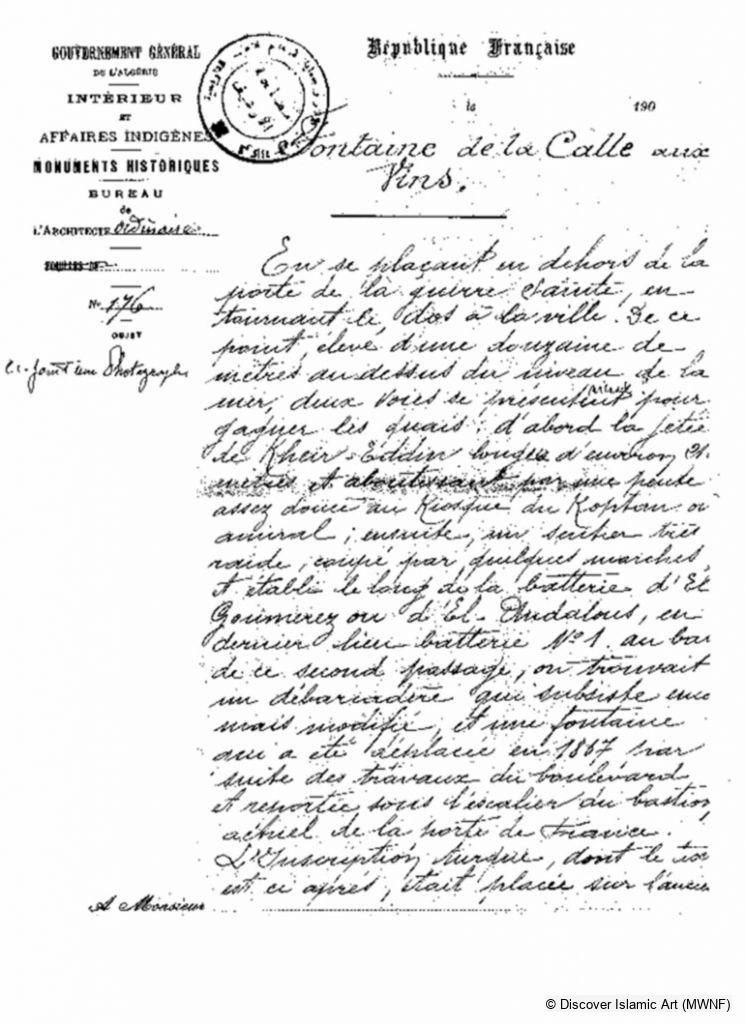
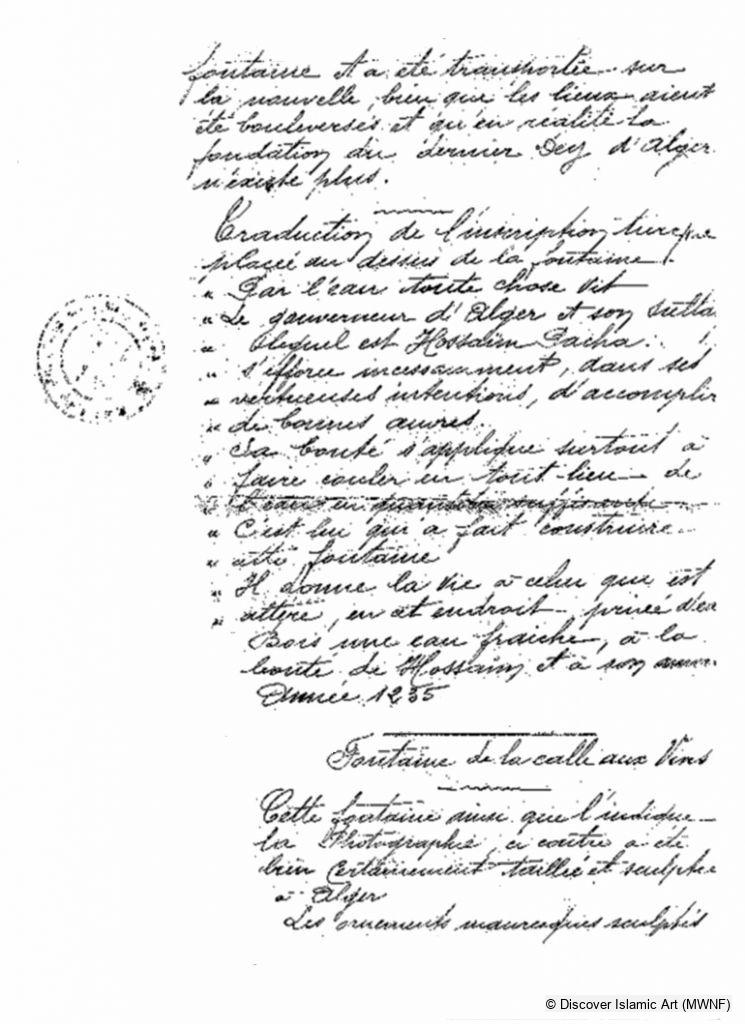
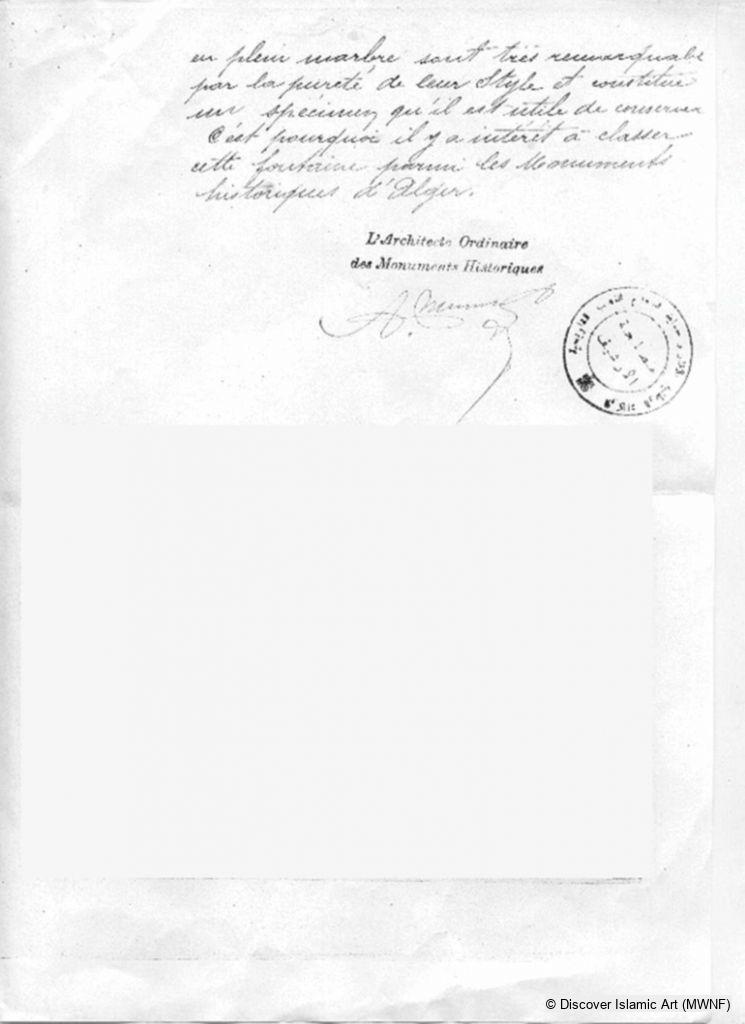
One of these fountains, known as the fountain 'de la Calle aux Vins', has ended up on an exterior wall of the present National Museum of Antiquities and Islamic Art. Built by the dey Husayn in AH 1235 / AD 1820 outside Bab al-Djazira (Gate of the Island', also referred to as Gate of the Holy War) and below the battery of al-Andalus, it was moved for the first time in 1867 to 'underneath the stairway of the present bastion of the Gate of France' (undated report on the proposition of making an endowment to the state; but the agreement on the endowment is dated 13 May 1905). Then it was moved a second time to the Park of Liberty (formerly Gallant Park), to be placed against the wall of the Department of Antiquities, where, in correspondence dated 27 May 1968, it is the subject of an account of the maintenance work carried out by the chief architect of historic monuments.
The town of Al-Djazaïr had a number of public fountains, most of which were built during the AH 12th / AD 18th century by the Ottoman deys. These fountains bore, on a marble or slate plaque, the names of the benefactors who commissioned them and were managed by an body under the aegis of the 'fountains secretary'. In AH 1235 / AD 1820, dey Husayn had a fountain built outside Bab al-Djazira, the gateway that bears an inscription in his honour.
How Monument was dated:
Through an inscription in Arabic and Osmanli: 'Everything lives through water. The governor of Algiers along with his sultan, who is Husayn Pasha, incessantly strives, with virtuous intentions, to accomplish good deeds. His bounty attempts above all to bring running water in sufficient quantities to all places. It is he who commissioned the building of this fountain. He gives life to him that is thirsty and deprived, in this place that lacks water. Drink fresh water thanks to the generosity of Husayn and his love. Year 1235 [1820].'
Selected bibliography:
Belhamissi M., Alger par les eaux XVIe–XIXe, Algiers, 2004.
Missoum, S., Alger à l'époque ottomane, Aix-en-Provence; Algiers, 2003.
National Archaeological and Historic Monuments Agency, Archives, notably the report on endowments to the state, undated.
Citation of this web page:
Ali Lafer "Public fountains" in Discover Islamic Art, Museum With No Frontiers, 2026. 2026.
https://islamicart.museumwnf.org/database_item.php?id=monument;ISL;dz;Mon01;24;en
Prepared by: Ali LaferAli Lafer
Architecte diplômé de l'École nationale d'architecture et des beaux-arts d'Alger, stagiaire du Centre international pour la conservation et la restauration des biens culturels (ICCROM) à Rome, Ali Lafer a été architecte en chef des Monuments au ministère de la Culture pendant son service civil. Directeur de l'Atelier Casbah chargé des études d'aménagement de la médina d'Alger, il a également enseigné au cours de Tunis pour la formation d'architectes du patrimoine maghrébin. Membre fondateur de l'association “Les amis du Tassili”, il est aussi chercheur dans les domaines de la numérisation de la documentation graphique et du relevé photogrammétrique.
Copyedited by: Margot Cortez
Translation by: Maria Vlotides
Translation copyedited by: Monica Allen
MWNF Working Number: AL 32
RELATED CONTENT
Islamic Dynasties / Period
On display in
Exhibition(s)
The Table Is Set
Social Life | Food as a Bond of Communal IdentityWater in Islam
Contemporary Context: Water in the Islamic World Today | Art and Water, Contemporary Approach Domestic and Urban Spheres | Urban Water Infrastructure Religion and Spirituality | "The Best Charity is a Drink of Water" (Hadith: Sunan An-Nasa'i 3694)Download
As PDF (including images) As Word (text only)