

 Back
Back
Name of Monument:
Málaga Citadel and Gibralfaro Castle
Location:
Málaga, Spain
Date of Monument:
Hegira 5th–8th centuries / AD 11th–14th centuries
Period / Dynasty:
Taifa kingdoms of Banu Hammud and Banu Ziri; Nasrid
Patron(s):
Yahya al-Mu’tali (r. AH 417–27 / AD 1026–35); Badis al-Muzaffar (r. AH 449–56 / AD 1057–73); Yusuf I (r. AH 734–55 / AD 1333–54).
Description:
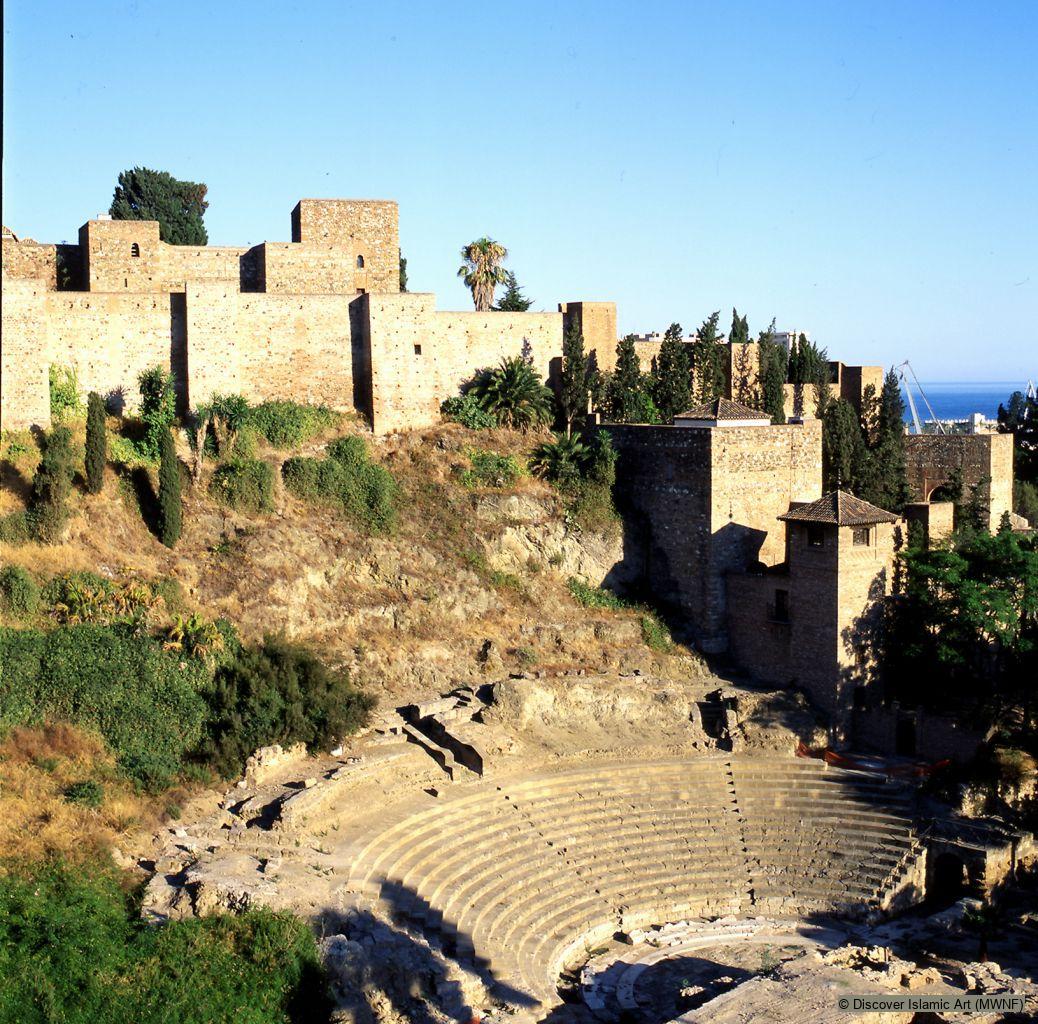
The city of Málaga , situated on an inlet with coastal hills that make it easy to defend, has had a succession of settlements since Phoenician times. The only surviving remains from the Muslim period is the defensive structure consisting of the citadel and the Gibralfaro Castle.
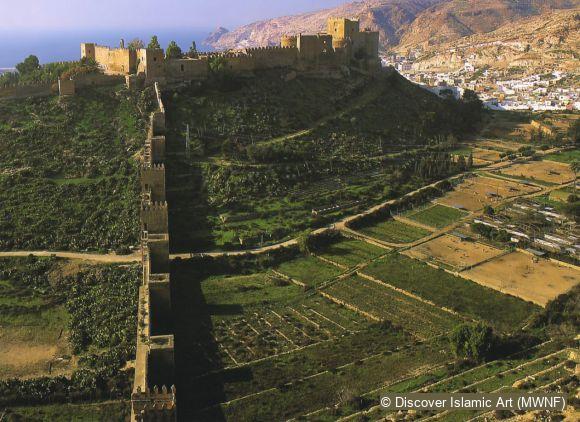
Two hills dominate the inlet: the remains of the citadel are to be found on the lower of the two and the castle of Gibralfaro stands on the taller, steeper one. The two structures are linked by a coracha or passageway walled and zigzagged to protect it.
The citadel was built at the time of the Taifa kingdoms in the mid AH 5th / AD 11th century. Towards the end of the AH 7th / AD 13th century and during the first half of the AH 8th / AD 14th century, during the Nasrid period, the building was partially reconstructed and new structures were added.
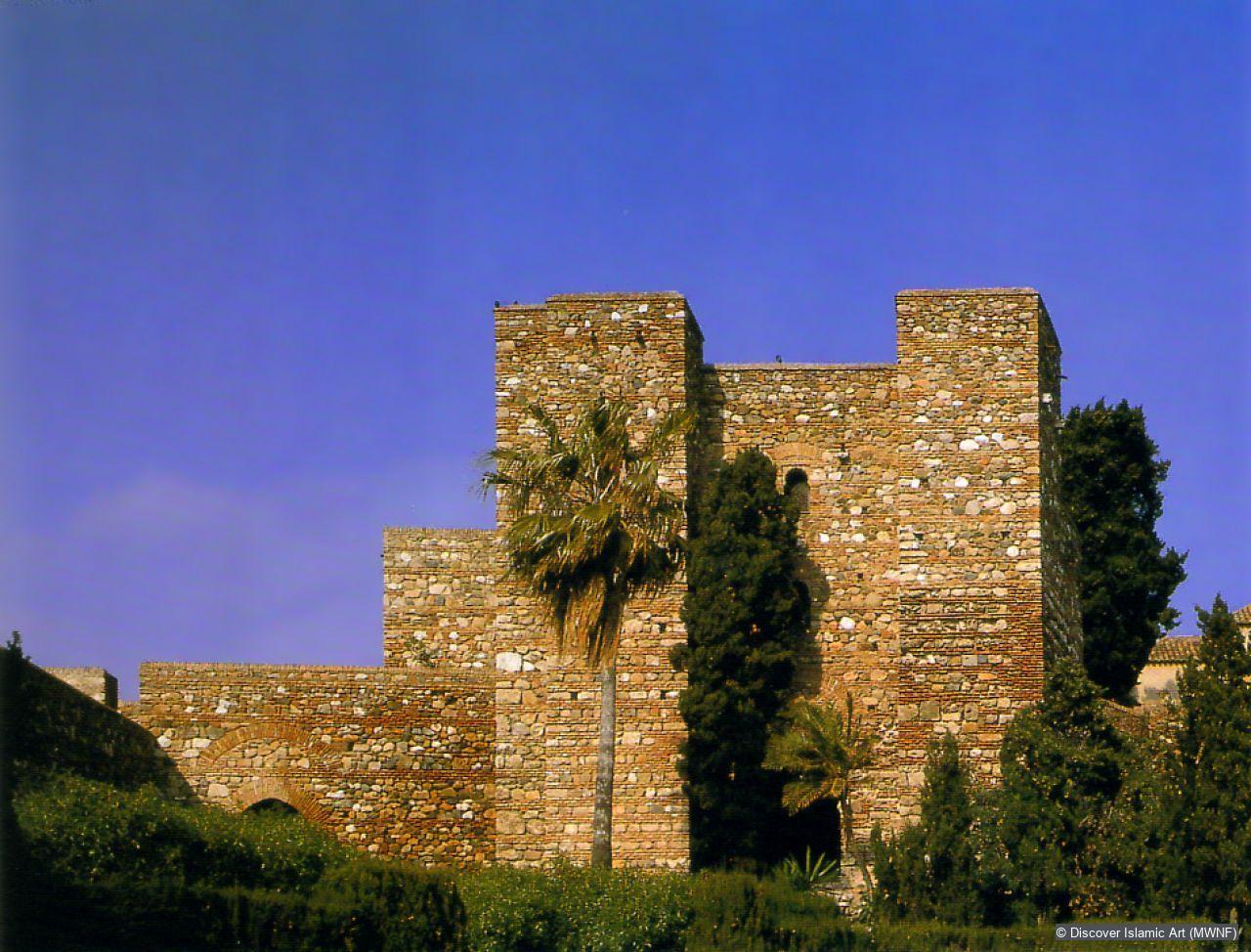
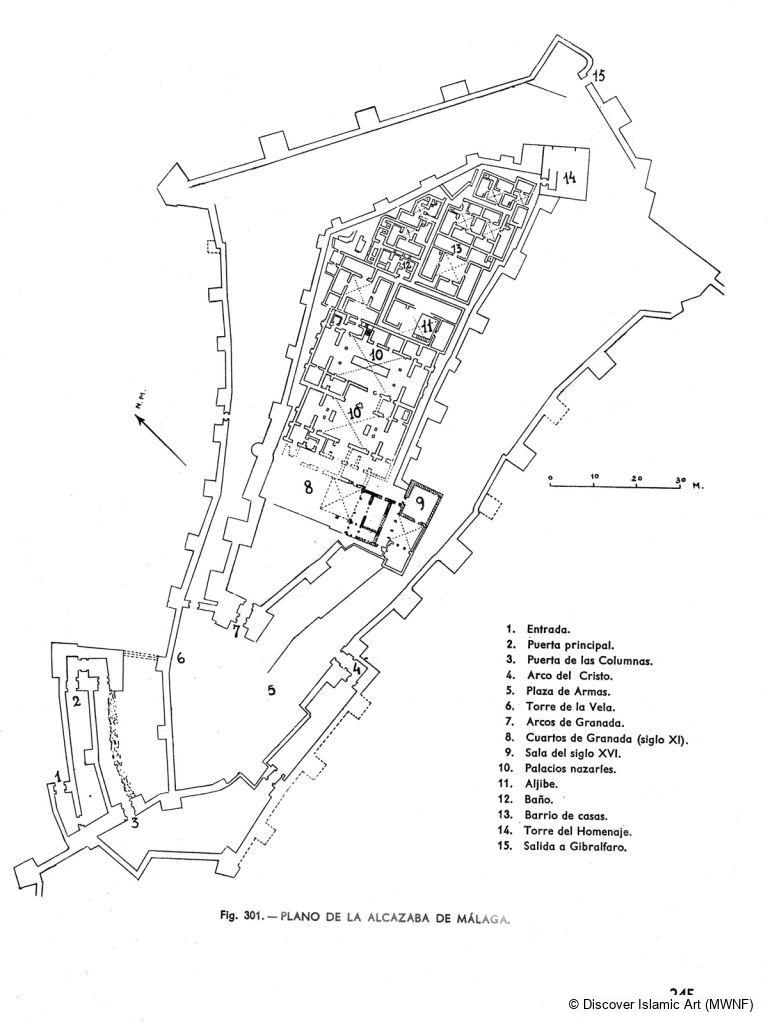
The defensive structure of the citadel is made up of two walled enclosures with quadrangular towers and a series of advance fortifications that protect the entrance. The outer enclosure, which was accessed through a bent-entrance gateway dating to the AH 5th / AD 11th century, is situated halfway down the hill and entirely surrounds the inner enclosure. This higher enclosure occupies the summit of the hill and contains remains of the palatine buildings and a large tower on the eastern side. The double defensive enclosure and the five gateways that had to be opened to reach the final one (the palace area) demonstrate the military importance of the fortress.
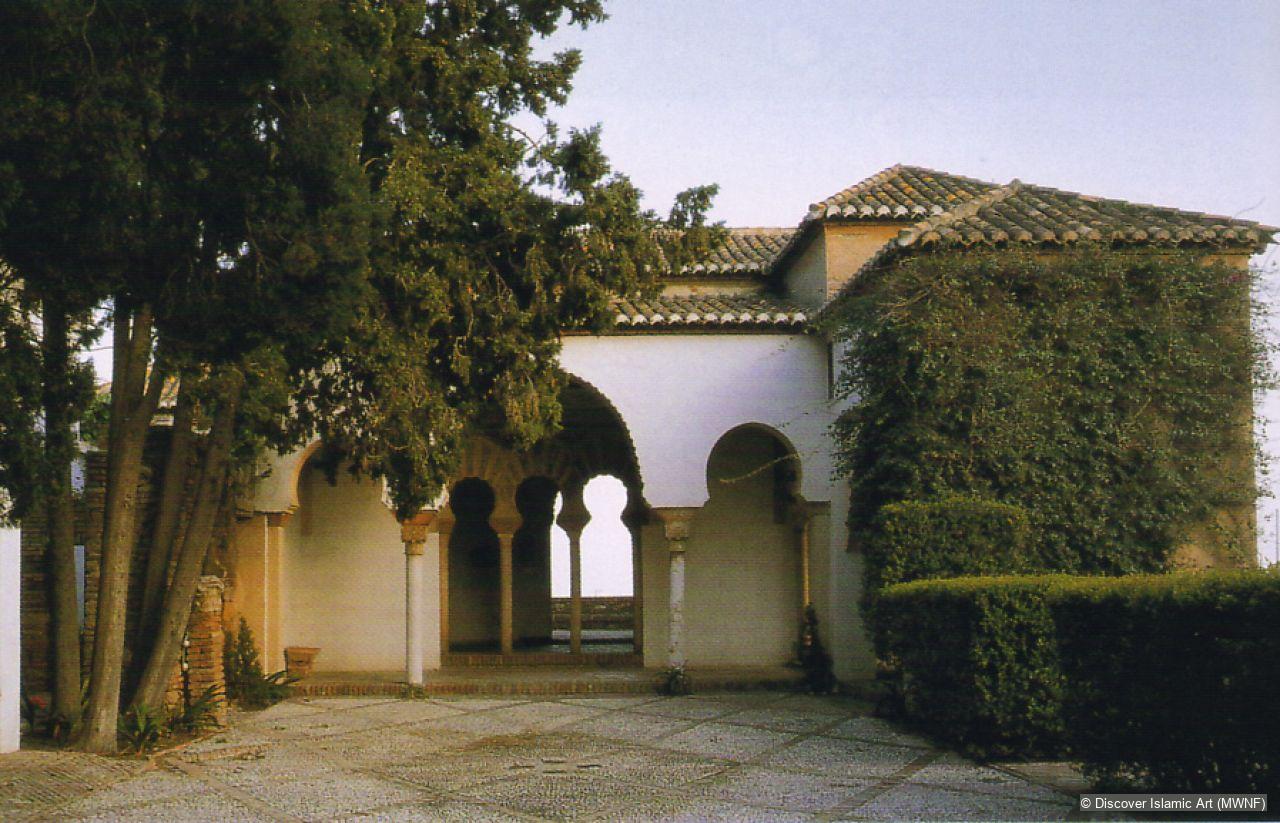
The most important structural remains of those found inside are the ones in the 'Granada Rooms', which have made it possible to reconstruct part of the AH 5th- / AD 11th-century Taifa palace, principally a rectangular room linked to an arcade through three horseshoe arches, whose voussoirs are richly decorated in plasterwork. At one end of the arcade there is a small square room that retains intertwined lobed arches supported on a central column. There are clear parallels between these elements and Caliphate art, specifically the part of the Great Mosque of Córdoba built under al-Hakam II. The layout of the room that opens out onto the arcade is similar to the Rich Room at Madinat al-Zahra. The sculpted stuccos, inspired by Caliphate prototypes but flatter and less varied than these, are among the very first manifestations of the new aesthetics of the Taifa kingdoms.
The fortress of Gibralfaro is situated on another hill, dominating the citadel. References to the fortification are late, but they suggest it was constructed under Yusuf I in the AH 8th / AD 14th century. Increasing use of artillery must have made it clear that a fortress was needed to protect the citadel, which was defenceless to attack from the hills that dominate it.
The Nasrid fortifications do not introduce any significant developments on Almohad structures, although the defensive barriers are multiplied and the towers increase in size. During this period, possibly due to the Christian influence of the homage tower, a large tower was built in one corner, a first in al-Andalus at that time.
The town of Málaga is located strategically on the south coast of the peninsula. When it became a Taifa kingdom, a citadel was built with double walls, square towers, a main chicane entrance and a palace for the king. This fortress was an essential part of the development of Hispano-Muslim military architecture owing to the construction of its walls, which consisted of masonry with double rows of bricks that afforded it great strength.
The Gibralfaro Castle, linked to the citadel by a coracha or double wall, was built under the Nasrids to reinforce the defensive system.
How Monument was dated:
Some authors believe that the palace was built under Yahya al-Mu’tali, first Hammadid amir, and that the double wall was added by Badis, Zirid king of Granada, whose troops conquered Málaga . However, there is no conclusive evidence to determine which of the two dynasties that ruled Málaga in the mid 5th /11th century built the enclosure of the citadel and its palace. Studies and digs carried out on the enclosure have given evidence of later construction in the Nasrid era, as well as the construction of the castle of Gibralfaro under Yusuf I.
Selected bibliography:
Robinson, C., “Las Artes en los Reinos de Taifas”, in Al-Andalus: Las Artes Islámicas en España, Madrid, 1992, pp.52–5.
Torres Balbás, L., Arte Almohade, Arte Nazarí, Arte Mudéjar, Ars Hispaniae,Vol. IV, Madrid, 1949, pp.160–8.
Torres Balbás, L., “Hallazgos en la Alcazaba de Málaga”, Al-Andalus, Vol. II, Madrid; Granada, 1934, pp.344–61.
Citation of this web page:
Margarita Sánchez Llorente "Málaga Citadel and Gibralfaro Castle" in Discover Islamic Art, Museum With No Frontiers, 2026. 2026.
https://islamicart.museumwnf.org/database_item.php?id=monument;ISL;es;Mon01;7;en
Prepared by: Margarita Sánchez LlorenteMargarita Sánchez Llorente
Margarita Sánchez Llorente cursó estudios de Historia del Arte y Psicología en la facultad de Filosofía y Letras de la Universidad Complutense de Madrid, obteniendo la licenciatura en 1974.Tras realizar numerosos cursos de posgrado en museología y documentación del patrimonio histórico-artístico y arqueológico, le fueron concedidas varias becas de investigación en museística. De 1989 a 2000 trabajó en el Museo Arqueológico Nacional, en la gestión y documentación de los proyectos de la Unión Europea: EMN (European Museum Network), RAMA (Remote Access to Museum Archives) y –como colaboradora del departamento de Antigüedades Egipcias y del Próximo Oriente– Champollion. Ha participado en numerosos coloquios y encuentros internacionales y publicado varios artículos sobre las nuevas tecnologías aplicadas a la documentación en los museos.
Copyedited by: Rosalía AllerRosalía Aller
Rosalía Aller Maisonnave, licenciada en Letras (Universidad Católica del Uruguay), y en Filología Hispánica y magíster en Gestión Cultural de Música, Teatro y Danza (Universidad Complutense de Madrid), ha obtenido becas de la Agencia Española de Cooperación Internacional y la Universidad Nacional de Educación a Distancia de Madrid, así como el Diplôme de Langue Française (Alliance Française), el Certificate of Proficiency in English (University of Cambridge) y el Certificado Superior en inglés y francés (Escuela Oficial de Idiomas de Madrid). Profesora de Estética de la Poesía y Teoría Literaria en la Universidad Católica del Uruguay, actualmente es docente de Lengua Castellana y Literatura en institutos de Enseñanza Secundaria y formación del profesorado en Madrid. Desde 1983, ha realizado traducción y edición de textos en Automated Training Systems, Applied Learning International, Videobanco Formación y El Derecho Editores. Integra el equipo de Museo Sin Fronteras desde 1999 y ha colaborado en la revisión de los catálogos de “El Arte Islámico en el Mediterráneo”. Así mismo, ha realizado publicaciones sobre temas literarios y didácticos, ha dictado conferencias y ha participado en recitales poéticos.
Translation by: Laurence Nunny
Translation copyedited by: Monica Allen
MWNF Working Number: SP 07
RELATED CONTENT
Related objects

Related monuments

On display in
Exhibition(s)
Download
As PDF (including images) As Word (text only)