

 Back
Back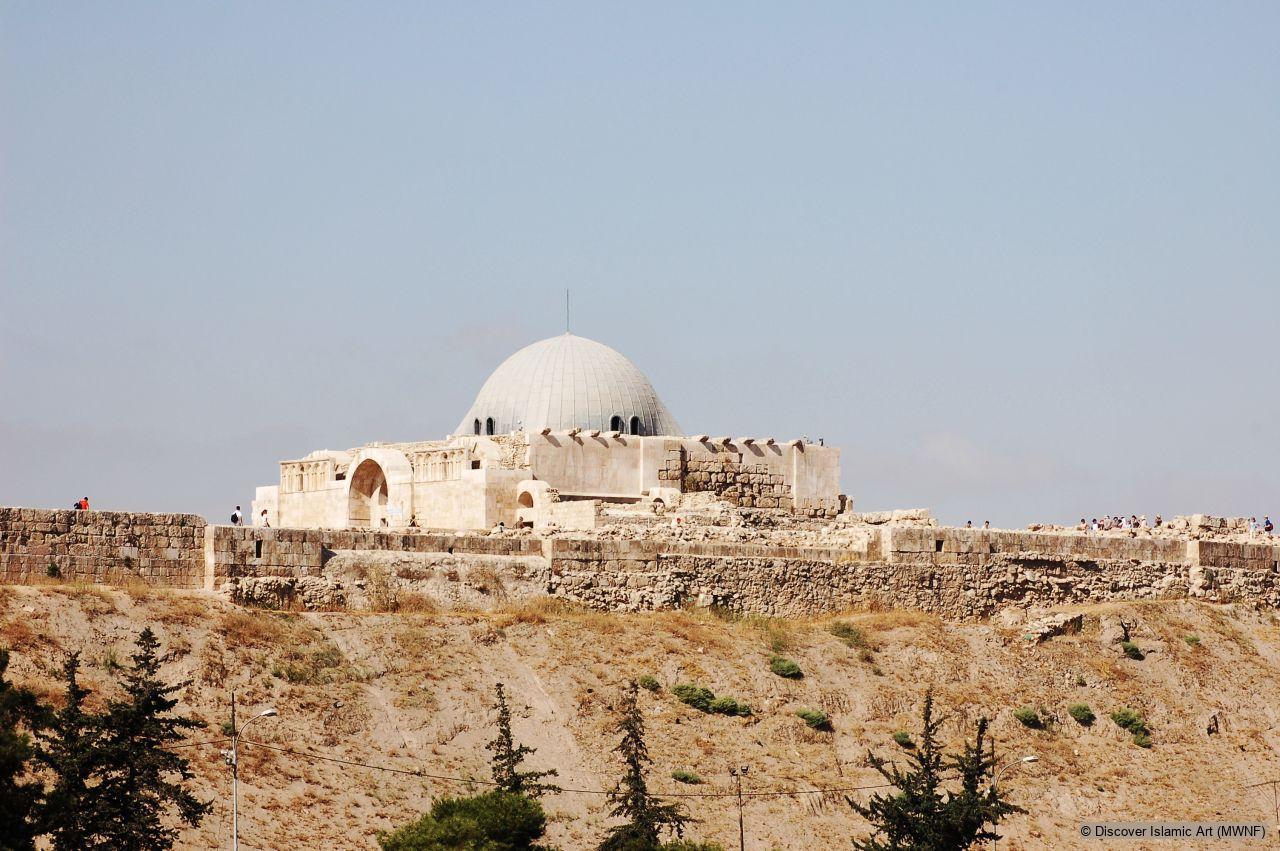




Name of Monument:
Citadel of Amman (Audience Hall)
Location:
Amman, Jordan
Date of Monument:
Around hegira 110 / AD 728
Period / Dynasty:
Umayyad
Patron(s):
Hisham ibn 'Abd al-Malik (r. 105–25 / 724–43).
Description:
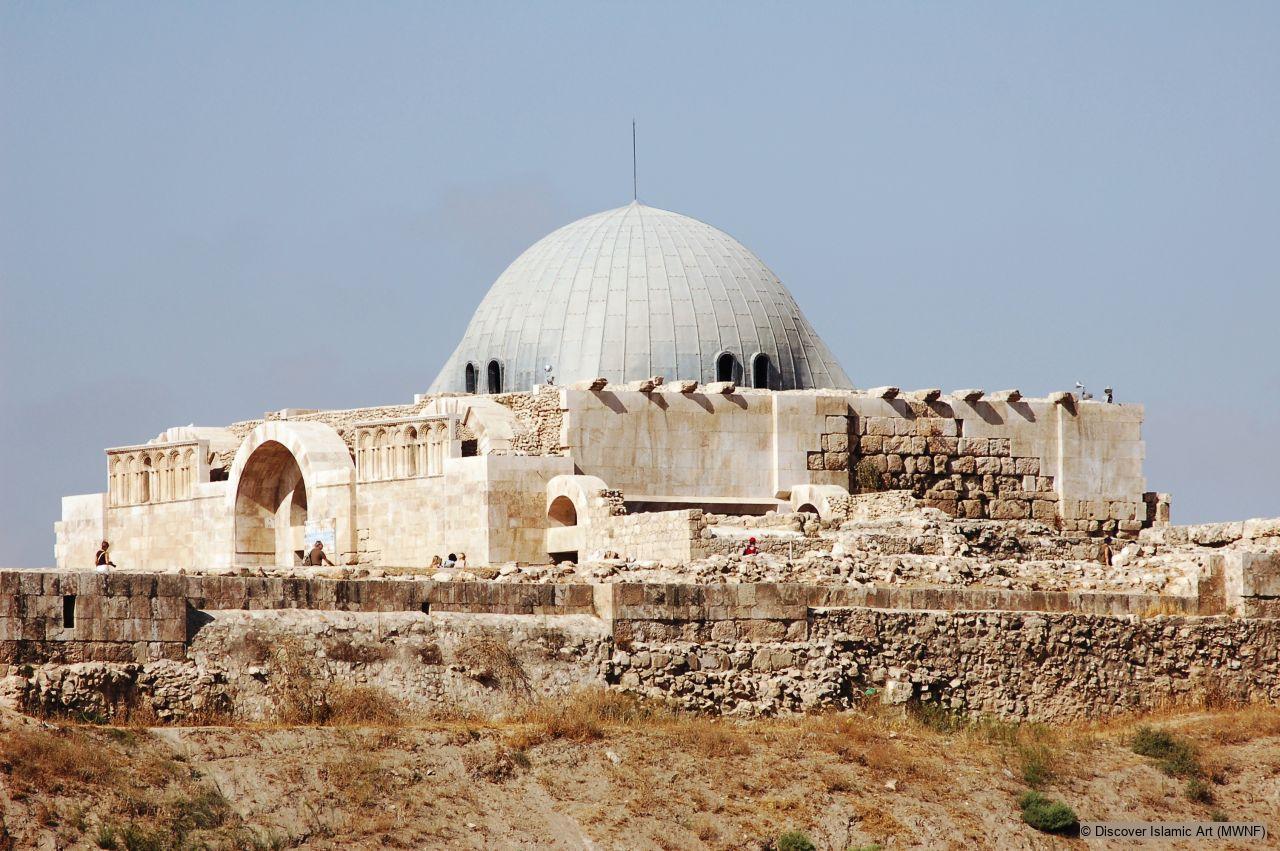
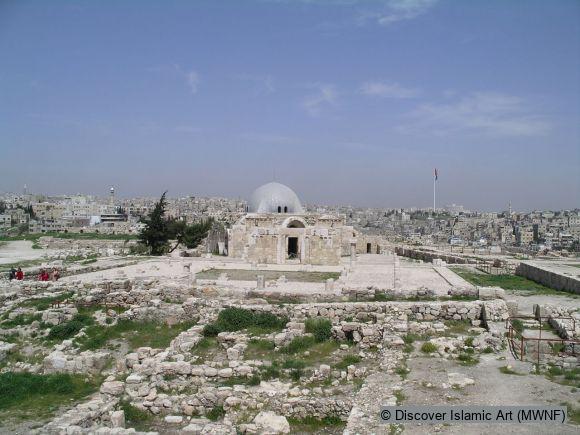
The north terrace of the Citadel of Amman is dominated by an Umayyad palatial complex that was built after AH 101 / AD 720. This complex comprises three distinctive architectural elements. From south to north they are: the Audience Hall which was at the same time a monumental gateway, the central plaza with a colonnaded street flanked by nine residential units (bayts), and the official reception hall of the amir flanked by bayts. The most prominent standing structure amongst these is the great vestibule, or the Audience Hall.
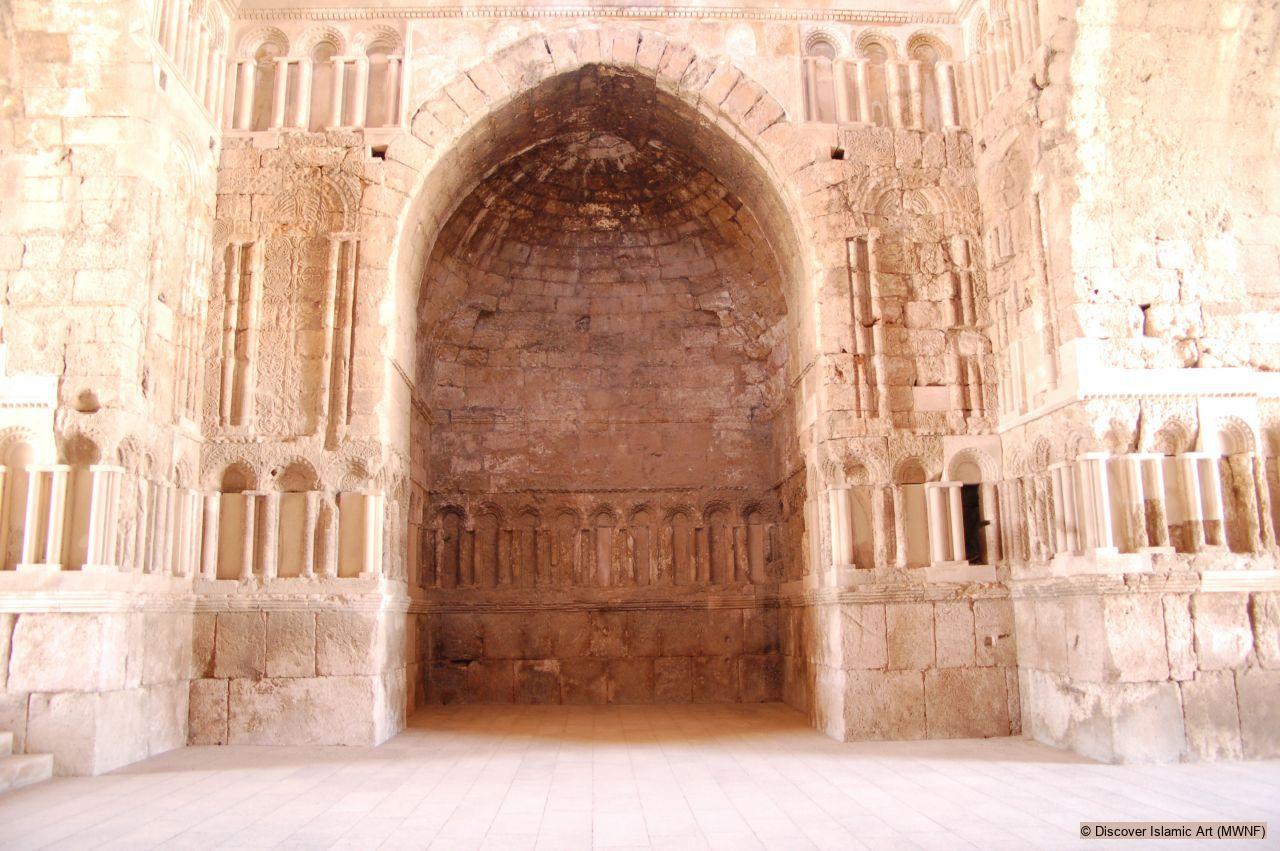
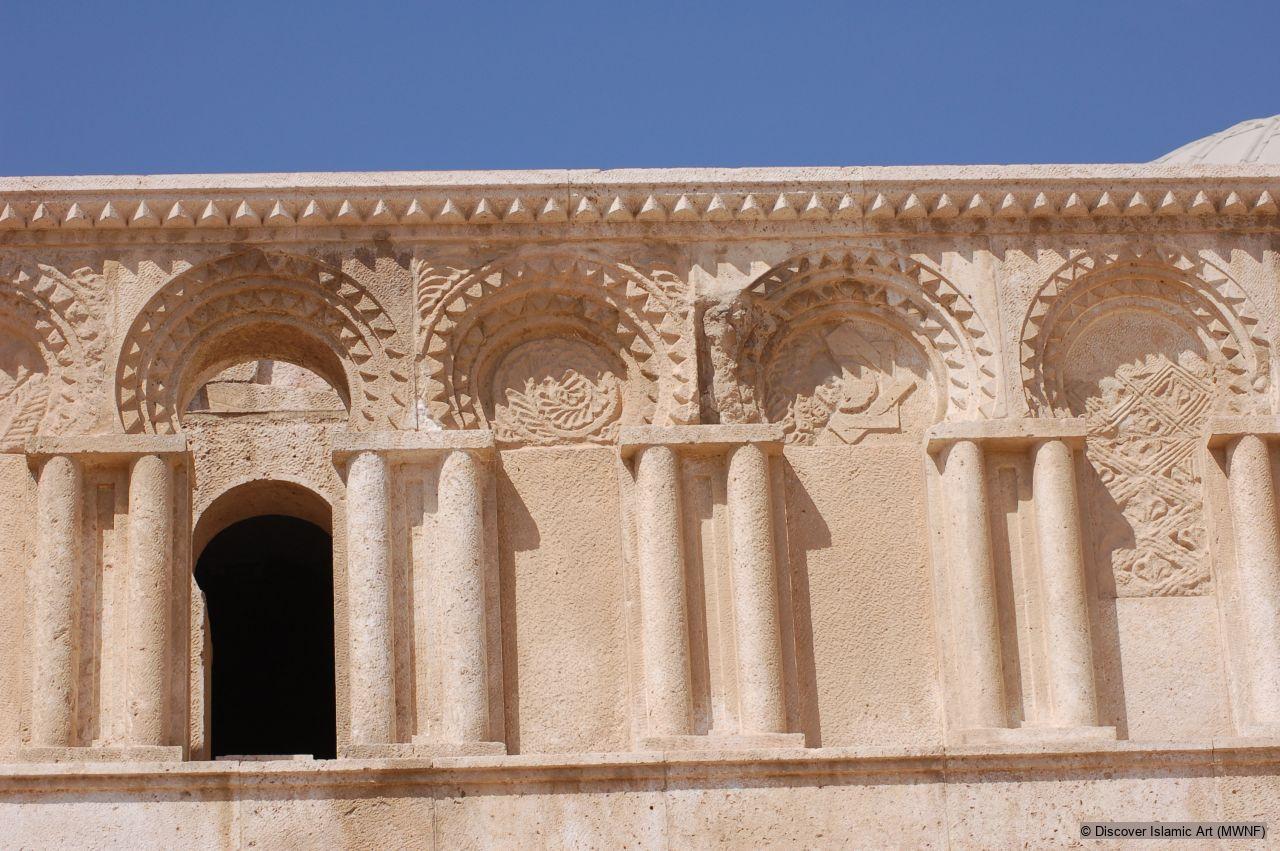
A structure almost square in shape (25 m x 26 m) in the form of a Greek cross, the Audience Hall has four niches in each arm of the cross, which are organised around a domed central space. The structure has two entrances one from the south and the other from the north. The ceiling of the north and south arms of the cross are covered with barrel vaults. Each of the east and the west chambers has a barrel vault in the front and a semi-dome, based on counterfeit squinches, in the back. A decorative band of horseshoe shaped blind niches supported by double half-columns run around the walls. The niches were painted and decorated with stone carving and stucco lines in the form of stylised floral motifs and geometric designs.
Four additional rooms are located at the corners of this structure: those on the south side were once accessed from inside the hall, whereas access to the north rooms was from the courtyard. This monument was built on the top of an earlier structure dated to the 5th century AD. The overall plan and decoration of the complex show strong Sassanid influences and demonstrate clearly how early Islamic art and architecture absorbed and incorporated foreign artistic traditions to create a new genre of Early Islamic art and architecture.
The Audience Hall is part of an Umayyad palatial complex built after AH 101 / AD 720 on the north terrace of the Citadel of Amman. Constructed on top of an earlier AD 5th-century structure, the monument is in the form of a Greek cross with four niches in each arm, organised around a domed central space. A decorative band of horseshoe-shaped blind niches supported by double half-columns run around the walls. The plan and decoration show strong Sassanid influences and demonstrate how early Islamic art and architecture incorporated foreign artistic traditions to create a new genre of art.
How Monument was dated:
The monument was dated to the second quarter of the 2nd / 8th century on the basis of archaeological excavations and stylistic analysis of, for instance, the red-painted ceramics that were found under the layer representing the destruction caused by the 749 earthquake, and of the broad, slightly pointed barrel-vaults and horse-shoe shaped blind niches that were found. Historical sources such as 'al-Tabari' were used, which suggested that there was a prison and treasury at the Citadel before 125/743 and Sulayman ibn Hisham (r. 105–25 / 724–43) was imprisoned at the Citadel during the reign of al-Walid II (r. 125–6 / 743–4).
Selected bibliography:
Almagro, A., “El Palacio Omeya de Amman”, in La Arquitectura, Madrid, 1983.
Creswell, K. A. C., and Allan, J. W., A Short Account of Early Muslim Architecture, Cairo, 1989, pp.169–73.
Khouri, R. G., Amman: A Brief Guide to the Antiquities, Amman, 1988, pp.16–18.
Koutsoukou, A., et al, The Great Temple of Amman: The Excavations, Amman, 1997, pp.16–18.
Northedge, A. E., Studies on Roman and Islamic Amman, Vol. I., Oxford, 1992, pp.75–82.
Citation of this web page:
Mohammad Najjar "Citadel of Amman (Audience Hall)" in Discover Islamic Art, Museum With No Frontiers, 2026. 2026.
https://islamicart.museumwnf.org/database_item.php?id=monument;ISL;jo;Mon01;33;en
Prepared by: Mohammad NajjarMohammad Najjar
Mohammad Najjar is an archaeologist and has been Director of Excavations and Surveys at the Department of Antiquities of Jordan since 1988. He studied archaeology at the Institute of Archaeology in Moscow from where he holds his Ph.D. He was affiliated to the Department of Antiquities of Jordan in 1982 as Curator of Jordan Archaeological Museum. He was the Technical Director of Cultural Resources Management (sites development) at the Ministry of Tourism and Antiquities between 1994 and 1997. He is the author of numerous publications on the archaeology of Jordan.
Copyedited by: Mandi GomezMandi Gomez
Amanda Gomez is a freelance copy-editor and proofreader working in London. She studied Art History and Literature at Essex University (1986–89) and received her MA (Area Studies Africa: Art, Literature, African Thought) from SOAS in 1990. She worked as an editorial assistant for the independent publisher Bellew Publishing (1991–94) and studied at Bookhouse and the London College of Printing on day release. She was publications officer at the Museum of London until 2000 and then took a role at Art Books International, where she worked on projects for independent publishers and arts institutions that included MWNF’s English-language editions of the books series Islamic Art in the Mediterranean. She was part of the editorial team for further MWNF iterations: Discover Islamic Art in the Mediterranean Virtual Museum and the illustrated volume Discover Islamic Art in the Mediterranean.
True to its ethos of connecting people through the arts, MWNF has provided Amanda with valuable opportunities for discovery and learning, increased her editorial experience, and connected her with publishers and institutions all over the world. More recently, the projects she has worked on include MWNF’s Sharing History Virtual Museum and Exhibition series, Vitra Design Museum’s Victor Papanek and Objects of Desire, and Haus der Kulturen der Welt’s online publication 2 or 3 Tigers and its volume Race, Nation, Class.
MWNF Working Number: JO 33
RELATED CONTENT
Related objects



Related monuments



Islamic Dynasties / Period
Download
As PDF (including images) As Word (text only)