

 Back
Back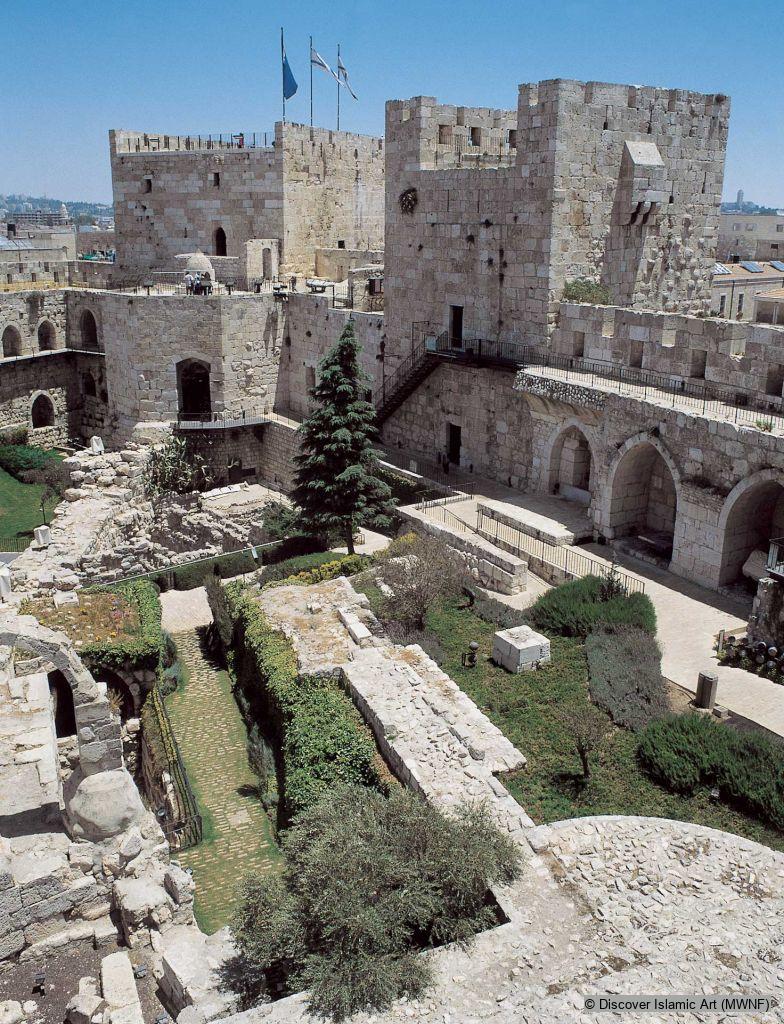
Name of Monument:
Citadel of Jerusalem
Location:
The citadel is located at the centre of the West Wall of Jerusalem to the south of Bab al-Khalil (Jaffa Gate) one of the gates into the city, the wall takes the form of a fortress (citadel), Jerusalem
Date of Monument:
The citadel dates to hegira the 8th / AD 14th century and to the AH 10th / AD 16th century. In the citadel there are remains from the 1st century BC to the AH 6th / AD 12th century
Architect(s) / master-builder(s):
A document in the Registry of the Shari’a Court in Jerusalem (No. 6: 2) dated AH 12 Rabi’a II, 938 (AD 23rd November 1531), mentions three architects who participated in the restoration of the citadel wall during the reign of Sultan Sulayman the Magnificent: al-Mu’allim Muhammad Ibn al-Hamwi, al-Mu’allim Muhammad Ibn Mansur al-Hamwi and al-Mu’allim Husayn Ibn Nimr al-Maqdisi.
Period / Dynasty:
The citadel dates to the Mamluk and Ottoman periods, and contains Roman and Crusader ruins
Patron(s):
Herod (r. 37–4 BC); Mamluk sultan, al-Nasir Muhammad Ibn Qalawun (who ruled three times: AH 693–4, 698–708 and 709–41 / AD 1294–5, 1299–1309 and 1309–40) and Sultan Sulayman the Magnificent (r. AH 926–74 / AD 1520–66).
Description:
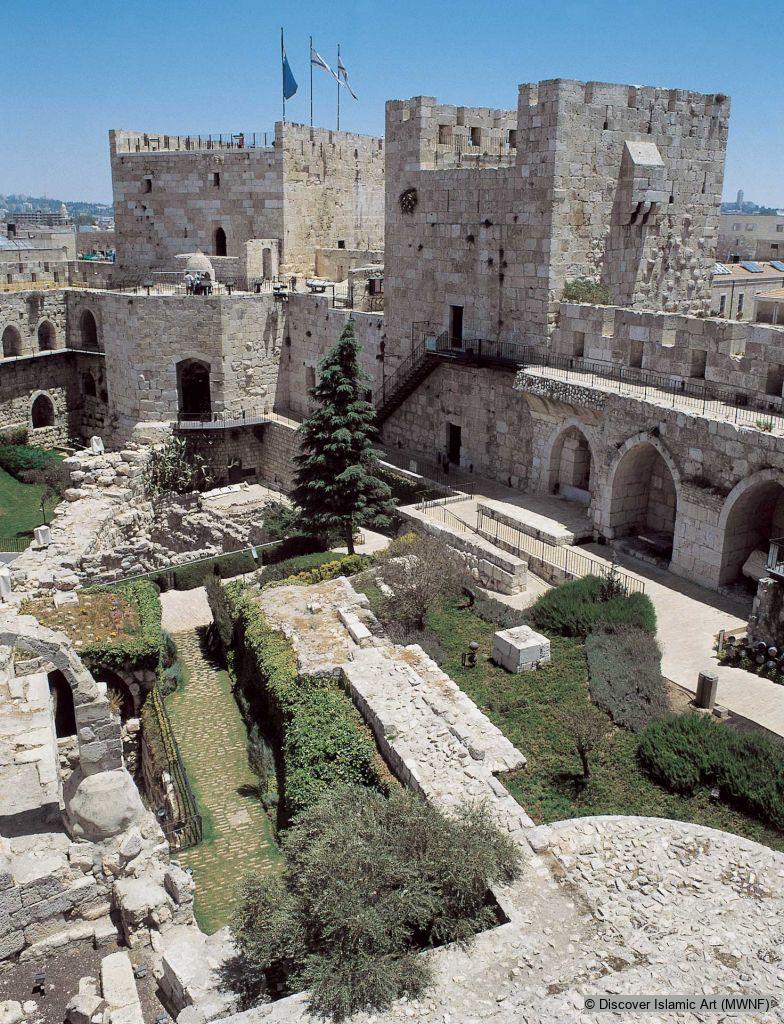
The Citadel of Jerusalem contains a great outer wall, a moat, five towers, a principle eastern portal, several open courtyards, two mosques and a minaret. It assumed its present form during the Ottoman era, although this was the result of an architectural development that began in the Greco-Roman period and which developed over time to its present state. The fortress or citadel, and the principle tower in it (known widely as the Tower of David) were destroyed in AH 637 / AD 1239 so that it would not fall into the hands of the Crusaders. Several attempts were made by Sultan Nasir Muhammad Ibn Qalawun in AH 710 / AD 1310 to rebuild it. This was followed by a comprehensive project to restore the fortress during the reign of Sultan Sulayman the Magnificent in AH 938 / AD 1531; this included enclosing the citadel with battlements.
The citadel is considered to be one of the major landmarks of Jerusalem, for it links the walls of the old city and encompasses the city's most important buildings, such as the Aqsa Mosque, the Dome of the Rock, the Church of the Holy Sepulchre and the Wall of al-Buraq. The great traveller, Awliya' Chalabi (Evliya Çelebi in Turkish) described the citadel when he visited Jerusalem in AH 1059 / AD 1649 extolling both its strategic and administrative importance during the Ottoman period. Besides being the first comprehensive restoration programme to be undertaken by the Ottoman Sultanate in Jerusalem, the citadel was also where the Janissary army resided.
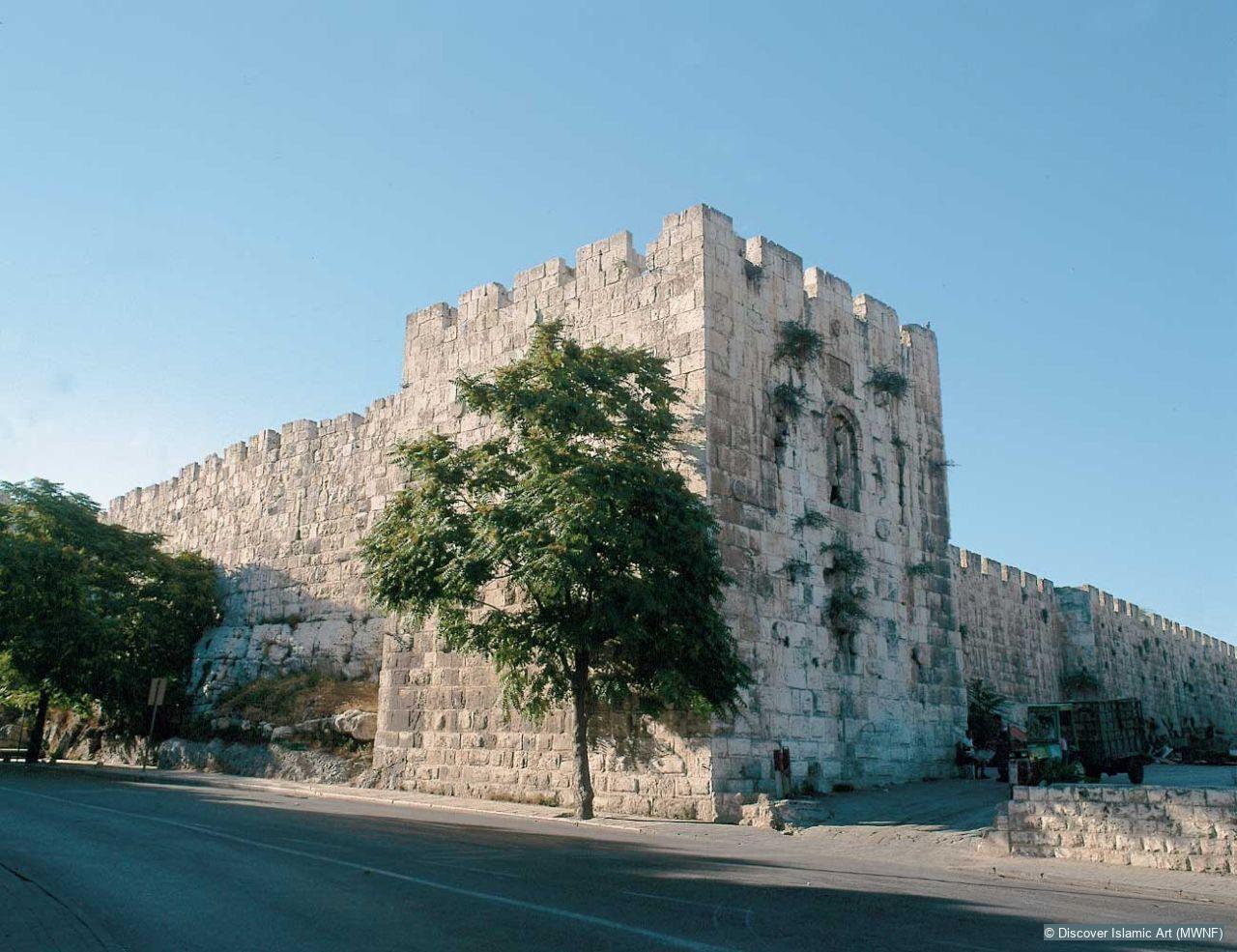
The plan of the citadel is an irregular rectangle: three sides of it are almost straight while the fourth, south wall zigzags following the old line of the original fortification, which was itself dictated by the south-sloping topography of the site. The citadel is encompassed within an outer curtain wall that was built with huge stone blocks, seen especially in the foundations and the lower courses.
The citadel is defended by five large towers, four of which are set at the corners of the citadel, while the fifth is at the centre of the eastern wall in the middle of an open courtyard. The citadel is surrounded by a moat that is clearly visible from inside the city on the north and east sides.
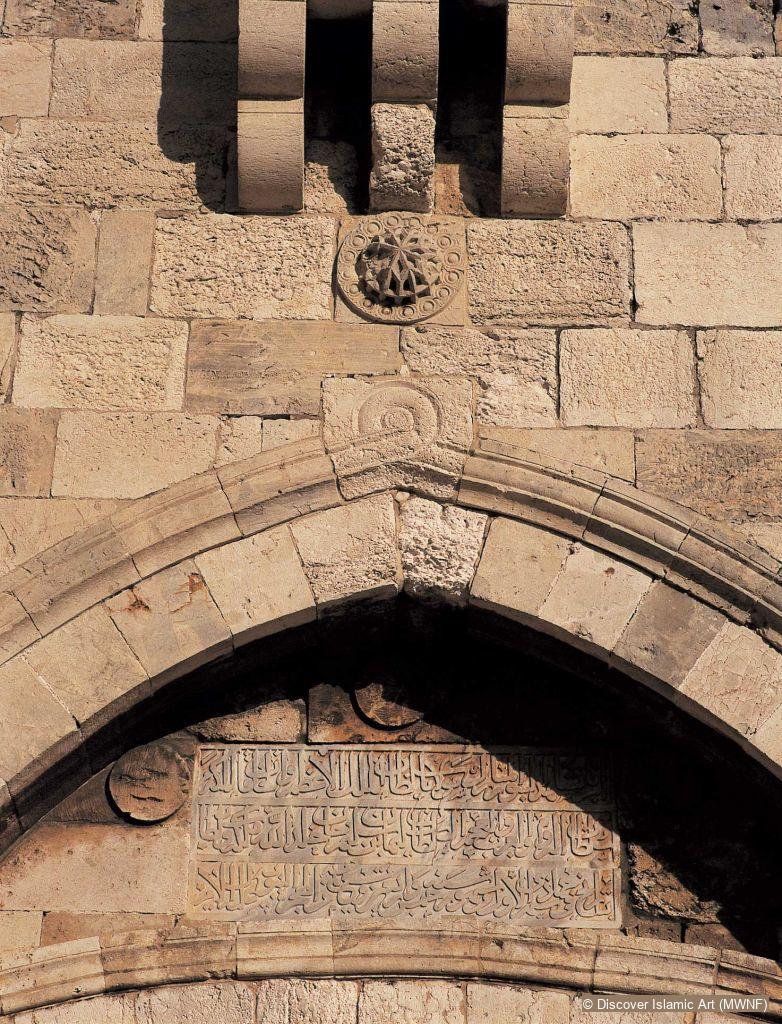
The interior of the citadel is accessed by means of the principle, eastern portal which is composed of two sections or gates. The first, outer gate has a double staircase, the landing of which can be reached from both the north and the south. The second interior gate is placed within a receding niche crowned by a pointed arch. On the outside of the arch there is an inscription which states that the renovation of the citadel took place in AH 938 / AD 1531–2 by order of Sultan Sulayman. The outer entrance is separated from the inner portal by a fixed wooden bridge. To the left (south) of the bridge there is an open-air mosque for use in the summer months. Worked into the front fortifications is the tughra of Sultan Sulayman.
The solitary Citadel of Jerusalem is located at the centre of the Western Wall of the city. It is a large complex which contains a variety of defensive features: a large outer wall, a trench, a drawbridge, five towers, an eastern principle entrance, a number of open plazas, two mosques and a minaret. These buildings were a result of defensive works dating from the time of the Romans until the Ottoman period. In its present form its core dates to the Mamluk and Ottoman periods.
How Monument was dated:
The dating of the citadel and its various sections depended upon several Ayyubid, Mamluk and Ottoman inscriptions, some of which are still in situ. Ceramic fragments and architectural remains recovered in archaeological excavations have also helped to decide an accurate dating.
Selected bibliography:
Al-'Asli, K., Al-Quds fi Kutub al-Rahhala al-Muslimin [Jerusalem by Accounts of Muslim Travellers], Amman, 1992.
Berchem, M. van, Matériaux pour un Corpus Inscriptionum Arabicarum, Vol. II, Cairo, 1922.
Hawari, M., “The Citadel (Qal'a) in the Ottoman Period”, in R. Hillenbrand and S. Auld (eds), Ottoman Jerusalem: The Living City 1517–1917 (Part I), London, 2000.
Johns, C. N., “The Citadel, Jerusalem: A Summary of Work Since 1934”, Quarterly of the Department of Antiquities in Palestine, No. 14, 1950, pp.121–90.
Citation of this web page:
Yusuf al-Natsheh "Citadel of Jerusalem" in Discover Islamic Art, Museum With No Frontiers, 2026. 2026.
https://islamicart.museumwnf.org/database_item.php?id=monument;ISL;pa;Mon01;29;en
Prepared by: Yusuf Al-NatshehYusuf al-Natsheh
Yusuf Said Natsheh is a Palestinian and since 1997 he has been Director of the Department of Islamic Archaeology in al-Haram al-Sharif in Jerusalem. He is a lecturer at al-Quds University. He was educated in Jerusalem and Cairo and in 1997 obtained his Ph.D. from the School of Oriental and African Studies, University of London. Dr Natsheh is a council member of many Palestinian societies for architectural heritage and a consultant for various projects on Jerusalem. He has written books and more than 40 articles about Jerusalem's architectural heritage including the architectural survey of Ottoman architecture in R. Hillenbrand and S. Auld (eds) Ottoman Jerusalem: The Living City 1517–1917 (London: Altajir World of Islam Trust, 2000). He has contributed to many international and national conferences. He supervised the restoration project, sponsored by the Arab League, on Mamluk monuments in and around al-Haram al-Sharif, and was Palestinian expert for the UNESCO mission to Jerusalem in 2004.
Copyedited by: Majd Musa
Translation by: Amal Sachedina (from the Arabic).
Translation copyedited by: Mandi GomezMandi Gomez
Amanda Gomez is a freelance copy-editor and proofreader working in London. She studied Art History and Literature at Essex University (1986–89) and received her MA (Area Studies Africa: Art, Literature, African Thought) from SOAS in 1990. She worked as an editorial assistant for the independent publisher Bellew Publishing (1991–94) and studied at Bookhouse and the London College of Printing on day release. She was publications officer at the Museum of London until 2000 and then took a role at Art Books International, where she worked on projects for independent publishers and arts institutions that included MWNF’s English-language editions of the books series Islamic Art in the Mediterranean. She was part of the editorial team for further MWNF iterations: Discover Islamic Art in the Mediterranean Virtual Museum and the illustrated volume Discover Islamic Art in the Mediterranean.
True to its ethos of connecting people through the arts, MWNF has provided Amanda with valuable opportunities for discovery and learning, increased her editorial experience, and connected her with publishers and institutions all over the world. More recently, the projects she has worked on include MWNF’s Sharing History Virtual Museum and Exhibition series, Vitra Design Museum’s Victor Papanek and Objects of Desire, and Haus der Kulturen der Welt’s online publication 2 or 3 Tigers and its volume Race, Nation, Class.
MWNF Working Number: PA 29
RELATED CONTENT
Related objects

Related monuments


See also
Virtual Visit Exhibition Trail
Pilgrimage, Sciences and Sufism. Islamic Art in the West Bank and Gaza
Download
As PDF (including images) As Word (text only)