

 Back
Back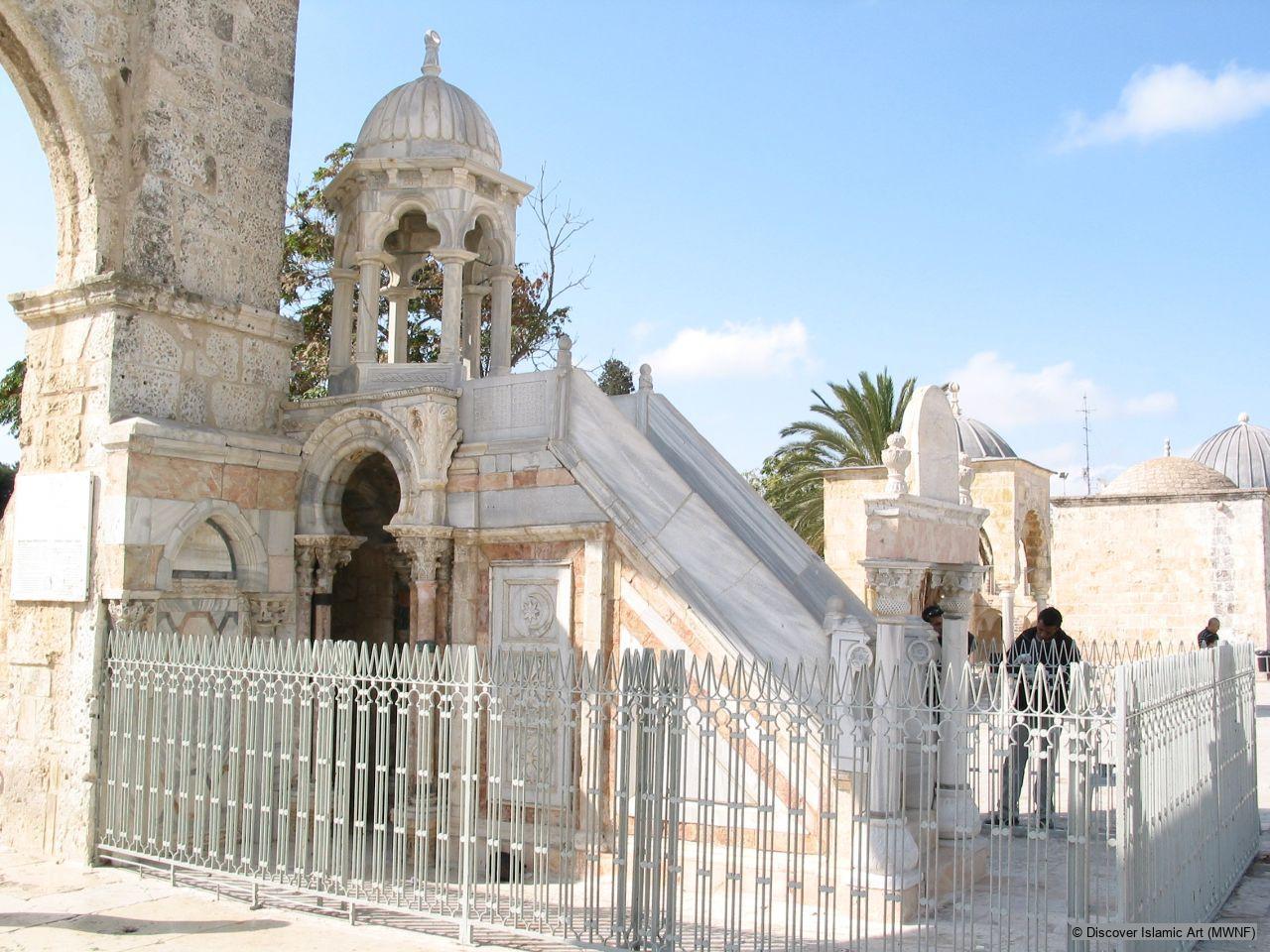
Name of Monument:
Minbar of Burhan al-Din
Also known as:
Minbar al-Sayf (The Summer Pulpit)
Location:
The minbar is located in the Haram al-Sharif on the platform of the Dome of the Rock, parallel to the southern arcade, Jerusalem
Date of Monument:
It is not known when the minbar was constructed but it was restored in the AH mid-8th / AD 14th century, and again in AH 1259 / AD 1843
Period / Dynasty:
Restored in the Mamluk period and again in the Ottoman period during the rule of Sultan ‘Abd al-Majid (Abdülmecid, r. 1255–77 / AD 1839–61)
Patron(s):
It is not known who sponsored the minbar but Qadi Burhan al-Din Ibn Jama’a (AH 725–90 / AD 1325–88) supervised the initial restoration.
Description:
The minbar occupies an elevated position in Islamic Art. The minbar is an essential piece of furniture within the mosque for it is where the preacher stands to deliver his khutba specifically on religious occasions; for the Friday khutba it is not permissible to conduct prayers without the minbar. Thus the minbar is an important object linked closely with prayer one of the five pillars of Islam, and one of the most important Islamic rites after the Shahada. The minbar is found predominantly in congregational mosques, although it is found in some madrasas as in, for example, the Mamluk madrasas in Cairo, the madrasas in Jerusalem, do not have minbars.
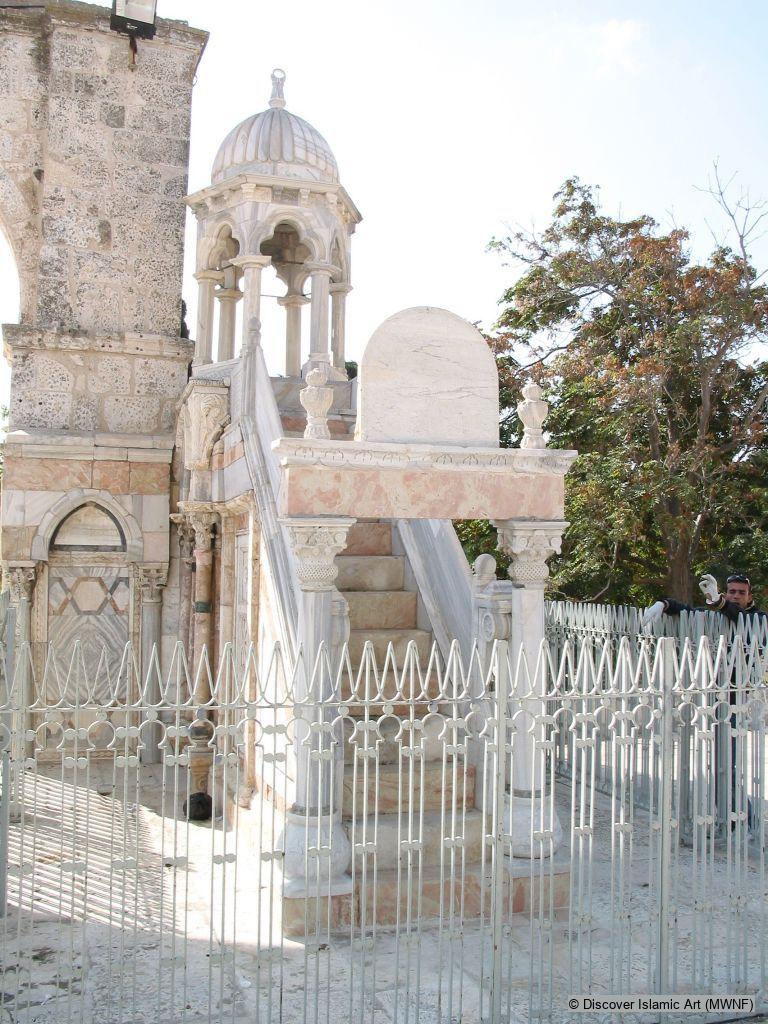
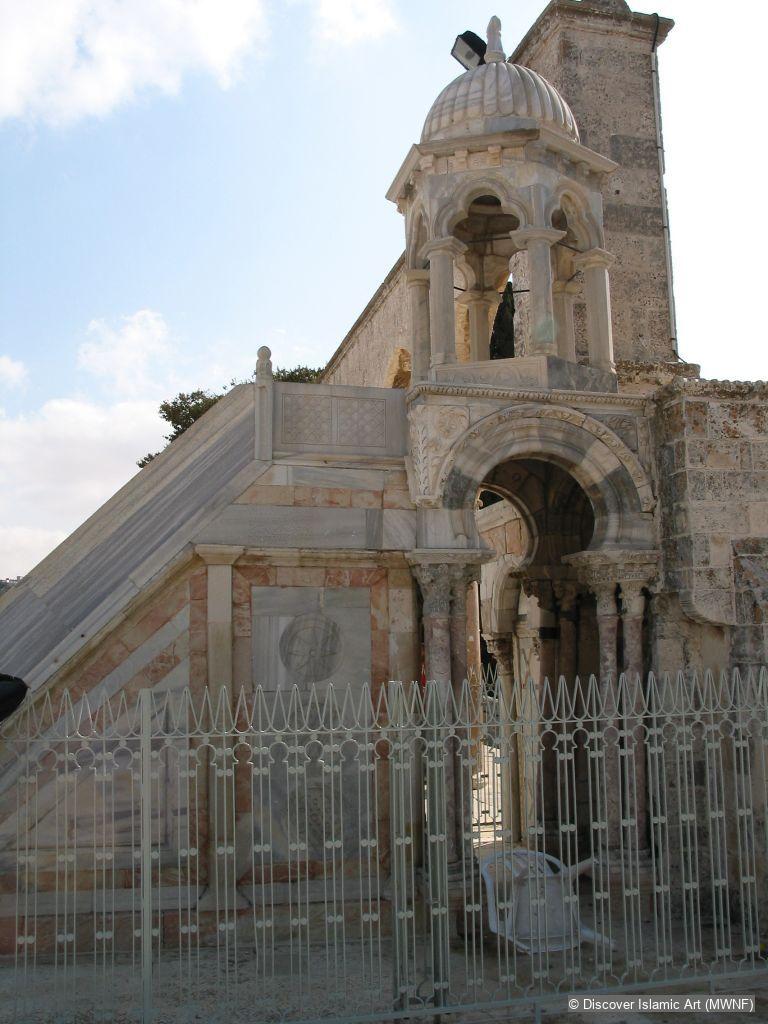
The Minbar of Burhan al-Din is a rarity for it is a purpose-built construction made specifically for open-air use and constructed out of stone and marble and not from wood as is more commonly seen. It seems that this minbar replaced the need fora wooden one, which normally would be towed on wheels as necessary.
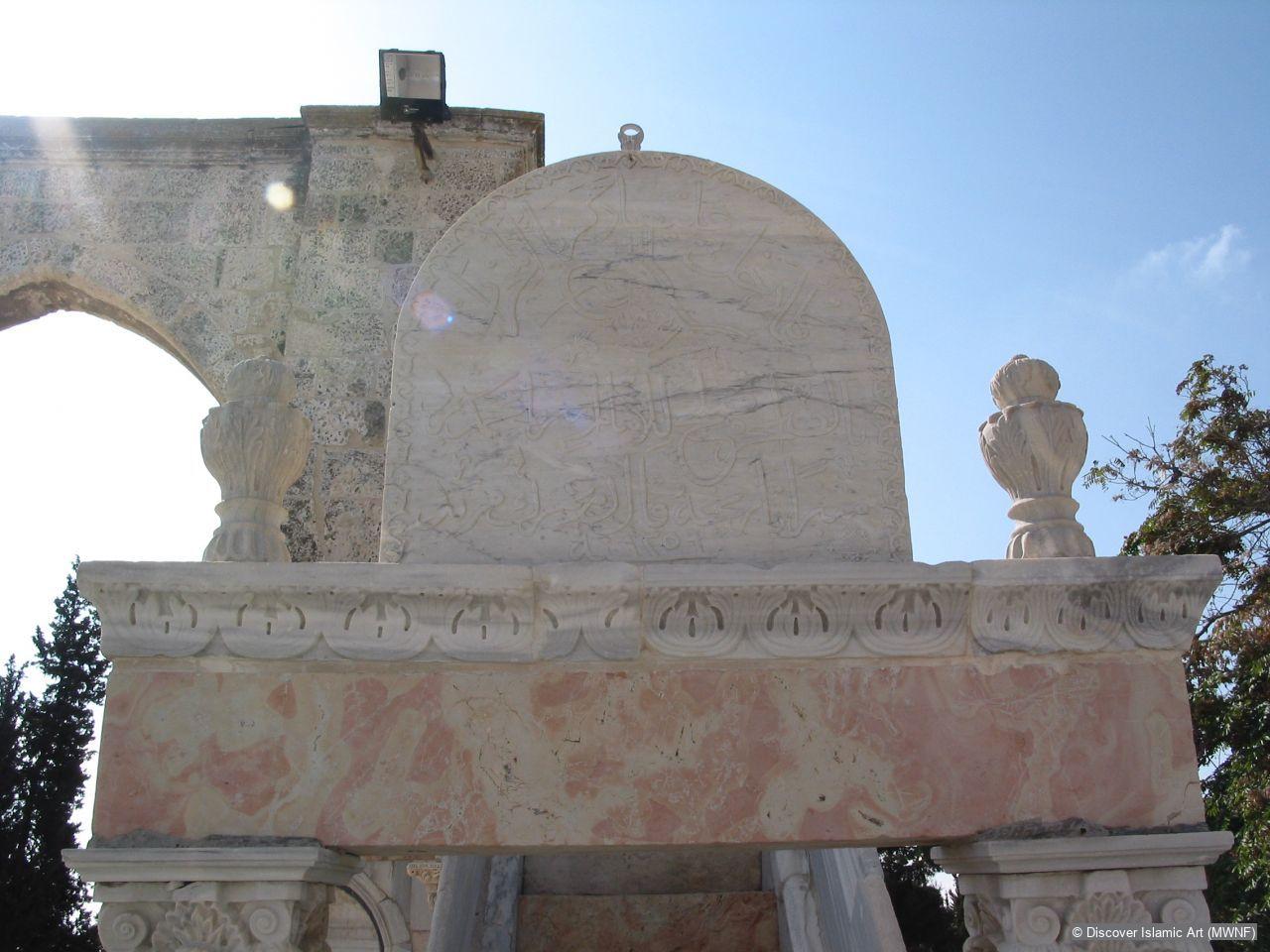
The present minbar contains a number of sections, the most prominent of which is the front panel, for this is the principle façade. The front of the minbar is composed of a rectangular opening flanked between two marble columns. Each column has a cylindrical base and a capital. Both columns bear stone lintels directly above them, where there is a stone panel that ends in the form of an arch. The panel has a carved inscription in naskhi script which dates the restoration of the minbar to the Ottoman period in AH 1259 / AD 1843. A series of stone steps at the front of the minbar lead to the jawsaq where the orator stands. The jawsaq consists of a small square platform covered by a segmented dome (known as the Qubbat al-Maizan), which is erected on top of a hexagonal drum. The drum is supported by six small tri-lobed arches, held up by marble pillars. The architectural elements of the minbar were not made specifically for it but were taken from sites and buildings dating to the Crusader period.
The minbar has two sides designated the risha of the minbar. Both sides are triangular with corners that are characterised by marble side-panels. In the east corner of the minbar, on the supporting arches of the dome, a surface-mihrab has been erected which terminates in a tapered arch consisting of seven voussoirs. The mihrab is decorated with simple geometric forms on the upper and lower sections, and with natural vegetal forms in the central section.
This minbar was used to preach to the masses in al-Aqsa Mosque on occasions which necessitated guidance, the strengthening of resolution and the calling for patience, especially in the execution of prayers for rain. The minbar was used particularly in the summer months to present religious lessons.
This minbar (pulpit) is built from marble and stone and is located in the open plaza of the Dome of the Rock. It is the only minbar in Jerusalem which is located in an open area and was most probably used to deliver the khutba (Friday sermon) and lessons on summer days and on important occasions. It is therefore also known as the ‘summer minbar’. The minbar is an artistic piece characterised by vegetal and geometric decoration, columns and capitals and inscription panels. All of this has been implemented in the Mamluk style.
How Monument was dated:
The minbar was dated by historical information from several sources; for example in the work of the historian Mujir al Din Hanbali (d. 928 / 1521) and in the writing of Ibn Fadl Allah al-'Umari (d. 749 / 1348), which dates to around 745 / 1345.
Selected bibliography:
Berchem, M. van, Matériaux pour un Corpus Inscriptionum Arabicarum, Vol. II, Cairo, 1922.
Burgoyne, M., Mamluk Jerusalem: An Architectural Study, London, 1987.
Al-Hanbali, Mujir al-Din, Al-Uns al-Jalil bi Tarikh al-Quds wa al-Khalil [The Magnificent Ambiance in the History of Jerusalem and Hebron], Amman, 1973.
Citation of this web page:
Yusuf al-Natsheh "Minbar of Burhan al-Din" in Discover Islamic Art, Museum With No Frontiers, 2026. 2026.
https://islamicart.museumwnf.org/database_item.php?id=monument;ISL;pa;Mon01;32;en
Prepared by: Yusuf Al-NatshehYusuf al-Natsheh
Yusuf Said Natsheh is a Palestinian and since 1997 he has been Director of the Department of Islamic Archaeology in al-Haram al-Sharif in Jerusalem. He is a lecturer at al-Quds University. He was educated in Jerusalem and Cairo and in 1997 obtained his Ph.D. from the School of Oriental and African Studies, University of London. Dr Natsheh is a council member of many Palestinian societies for architectural heritage and a consultant for various projects on Jerusalem. He has written books and more than 40 articles about Jerusalem's architectural heritage including the architectural survey of Ottoman architecture in R. Hillenbrand and S. Auld (eds) Ottoman Jerusalem: The Living City 1517–1917 (London: Altajir World of Islam Trust, 2000). He has contributed to many international and national conferences. He supervised the restoration project, sponsored by the Arab League, on Mamluk monuments in and around al-Haram al-Sharif, and was Palestinian expert for the UNESCO mission to Jerusalem in 2004.
Copyedited by: Majd Musa
Translation by: Amal Sachedina (from the Arabic).
Translation copyedited by: Mandi GomezMandi Gomez
Amanda Gomez is a freelance copy-editor and proofreader working in London. She studied Art History and Literature at Essex University (1986–89) and received her MA (Area Studies Africa: Art, Literature, African Thought) from SOAS in 1990. She worked as an editorial assistant for the independent publisher Bellew Publishing (1991–94) and studied at Bookhouse and the London College of Printing on day release. She was publications officer at the Museum of London until 2000 and then took a role at Art Books International, where she worked on projects for independent publishers and arts institutions that included MWNF’s English-language editions of the books series Islamic Art in the Mediterranean. She was part of the editorial team for further MWNF iterations: Discover Islamic Art in the Mediterranean Virtual Museum and the illustrated volume Discover Islamic Art in the Mediterranean.
True to its ethos of connecting people through the arts, MWNF has provided Amanda with valuable opportunities for discovery and learning, increased her editorial experience, and connected her with publishers and institutions all over the world. More recently, the projects she has worked on include MWNF’s Sharing History Virtual Museum and Exhibition series, Vitra Design Museum’s Victor Papanek and Objects of Desire, and Haus der Kulturen der Welt’s online publication 2 or 3 Tigers and its volume Race, Nation, Class.
MWNF Working Number: PA 32
RELATED CONTENT
Related objects

Related monuments

Islamic Dynasties / Period
On display in
Exhibition(s)
See also
Virtual Visit Exhibition Trail
Pilgrimage, Sciences and Sufism. Islamic Art in the West Bank and Gaza
Download
As PDF (including images) As Word (text only)