

 Back
Back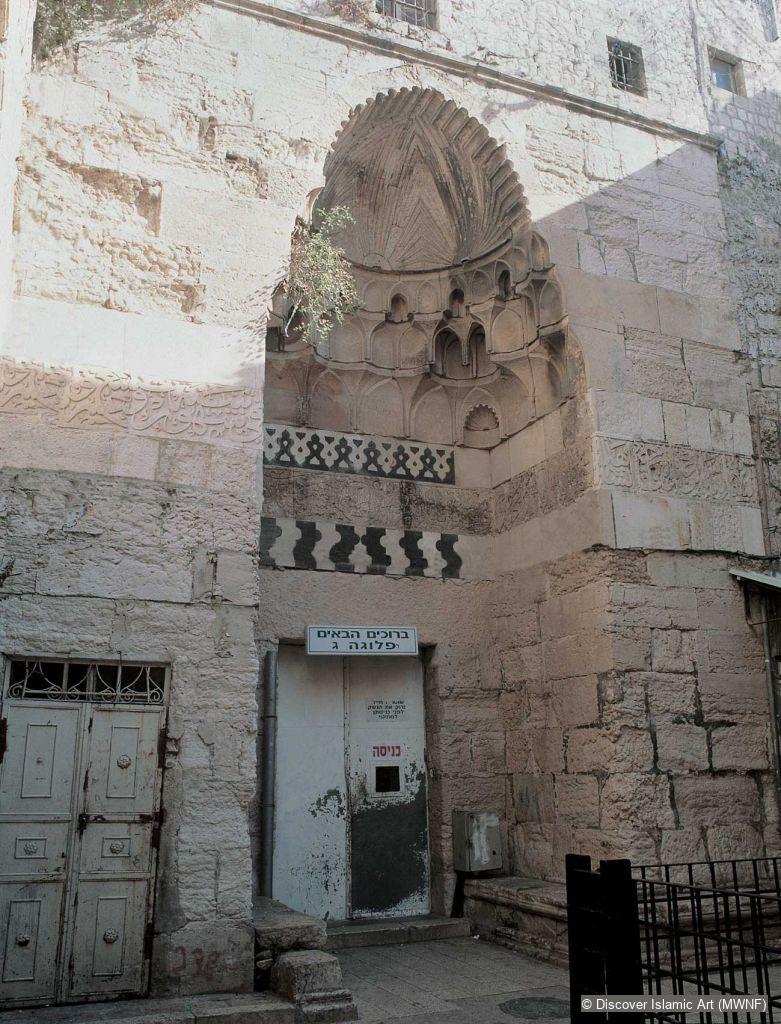
Name of Monument:
Madrasa Tankaziyya
Location:
The building is located on the east side of Bab al-Silsila Street (Gate of the Chain Street), parallel to the western border of the Haram al-Sharif, Jerusalem
Date of Monument:
Hegira 729 / AD 1328–9
Period / Dynasty:
Mamluk
Patron(s):
Amir Sayf al-Din Tankaz al-Nasiri (d. AH 741 / AD 1340). He was deputy to the sultanate in Bilad al-Sham (Greater Syria) during the period AH 712–40 / AD 1312–40, during the rule of Mamluk sultan al-Nasir Muhammad bin Qalawun (who ruled three times: AH 693–4, 698–708 and 709–41 / AD 1294–5, 1299–1309 and 1309–40).
Description:
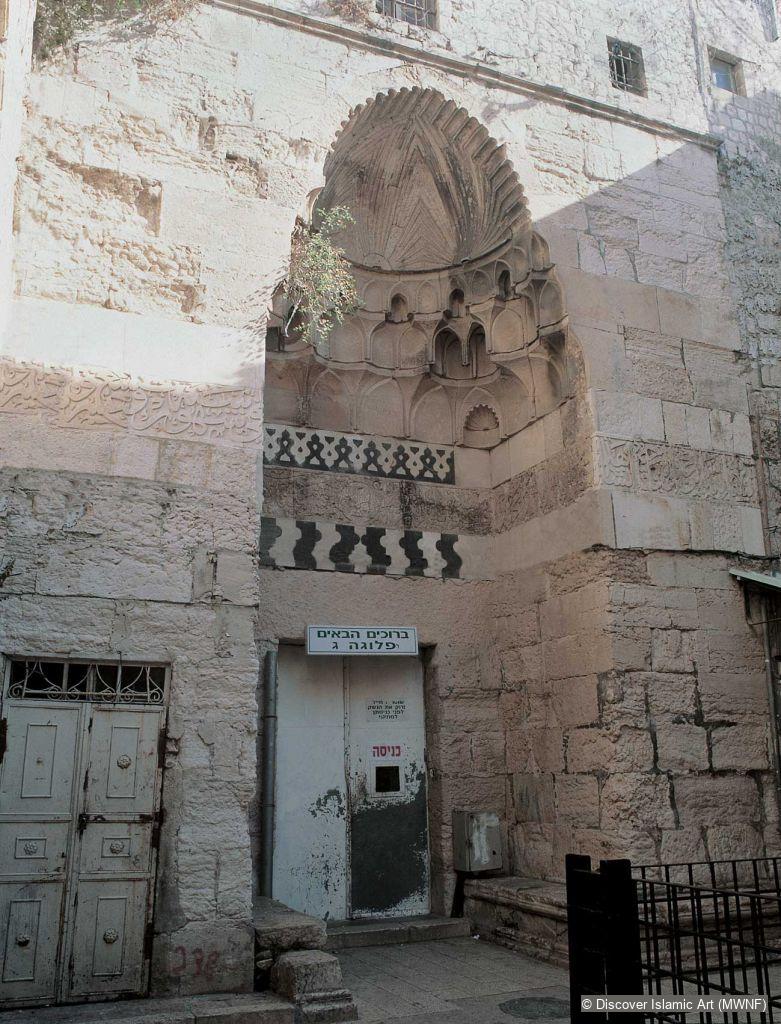
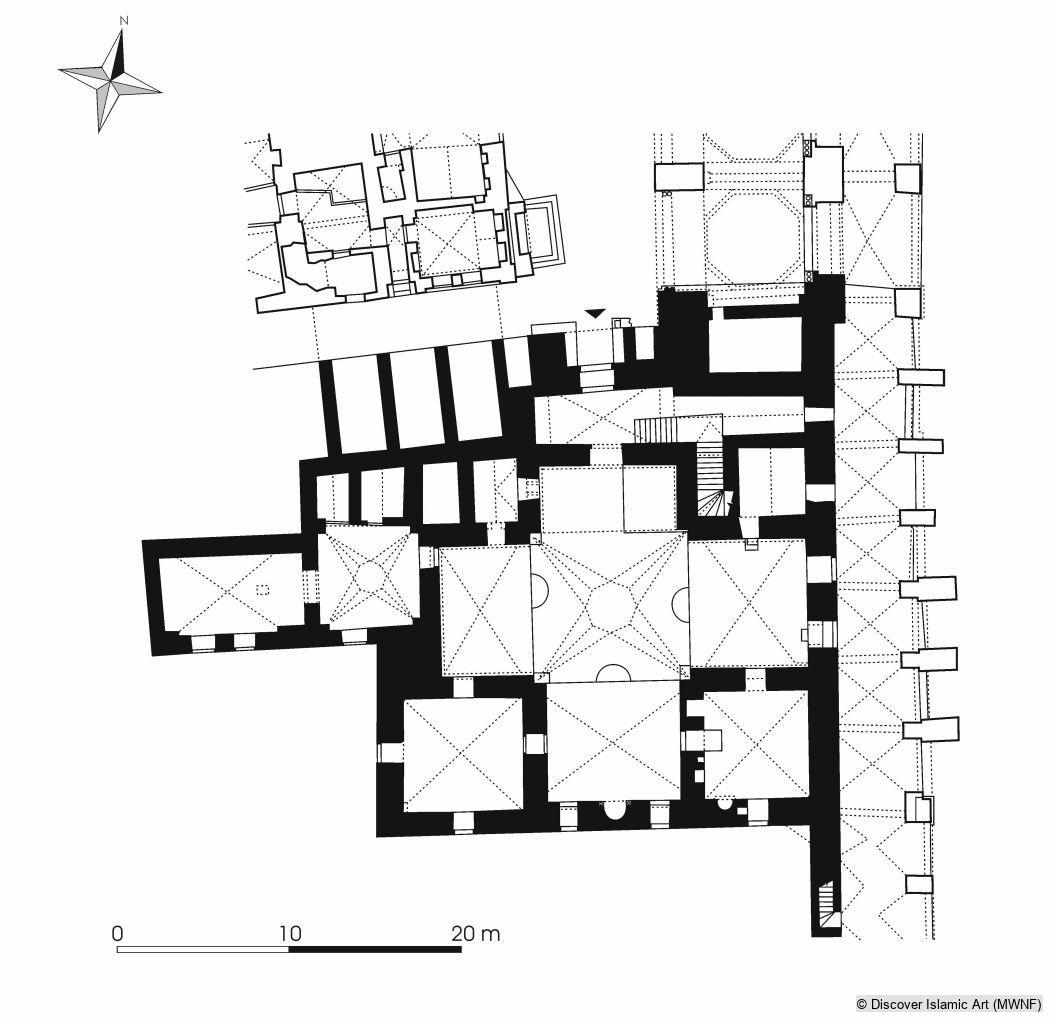
The Madrasa Tankaziyya is a large architectural complex that served a number of religious and educational functions. It is made up of three storeys: the ground floor, mezzanine floor and the upper storey. The northern façade of the Madrasa Tankaziyya overlooks Bab al-Silsila Street, and the eastern façade opens on to the plaza of the Haram al-Sharif.
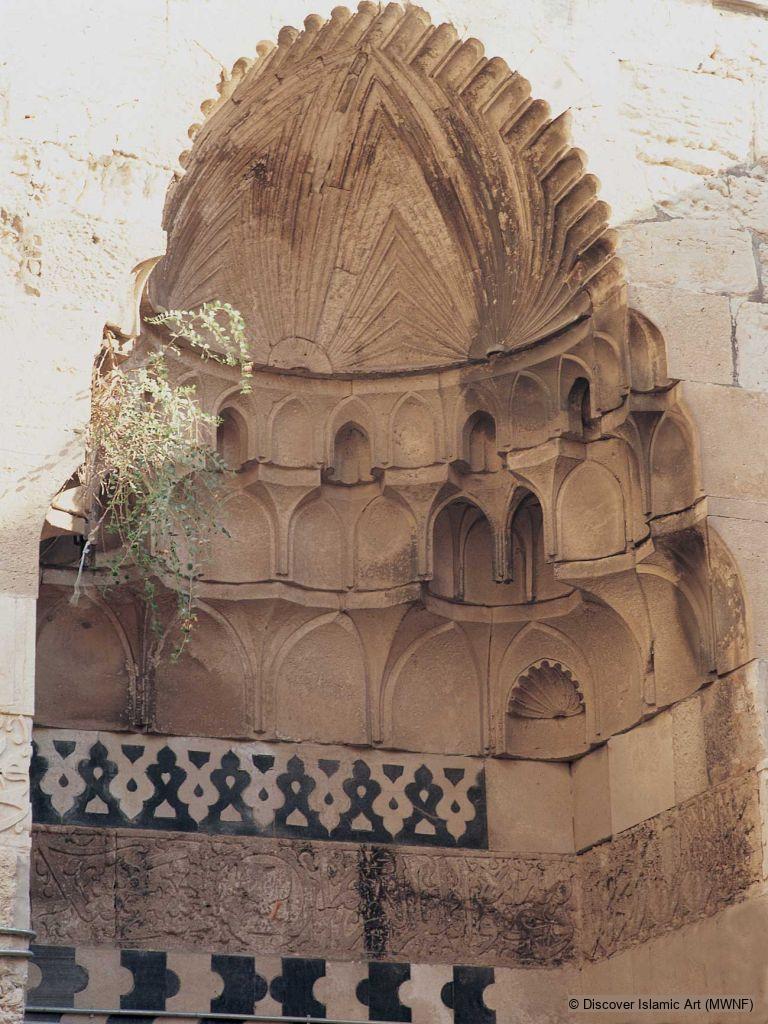
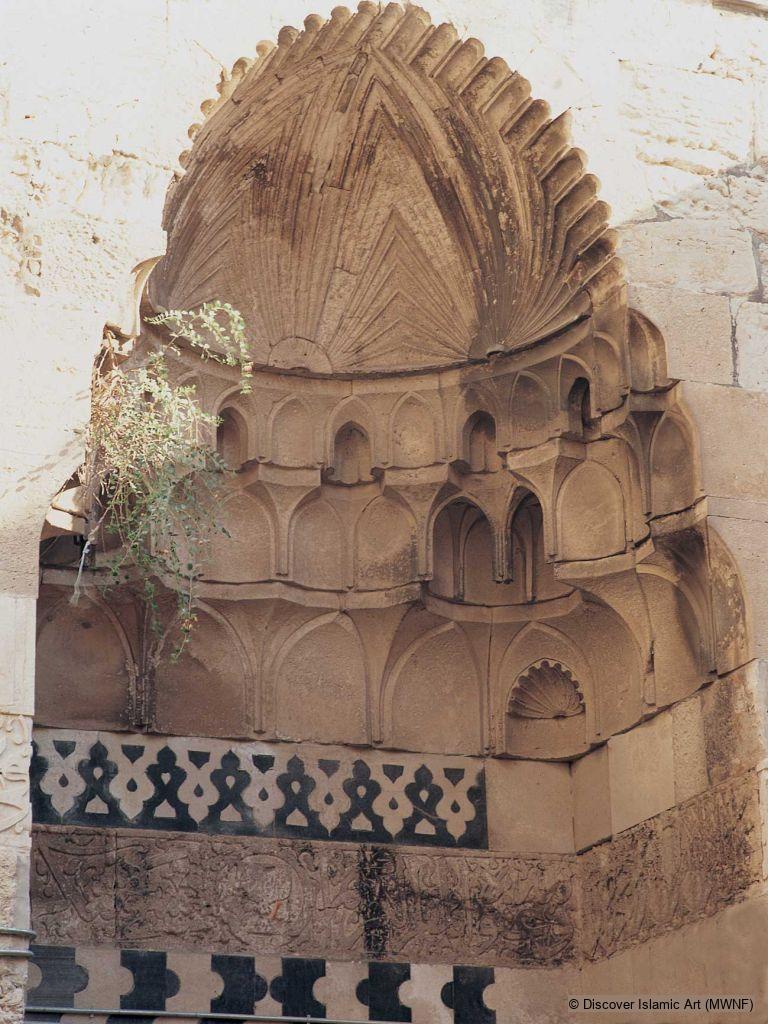
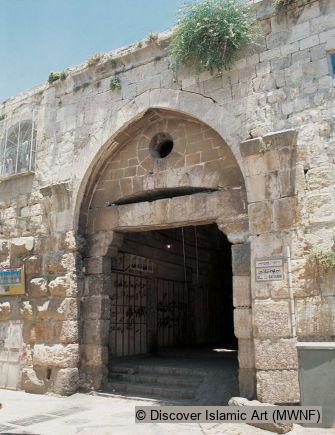
An imposing commemorative entrance portal in the north façade leads into the interior of the madrasa. This entrance is composed of a recess that withdraws into the portal, and which faces a pointed arch and a semi-domed ceiling. A decorative motif, consisting of a blazon of a horseman (a series of number “8s” are superimposed on it, one above the other) is carved on it, which radiates out from three centres. The semi-domed ceiling is supported by three tiers of muqarnas. The lower wall of the recess opens on to a rectangular entranceway above which is a massive lintel. Crowing this lintel is a band of interconnected voussoirs; above one of the voussoirs is a foundation plaque intersected by the emblem of Amir Tankaz, a large goblet drawn within a circle.
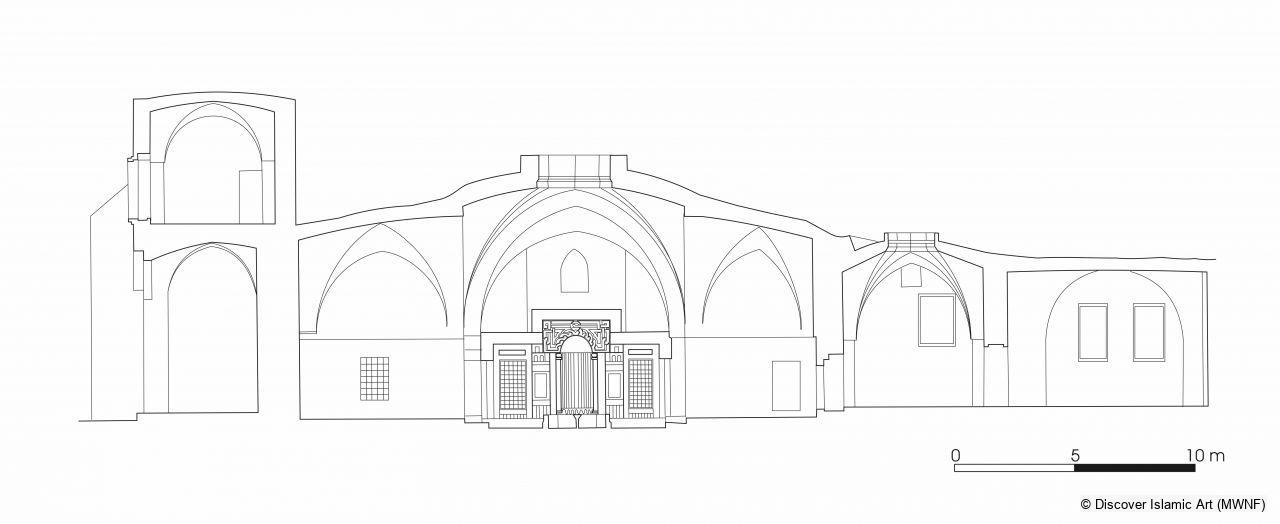
The entrance leads into a vestibule that in turn leads, initially, into a covered courtyard surrounded by four iwans. In the middle of the courtyard there is a beautiful marble fountain that is crowned by a fan-shaped vault, and in the middle of which is an octagonal skylight. On the wall of the qibla (southern wall) of the iwan, is a mihrab lined with marble-inlaid supports, and decorated with geometric and vegetal motifs. The entrance also leads to a corridor, whose southern wall has an opening on to the remaining parts of the madrasa. Comprising the accommodation iwans, this area is composed of rooms and halls that were used to house Sufis and students.
Madrasa al-Tankaziyya is rich in Mamluk architectural elements and decorative motifs, especially those which appear at the northern entrance to the madrasa, its marble floors, water fountain and some of the niches. The madrasa enjoyed an income from a number of awqaf (endowments), which were liberally distributed to its administrative and educational facilities.
This is a large complex which is located on the western wall of al-Haram al-Sharif. The façade of the building extends to the height of its two storeys. Its muqarnas, ablaq masonry, inscription bands and the blazon of the Amir Tankaz al-Nasiri are delineated clearly within it. The madrasa is composed of two storeys and a mezzanine. It is built around an open courtyard in the centre of which is a water fountain surrounded by four iwans in a cruciform pattern. There are many rooms within it. During the Mamluk period, a number of sultans and amirs stayed in the madrasa during their visits to Jerusalem.
How Monument was dated:
The building is dated by the foundation inscription which is located on the northern façade above the principal entrance, and this dating is supported by the waqf document that is specific to the madrasa.
Selected bibliography:
Berchem, M. van, Matériaux pour un Corpus Inscriptionum Arabicarum, Vol. II, Cairo, 1922.
Burgoyne. M., Mamluk Jerusalem: An Architectural Study, London, 1987.
Al-'Umari, Ibn Fadl Allah (d. AH 749 / AD 1348), Masalik al-Absar fi Mamalik al-Amsar [Major Roads to Different Lands] Vol. 1, Cairo, 1924.
Pilgrimage, Sciences and Sufism: Islamic Art in the West Bank and Gaza, pp.123–5.
Citation of this web page:
Yusuf al-Natsheh "Madrasa Tankaziyya" in Discover Islamic Art, Museum With No Frontiers, 2026. 2026.
https://islamicart.museumwnf.org/database_item.php?id=monument;ISL;pa;Mon01;7;en
Prepared by: Yusuf Al-NatshehYusuf al-Natsheh
Yusuf Said Natsheh is a Palestinian and since 1997 he has been Director of the Department of Islamic Archaeology in al-Haram al-Sharif in Jerusalem. He is a lecturer at al-Quds University. He was educated in Jerusalem and Cairo and in 1997 obtained his Ph.D. from the School of Oriental and African Studies, University of London. Dr Natsheh is a council member of many Palestinian societies for architectural heritage and a consultant for various projects on Jerusalem. He has written books and more than 40 articles about Jerusalem's architectural heritage including the architectural survey of Ottoman architecture in R. Hillenbrand and S. Auld (eds) Ottoman Jerusalem: The Living City 1517–1917 (London: Altajir World of Islam Trust, 2000). He has contributed to many international and national conferences. He supervised the restoration project, sponsored by the Arab League, on Mamluk monuments in and around al-Haram al-Sharif, and was Palestinian expert for the UNESCO mission to Jerusalem in 2004.
Copyedited by: Majd Musa
Translation by: Amal Sachedina (from the Arabic).
Translation copyedited by: Mandi GomezMandi Gomez
Amanda Gomez is a freelance copy-editor and proofreader working in London. She studied Art History and Literature at Essex University (1986–89) and received her MA (Area Studies Africa: Art, Literature, African Thought) from SOAS in 1990. She worked as an editorial assistant for the independent publisher Bellew Publishing (1991–94) and studied at Bookhouse and the London College of Printing on day release. She was publications officer at the Museum of London until 2000 and then took a role at Art Books International, where she worked on projects for independent publishers and arts institutions that included MWNF’s English-language editions of the books series Islamic Art in the Mediterranean. She was part of the editorial team for further MWNF iterations: Discover Islamic Art in the Mediterranean Virtual Museum and the illustrated volume Discover Islamic Art in the Mediterranean.
True to its ethos of connecting people through the arts, MWNF has provided Amanda with valuable opportunities for discovery and learning, increased her editorial experience, and connected her with publishers and institutions all over the world. More recently, the projects she has worked on include MWNF’s Sharing History Virtual Museum and Exhibition series, Vitra Design Museum’s Victor Papanek and Objects of Desire, and Haus der Kulturen der Welt’s online publication 2 or 3 Tigers and its volume Race, Nation, Class.
MWNF Working Number: PA 07
RELATED CONTENT
Related objects

Related monuments
Islamic Dynasties / Period
On display in
Exhibition(s)
Discover Islamic Art
The Mamluks | Cairo, Damascus and Jerusalem: Centres of Mamluk Intellectual Life
See also
Virtual Visit Exhibition Trail
Pilgrimage, Sciences and Sufism. Islamic Art in the West Bank and Gaza
Download
As PDF (including images) As Word (text only)