

 Back
Back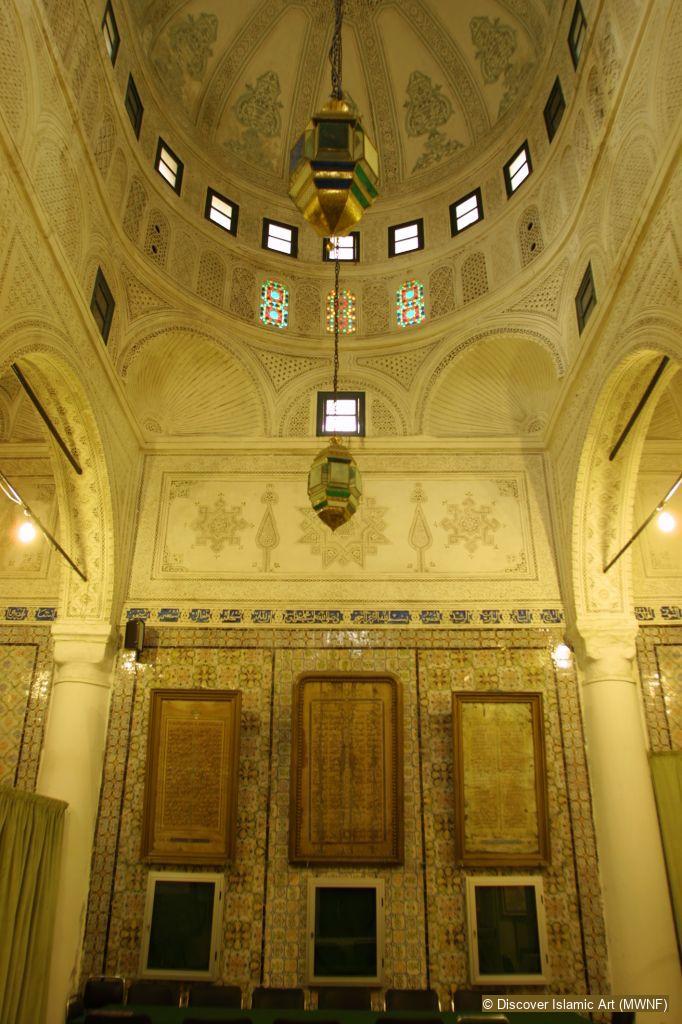
Name of Monument:
Zawiya of Sidi Shiha
Location:
In the Medina, Halfawiyyne district, Tunis, Tunisia
Date of Monument:
Hegira 1269–74 / AD 1852–7
Period / Dynasty:
Husaynid, Ottoman
Patron(s):
Sidi ‘Ali Shiha.
History:
The minister Mustafa Khaznadar was devoted to Sidi Shiha and contributed to the construction of the mausoleum, which he began after the birth of his son Muhammad in 1269 (1852). The works lasted five years until 1274 (1857).
Description:
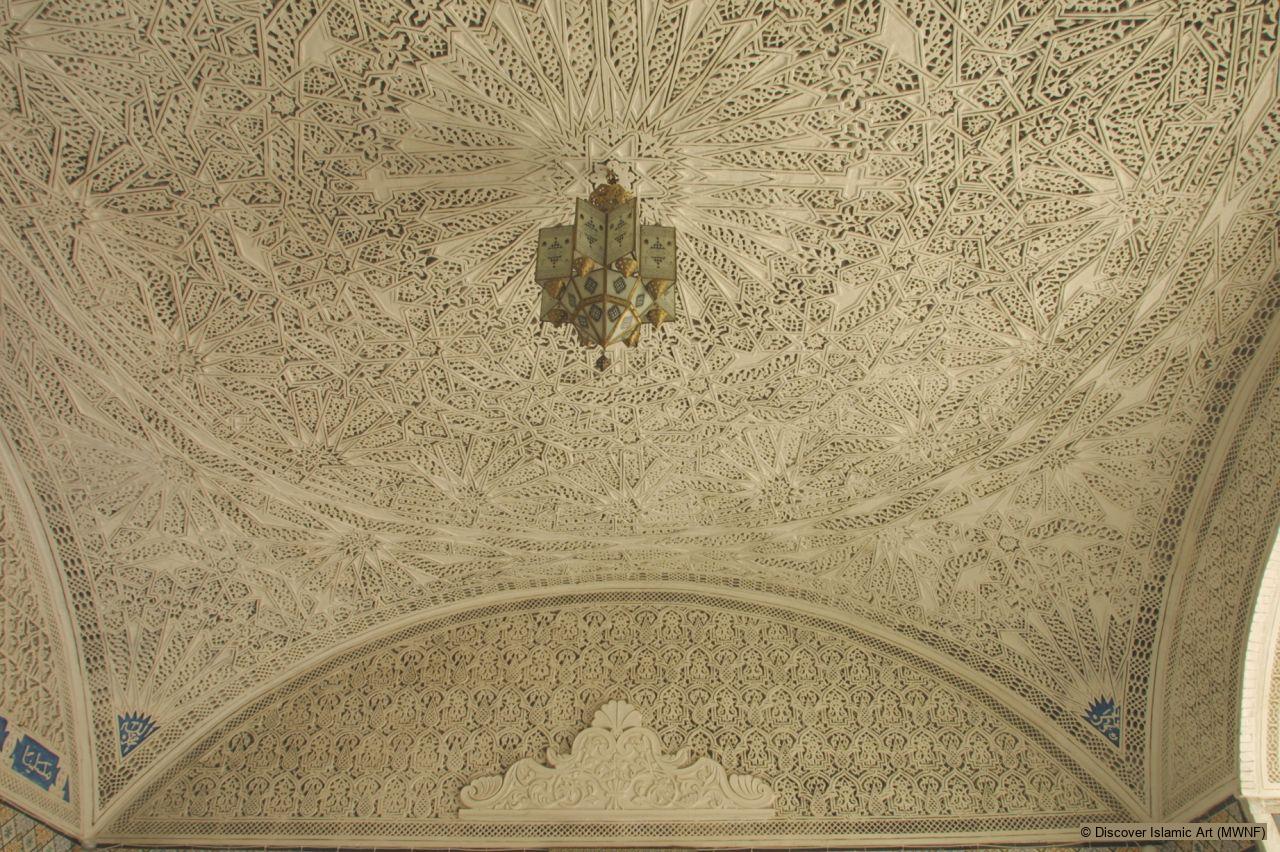
The great door of the zawiya leads into a sqifa or hallway which opens on to the patio. This is unusual in ancient buildings in this medina but probably explained by the function of the zawiya, which must have been an open space. Above the entrance is a type of flattened dome known as a turtle-back dome, covered in stucco in the Turkish manner. The rectangular patio is flanked on four sides with porticoes carrying horseshoe arcades. These arcades were supported on 12 columns which have been replaced by buttresses.
The patio floor is tiled with ceramic tiles originating from the Quallaline district in the Tunis Medina. This area has supplied ceramics of all kinds to Tunisians for centuries.
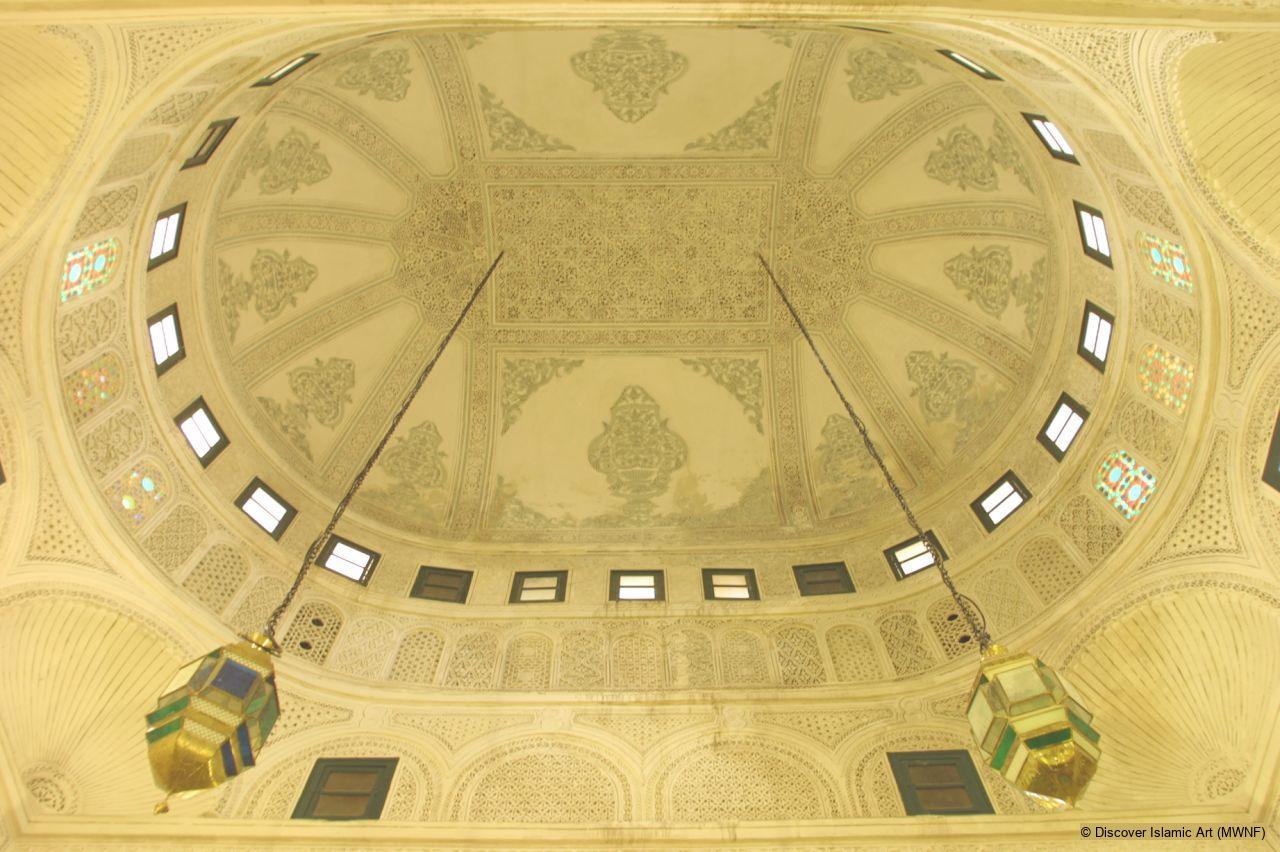
The huge room housing the sepulchre of Sidi Shiha, and that of his son Ahmed and one of his grand daughters, is noted for its rich decoration of small enamelled tiles, a technique known as zellij. The domes are particularly notable, though the barrel-vault is smaller than that of the mausoleum of Sidi Mehrez, and the Turbe al-Bey. It differs from the latter in its Turkish influenced stuccos (vases surrounding the dome on four sides, with window openings). This vault is flanked on its left and right sides by two domes. They are both reminiscent in every detail of the domes of Slimaniya Madrasa and Baschiya Madrasa which date from the AH 12th century (AD 18th). However, the Sidi Shiha domes are larger and more ornate. They rest on two enormous buttresses covered with marble, positioned in the centre of the hall and resting on two semi-columns set in the walls. This mausoleum currently houses the National Calligraphy Centre.
Situated in Halfawiyyne, a working-class district of the Tunis Medina, the Husaynid mausoleum of Sidi Shiha (AH 13th / AD 18th century) is today home to the National Calligraphy Centre. The monumental entrance has a so called flattened turtleback dome covered by Turkish-influenced stuccos. The enormous room containing the tomb of Sidi Shiha as well as that of his son Ahmad and one of his granddaughters is noteworthy for the opulence of their ceramic tile decoration.
How Monument was dated:
According to oral sources this monument was part of an architectural complex which included the Mosque of Yusuf Sahib al- Taba'a, a hammam and the zawiya.
Citation of this web page:
Mohamed Béji Ben Mami "Zawiya of Sidi Shiha" in Discover Islamic Art, Museum With No Frontiers, 2026. 2026.
https://islamicart.museumwnf.org/database_item.php?id=monument;ISL;tn;Mon01;28;en
Prepared by: Mohamed Béji Ben MamiMohamed Béji Ben Mami
Né le 27 janvier 1950 à Tunis, docteur en archéologie islamique, Mohamed Béji Ben Mami est directeur général de l'Institut national du patrimoine et vice-président de la Municipalité de Tunis. Il a restauré, sauvegardé et mis en valeur plus d'une cinquantaine de monuments de la médina de Tunis, dirigé les fouilles de grands sites islamiques et organisé diverses expositions relatives à la civilisation arabo-islamique.
Depuis 1996, il est vice-président de l'Union des historiens arabes et représentant de l'Union des archéologues arabes de Tunisie.
Mohamed Béji Ben Mami a pris part à divers congrès internationaux et publié plusieurs articles et ouvrages, parmi lesquels Tourbet el-Bey (Tunis, 2004) et Les médersas de la médina de Tunis (Tunis, 2005).
Copyedited by: Margot Cortez
Translation by: David Ash
Translation copyedited by: Mandi GomezMandi Gomez
Amanda Gomez is a freelance copy-editor and proofreader working in London. She studied Art History and Literature at Essex University (1986–89) and received her MA (Area Studies Africa: Art, Literature, African Thought) from SOAS in 1990. She worked as an editorial assistant for the independent publisher Bellew Publishing (1991–94) and studied at Bookhouse and the London College of Printing on day release. She was publications officer at the Museum of London until 2000 and then took a role at Art Books International, where she worked on projects for independent publishers and arts institutions that included MWNF’s English-language editions of the books series Islamic Art in the Mediterranean. She was part of the editorial team for further MWNF iterations: Discover Islamic Art in the Mediterranean Virtual Museum and the illustrated volume Discover Islamic Art in the Mediterranean.
True to its ethos of connecting people through the arts, MWNF has provided Amanda with valuable opportunities for discovery and learning, increased her editorial experience, and connected her with publishers and institutions all over the world. More recently, the projects she has worked on include MWNF’s Sharing History Virtual Museum and Exhibition series, Vitra Design Museum’s Victor Papanek and Objects of Desire, and Haus der Kulturen der Welt’s online publication 2 or 3 Tigers and its volume Race, Nation, Class.
MWNF Working Number: TN 28
RELATED CONTENT
Islamic Dynasties / Period
See also
Virtual Visit Exhibition Trail
Ifriqiya. Thirteen Centuries of Art and Architecture in Tunisia
Download
As PDF (including images) As Word (text only)