

 Back
Back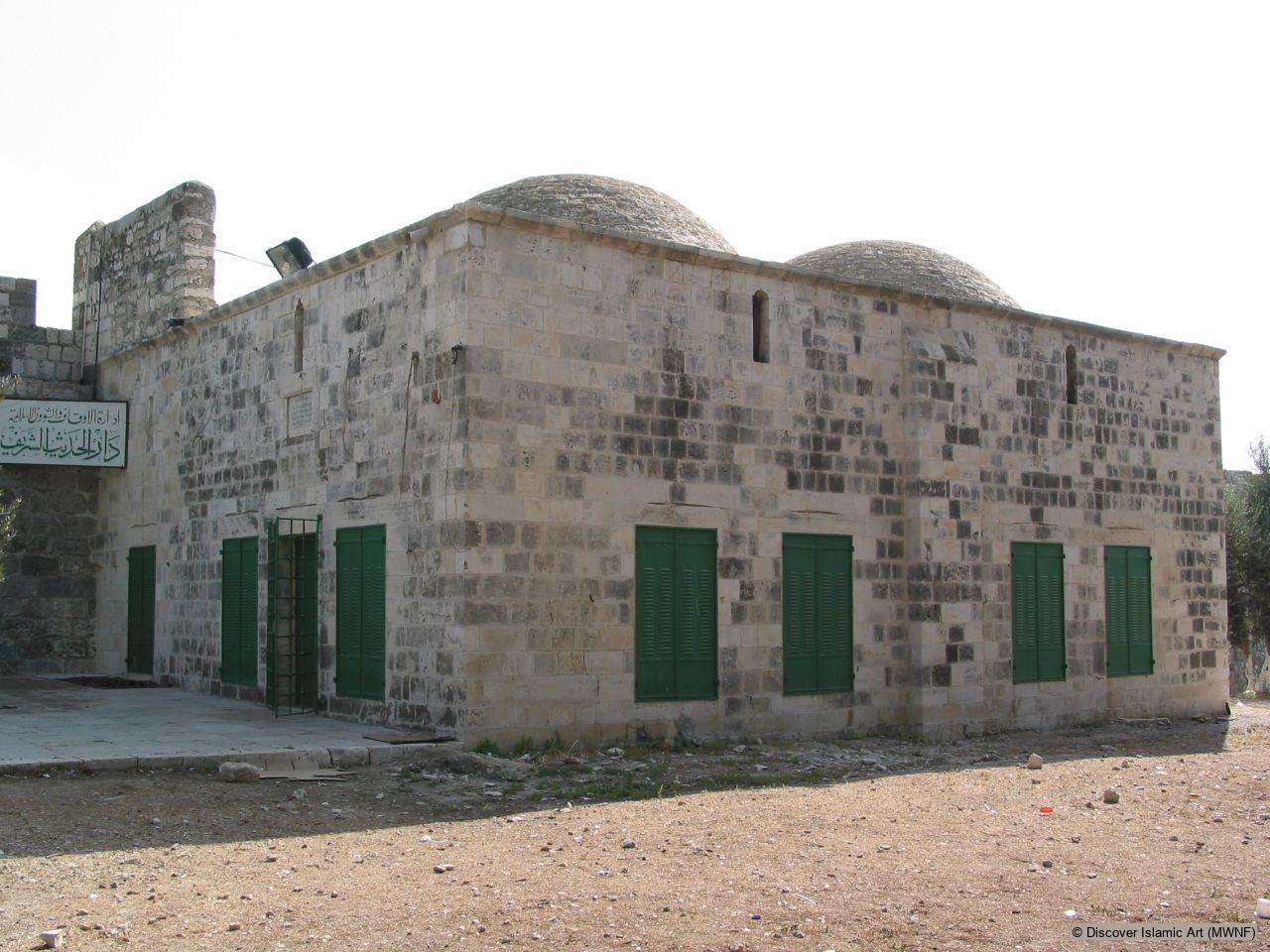
Name of Monument:
Kursi (throne) of Sulayman
Also known as:
Dar al-Hadith al-Sharif (present name)
Location:
The building adjoins the eastern wall of the Haram al-Sharif, and is located to the north of Bab al-Tawba (Gate of Repentance) and Bab al-Rahma (Gate of Mercy) a double gate leading into the Haram, Jerusalem
Date of Monument:
The building bears no date, but it is likely that it was built after hegira 1017 / AD 1608
Period / Dynasty:
Ottoman
Description:
The kursi (throne) of Sulayman is a commemorative building, the intention of which may have been to encourage visits to the Haram al-Sharif, and in this way to associate the Haram with various Prophets.
The building has only three facades since the fourth, eastern façade conjoins with the eastern wall of the Haram al-Sharif, so the eastern wall of the building became part of the enclosure wall of the old city of Jerusalem. The three facades are made of fine dressed stone. The entrance portal is in the northern façade. It is 1.1 m wide and 2 m high. The lintel above the entrance is surmounted by a relieving arch made up of three joggled stones. Surrounding the portal are three identically sized rectangular windows. The third window is located east of the eastern window. All three windows are provided with metal grills of similar designs. A rectangular sunken stone panel, which measures 75 cm x 50 cm, is placed four stone-courses above the lintels of the windows. Above this panel is an elongated window measuring 25 cm x 90 cm. The façade ends with a stone frame or cornice which projects slightly from the façade and which extends over to the western and southern façades. The western section of the building is crowned by two shallow domes; and while the western and southern facades resemble the northern façade in terms of the fabric of the building, they are different from it in the arrangement of the windows.
The interior is composed of a large hall with a rectangular ground plan, divided by means of two tapered arches into two divisions: western and eastern. The two arches are supported by a central pillar at one end, and by one of the walls of the building from which the arches emerge, at the other end. The western section of the hall is a prayer area (a mosque). It extends from north to south and is composed of two spaces each covered by a shallow dome without a zone of transition. On the southern wall of the western section is a mihrab of 1 m wide and 50 cm deep. It is crowned by a tapered arch with a semi-domed ceiling decorated with vegetal stucco motifs. The eastern section of the hall has a barrel vault that is supported on the west side by the two arches – which divide the hall into two sections – and from the east, by the east wall of the building. An imposing stone shrine (tomb), 9.5 m long and 2 m high, lies in this section. It is likely that this shrine was originally a rock and that two dressed stones were added to both ends of it in order to create a symbolic tomb (each with a diameter of 50 cm) of the Prophet Sulayman. On the east side of the shrine there is a rectangular panel upon which a Qur'anic verse is inscribed from the chapter “al-Naml” (“the Ants”, 27: 30–33).
This is a memorial that was probably built to commemorate the Prophet Sulayman (Solomon). It is located within the plaza of al-Haram al-Sharif, which supports its eastern wall. The building has a large hall divided into different areas, one of which is the prayer area with a mihrab. It is surmounted by two shallow domes. The hall also includes a symbolic tomb which might allude to the tomb of Sulayman or his throne. The building is presently used as an institute for Hadith (Dar al-Hadith).
How Monument was dated:
The building was dated by information available in the registers of the Shari'a Court of Jerusalem, and also by comparison of its architectural elements with those specific to the Zawiya al-Qadiriyya and the Zawiya al-As'adiyya in Jerusalem.
Selected bibliography:
Natsheh, Y., “Kursi Sulaiman” in S. Auld and R. Hillenbrand (eds.), Ottoman Jerusalem: The Living City 1517–1917 (Part II), London, 2000.
Citation of this web page:
Yusuf al-Natsheh "Kursi (throne) of Sulayman" in Discover Islamic Art, Museum With No Frontiers, 2026. 2026.
https://islamicart.museumwnf.org/database_item.php?id=monuments;ISL;pa;Mon01;10;en
Prepared by: Yusuf Al-NatshehYusuf al-Natsheh
Yusuf Said Natsheh is a Palestinian and since 1997 he has been Director of the Department of Islamic Archaeology in al-Haram al-Sharif in Jerusalem. He is a lecturer at al-Quds University. He was educated in Jerusalem and Cairo and in 1997 obtained his Ph.D. from the School of Oriental and African Studies, University of London. Dr Natsheh is a council member of many Palestinian societies for architectural heritage and a consultant for various projects on Jerusalem. He has written books and more than 40 articles about Jerusalem's architectural heritage including the architectural survey of Ottoman architecture in R. Hillenbrand and S. Auld (eds) Ottoman Jerusalem: The Living City 1517–1917 (London: Altajir World of Islam Trust, 2000). He has contributed to many international and national conferences. He supervised the restoration project, sponsored by the Arab League, on Mamluk monuments in and around al-Haram al-Sharif, and was Palestinian expert for the UNESCO mission to Jerusalem in 2004.
Copyedited by: Majd Musa
Translation by: Amal Sachedina (from the Arabic).
Translation copyedited by: Mandi GomezMandi Gomez
Amanda Gomez is a freelance copy-editor and proofreader working in London. She studied Art History and Literature at Essex University (1986–89) and received her MA (Area Studies Africa: Art, Literature, African Thought) from SOAS in 1990. She worked as an editorial assistant for the independent publisher Bellew Publishing (1991–94) and studied at Bookhouse and the London College of Printing on day release. She was publications officer at the Museum of London until 2000 and then took a role at Art Books International, where she worked on projects for independent publishers and arts institutions that included MWNF’s English-language editions of the books series Islamic Art in the Mediterranean. She was part of the editorial team for further MWNF iterations: Discover Islamic Art in the Mediterranean Virtual Museum and the illustrated volume Discover Islamic Art in the Mediterranean.
True to its ethos of connecting people through the arts, MWNF has provided Amanda with valuable opportunities for discovery and learning, increased her editorial experience, and connected her with publishers and institutions all over the world. More recently, the projects she has worked on include MWNF’s Sharing History Virtual Museum and Exhibition series, Vitra Design Museum’s Victor Papanek and Objects of Desire, and Haus der Kulturen der Welt’s online publication 2 or 3 Tigers and its volume Race, Nation, Class.
MWNF Working Number: PA 10
RELATED CONTENT
Related objects

Related monuments

Islamic Dynasties / Period
On display in
Exhibition(s)
Discover Islamic Art
Al-Franj: the Crusaders in the Levant | Culture in the Crusader Kingdom of Jerusalem
See also
Virtual Visit Exhibition Trail
Pilgrimage, Sciences and Sufism. Islamic Art in the West Bank and Gaza
Download
As PDF (including images) As Word (text only)