

 Back
Back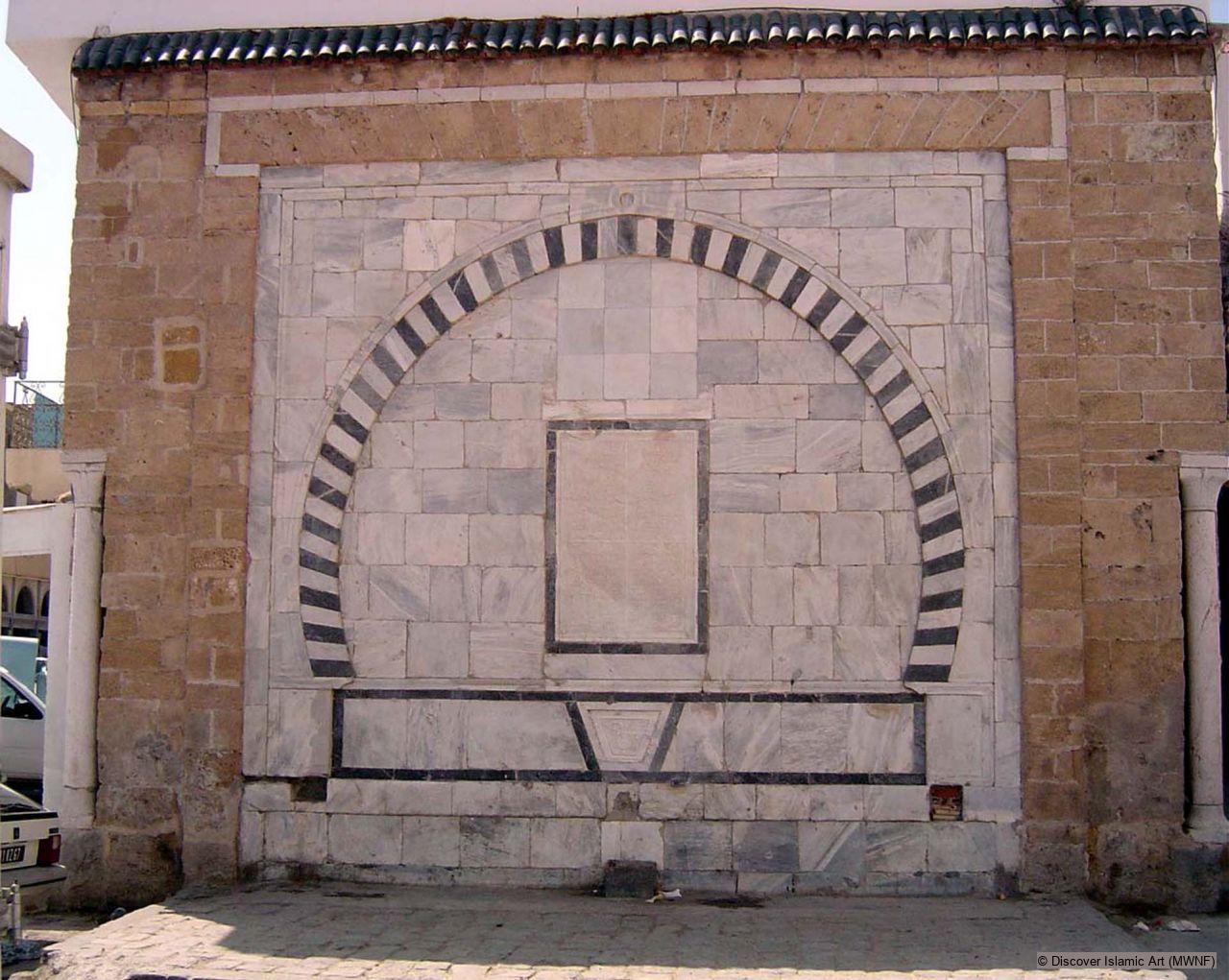

Name of Monument:
Sabil (public fountain) of Yussef Dey
Location:
Bizerte, Tunisia
Date of Monument:
Hegira 11th century / AD 17th century
Architect(s) / master-builder(s):
Master mason: Ali ibn Disim Andalusi.
Period / Dynasty:
Muradid (Ottoman)
Patron(s):
Yussef Dey.
History:
The sabil was erected by Yussef Dey, dey of the regency of Tunis (AH 1019–46 / AD 1610–37). It was restored during the 1990s and some of the windows overlooking the façade were blocked up.
Description:
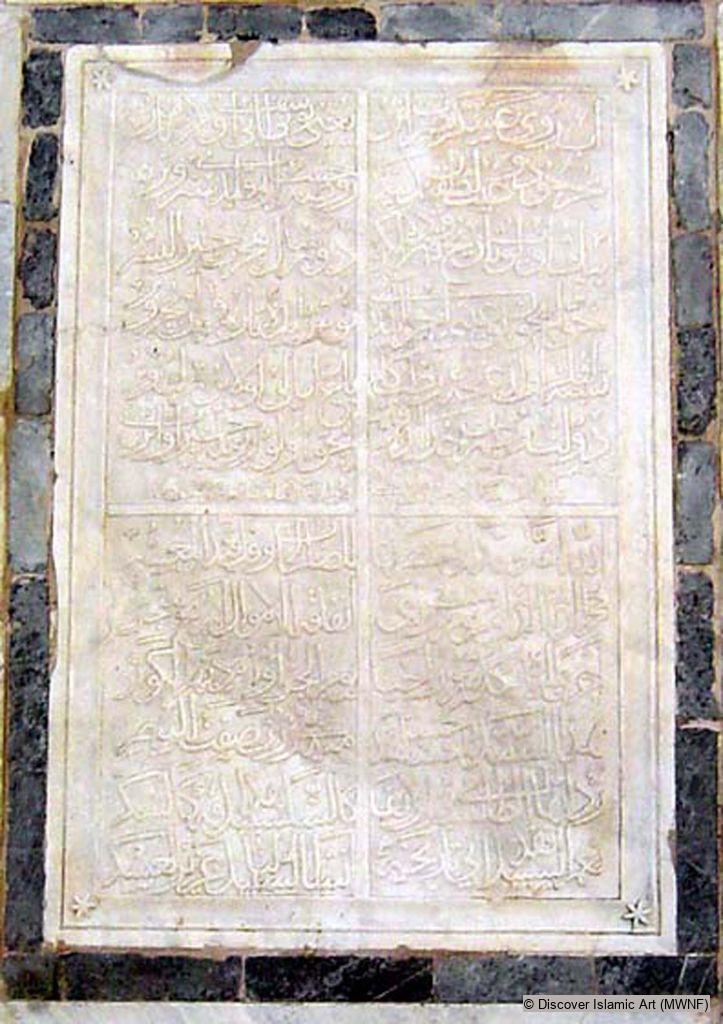
This monument stands in a public square which overlooks the old port and is the meeting point of several arterial roads used by merchants. It is a square construction of cut stone with a rim of green round tiles. There is a marble column on either side, each capped by an Ottoman-style foliate capitol. These provide the framework for a marble rectangle decorated with a horseshoe arch with ablaq type black and white arch-stones, a typical Tunisian feature since the Hafsid period. At the base of the rectangle, engraved in the marble, is a Turkish-style vase of flowers decoration. Two symmetrical foliate scrolls with stylised trefoil fleurons emerge from the vase. On the interior of the arch, slightly in relief, is a bilingual Arab and Turkish inscription which consists of the following poem written in 13 lines of thuluth script:
“God has chosen a lord of our times / to produce benefits and to undo the chains of the needy: / This most honourable citizen, the Dey Yussef, has realised how spending on public finances will ultimately be to his own profit. / He has caused water to spring forth on all sides / awaiting the reward of quenching his thirst beside the river al-Kaoutari. / How fine he is and how deeply the public is in his debt! / Thanks to him Bizerte has become a beauteous place to contemplate. / Drink, O thirsty one, from this delicious fountain / whose limpid water is so sweet! / Such a fine fountain built in 1041. / The chief of all the soldiers built us this fountain.”
“By the master mason Ali ibn Disim Andalusi, at the beginning of rabi II in the year 1041 [AD 1632]”.
The old marble drinking-trough has completely disappeared. Formerly, there was a room behind the fountain occupied by a waterwheel or noria and which was worked by a camel or by a mule.
This fountain was built in a public square that overlooks the old port of Bizerte and joins several main roads, and it remains the architectural highpoint of the district. It would have been supplied with water using a camel- or mule-powered noria. The old marble drinking trough has completely disappeared. The fountain was built by a Spanish emigrant and it has a very beautiful arch of alternating black and white marble voussoirs beneath a ledge of round, green tiles.
How Monument was dated:
The chronogram in the last line of the poem states the date of construction of the fountain, 1041 (1632).
Selected bibliography:
Gafsi, A., Monuments andalous de Tunisie, Tunis, 1993, p.38.
Hannezo, G., Bizerte, Revue tunisienne, No. 49, 1905, p.144.
Oudi, R., “Les inscriptions des fontaines publiques de la ville de Bizerte”, Africa, No. 16, 1998, pp.39–105.
Citation of this web page:
Saloua Zangar "Sabil (public fountain) of Yussef Dey" in Discover Islamic Art, Museum With No Frontiers, 2026. 2026.
https://islamicart.museumwnf.org/database_item.php?id=monuments;ISL;tn;Mon01;34;en
MWNF Working Number: TN 34
RELATED CONTENT
Related monuments
Islamic Dynasties / Period
On display in
Exhibition(s)
Water in Islam
Religion and Spirituality | "The Best Charity is a Drink of Water" (Hadith: Sunan An-Nasa'i 3694)
See also
Virtual Visit Exhibition Trail
Ifriqiya. Thirteen Centuries of Art and Architecture in Tunisia
Download
As PDF (including images) As Word (text only)