

 Back
Back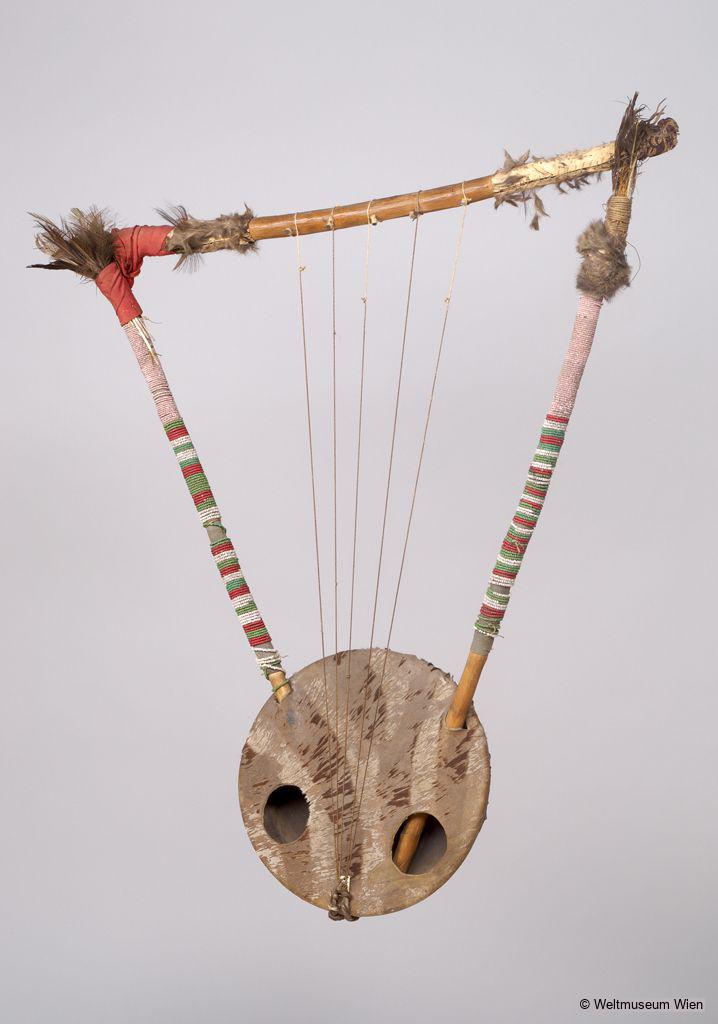
This item has been added to the Database within the Explore Islamic Art Collections project. Information is available in: English, Arabic.
Name of Object:
Lyre (tambura)
Location:
Vienna, Austria
Holding Museum:
Weltmuseum Wien
Date of Object:
First half of the 20th century
Museum Inventory Number:
97.421
Material(s) / Technique(s):
Wood, skin
Dimensions:
H: 100cm, W: 97cm, Diameter: 12cm
Provenance:
East Africa
Description:
A three, four, five or six-stringed lyre whose round sound box is covered with stretched goatskin with two openings called eyes (Arabic ‘ain). Protruding diagonally from the sound box are two wooden posts that are connected by crossbars at various heights and roughly form a trapezium. The wooden posts and the crossbars are wrapped with coloured ribbons, strings of pearls and brushes, and decorated with shells and amulets. The tambura is the most important instrument and is considered to be inspired by the asyad, masters who speak with the possessed. During the zar ceremonies (a form of dance therapy which displays a few points of connection with formal Islam) of North and East Africa the tambura is placed on a sacrificial table (kursi) with a set of indispensable items: candlesticks, flowers, food products and incense.
How date and origin were established:
Entry in the general inventory and archival documents.
How Object was obtained:
Catalog entry: "Addendum to the donation (former loan) of Professor Ludwig Karl Strauch, 1940."
How provenance was established:
Entry in the general inventory book.
Selected bibliography:
Steinmann, Axel, "Lyre (tambura)", in Anne-Marie Bouttiaux and Anna Seiderer (eds), Fetisch Modernity, exhibition catalogue, Tervuren: Royal Museum for Central Africa, 2011: 111.
Citation of this web page:
"Lyre (tambura)" in Explore Islamic Art Collections. Museum With No Frontiers, 2026.
https://islamicart.museumwnf.org/database_item.php?id=object;EPM;at;Mus23;15;en
MWNF Working Number: AT3 15
RELATED CONTENT
On display in
Exhibition(s)
MWNF Galleries
Musical instrumentsDownload
As PDF (including images) As Word (text only)