

 Back
Back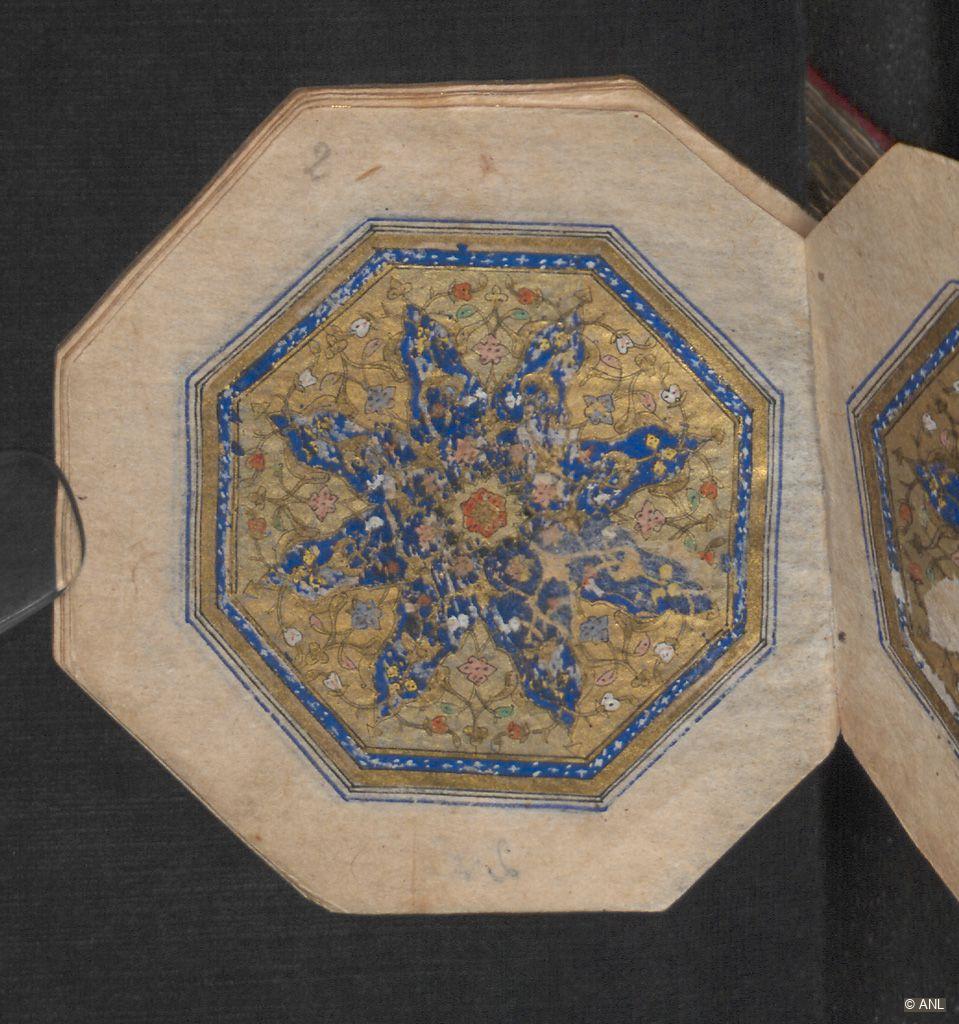
On fol. 1b-2a, the elaborate opening pages consist of a symmetrical double page showing two arabesque star rosettes in gold and blue within in an octagonal frame. The filigree arabesque composition is enriched by delicate flowers and flower buds of light blue, vermilion, pink, white, and turquoise, sitting on scrolling tendrils throughout the composition.
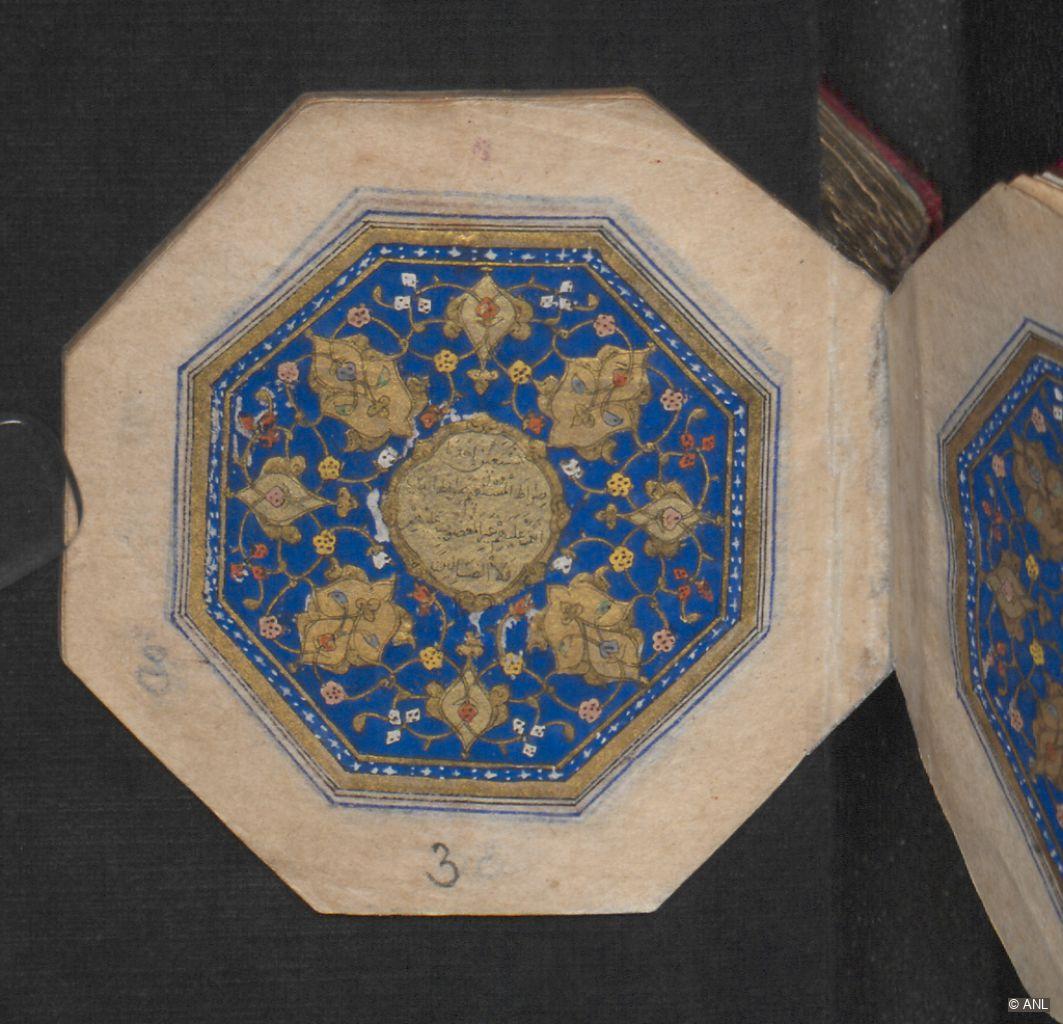
Fol. 2b-3a consists of two decorative symmetrical opening pages in an inverted blue and gold colour scheme to fol. 1b-2a. The golden central and circular medallion is surrounded by various shapes of closed golden arabesque forms before a dark blue background with a network of green vines in which flowers in white, yellow, and pink are sitting. The central rosette contains the first sura of the Qur’an in very small letters.
This item has been added to the Database within the Explore Islamic Art Collections project. Information is available in: English, Arabic.
Name of Object:
Qur’an with a Falnama (Book of Divination)
Location:
Vienna, Austria
Holding Museum:
Austrian National Library (ANL)
About Austrian National Library (ANL), Vienna
Date of Object:
AH 952 / 1545 AD
Museum Inventory Number:
A.F. 557
Material(s) / Technique(s):
Ink, colour and gold on paper. Calligraphic small naskh script of 12 lines per page.
Dimensions:
Octagonal shape with a diameter of 60mm, 56 x 56mm (43 x 43mm). ff. II, II*, 281 folios
Period / Dynasty:
Safavid
Place of production:
Shiraz, Iran
Provenance:
Iran
Binding:
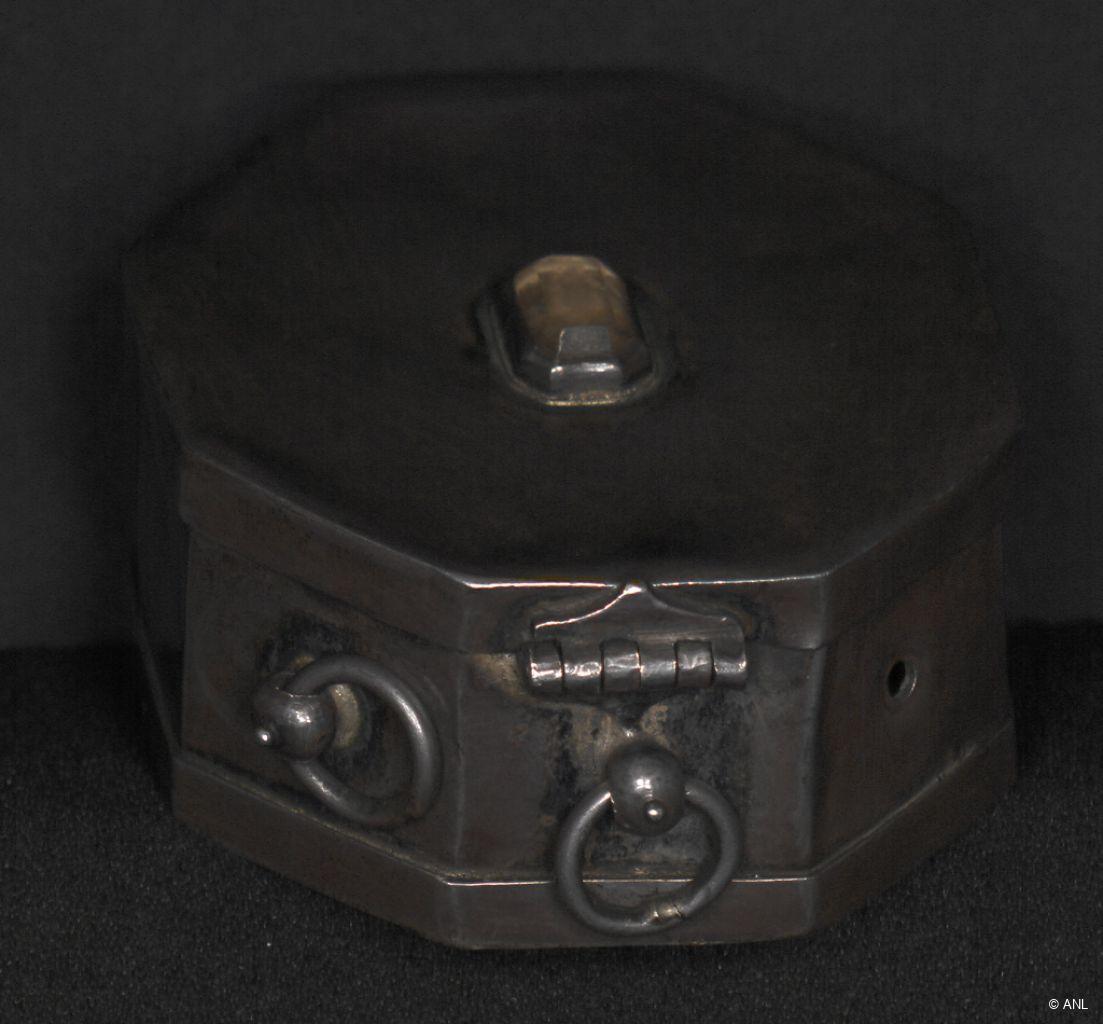
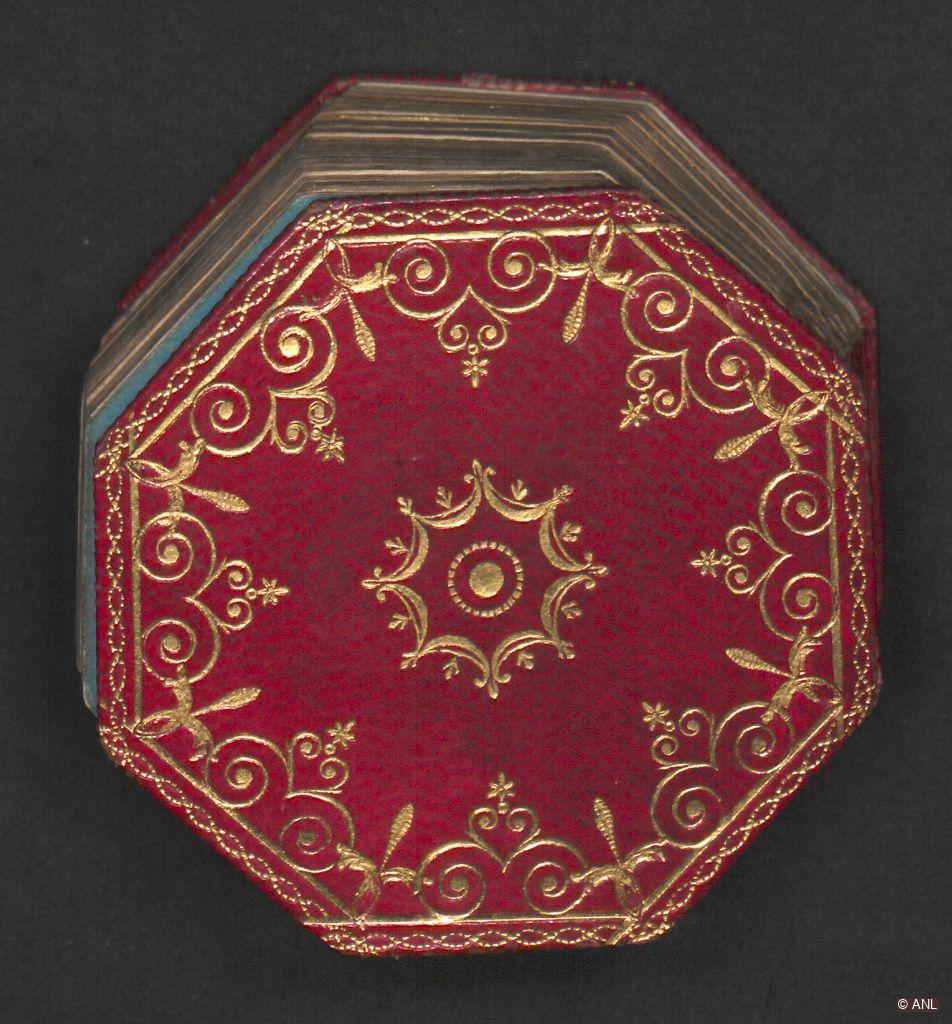
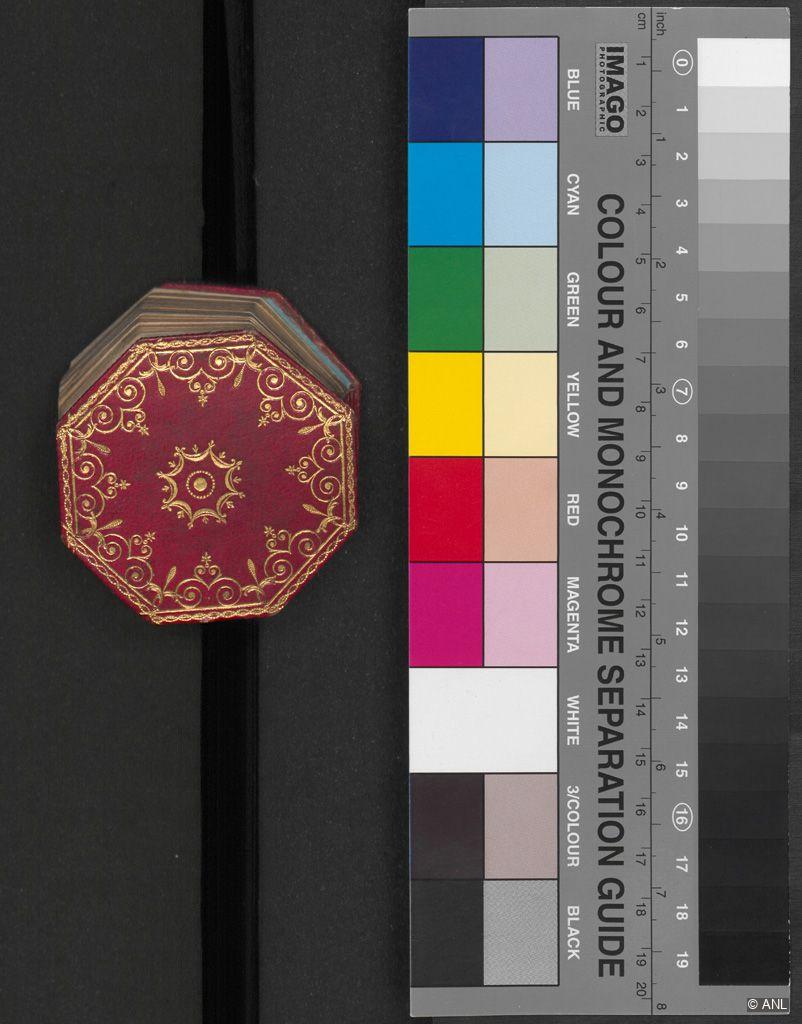
This red morocco binding has gold-stamped, lace-like ornaments and gold edging. It is probably an Austrian work from the end of the 18th century. The manuscript is preserved in an octagonal silver box from 17th-century Turkey, with its lid decorated with a cut pale beryl. The three suspension rings indicate that it was likely tied to or hung from something.
Description:
This miniature octagonal Qur’an with an attached Persian Falnama (Book of Divination) fragment was penned, according to the colophon, in March 1545, likely in the Iranian city of Shiraz. The elaborate opening consists first of a symmetrical double page of illuminated floral rosette patterns within an octagonal shape, followed by similarly symmetrical opening pages containing the first lines of the Qur’anic text. The text is written in small naskh script, divided into verses by gold dots and framed in blue, red, black, and gold details. Although the binding is not original, the manuscript is preserved in an octagonal silver box from 17th-century Turkey, with its lid decorated with a cut pale beryl. The three suspension rings attached to the box indicate that it was likely tied to or hung from something. Small Qur’ans of this type were worn on silver chains around the neck and had an amulet function for the owner, but were also an expression of luxury. Additionally, the small yet elaborate calligraphy, the very fine illumination, and the valuable box indicate a very distinguished owner or patron. In the Ottoman Empire, these Qur’ans were hung from the tops of flags. According to legend, this manuscript was found tied to a lance in a Turkish military camp outside of Vienna in 1683 and belonged to Prince Eugene. The inventory of the Viennese Kunstkammer, however, indicates that it may have been part of the collection of Rudolf II in Prague in the 17th century. The Falnama, or Book of Divination, written in Persian, is included at the end of the Qur’an on fol. 279b-281a. Both the inclusion of the Falnama as well as the decoration style suggest a Persian place of origin. This assumption is supported by a similar octagonal Qur’an in the British Library (OR. 2200), which was copied in Shiraz in AH 950 / 1543 AD. Related pieces can also be found in the Chester Beatty Library in Dublin or in the Topkapi Sarayi in Istanbul, among other locations.
How date and origin were established:
One colophon: AH 952 / AD 1545
How Object was obtained:
Allegedly found tied to a lance in a Turkish military camp outside of Vienna in 1683 and belonged to Prince Eugene. Part of the collection of Rudolf II in Prague in the 17th century according to the Kunstkammer inventory.
How provenance was established:
It has been in the Austrian National Library since at least the end of the 18th or the beginning of the 19th century.
Link to catalogue/digitisation in Holding Institution’s database:
http://data.onb.ac.at/rec/AC14411309
Selected bibliography:
Duda, Dorothea, Islamische Handschriften II. Persische Handschriften, Die illuminierten Handschriften und Inkunabeln der Österreichischen Nationalbibliothek, vol. 5, Vienna: Verlag der Österreichischen Akademie der Wissenschaften, 1992: 99-100.
Citation of this web page:
Theresa Zischkin "Qur’an with a Falnama (Book of Divination)" in Explore Islamic Art Collections. Museum With No Frontiers, 2026.
https://islamicart.museumwnf.org/database_item.php?id=object;EPM;at;Mus24;10;en
Prepared by: Theresa Zischkin
Copyedited by: Sophie-Anne Mullen
MWNF Working Number: AT4 10
RELATED CONTENT
Islamic Dynasties / Period
On display in
Exhibition(s)
Download
As PDF (including images) As Word (text only)