

 Back
Back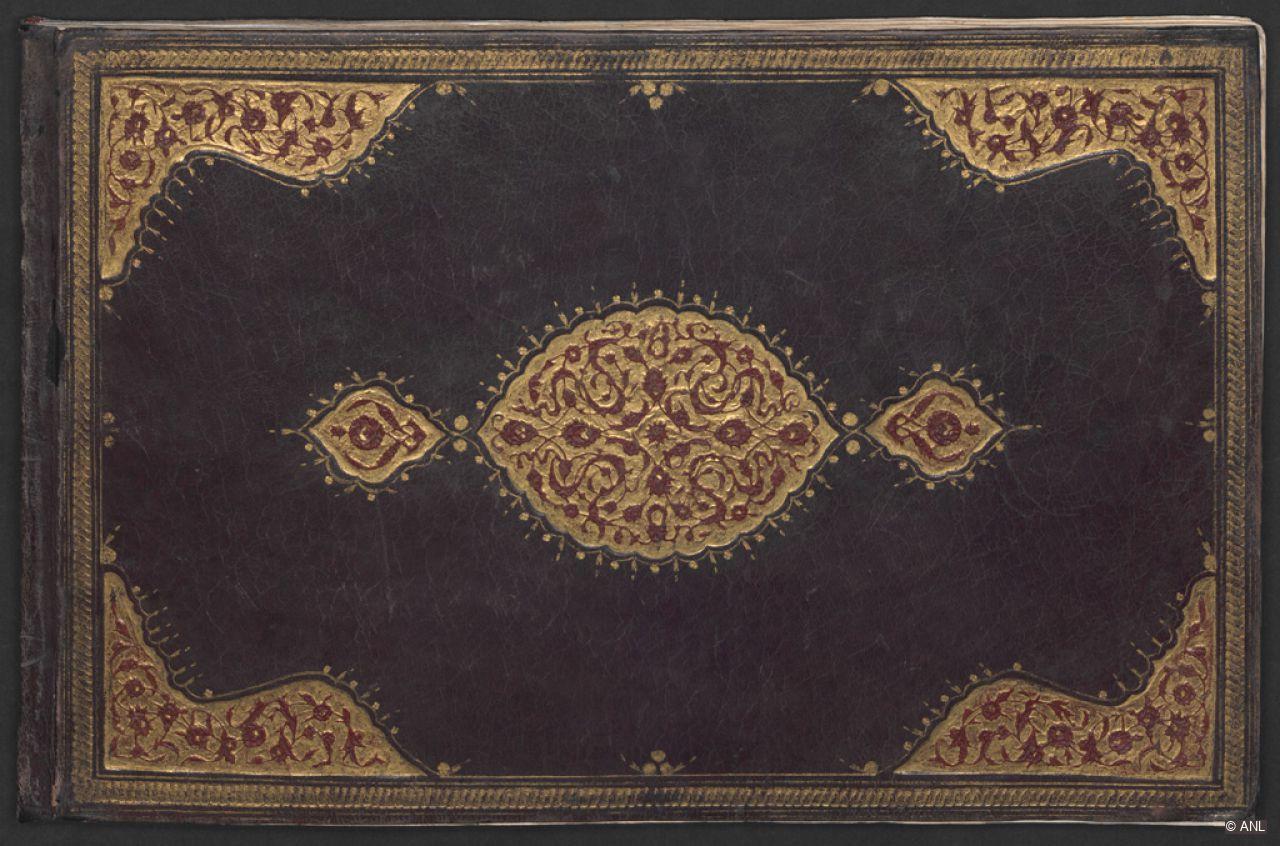
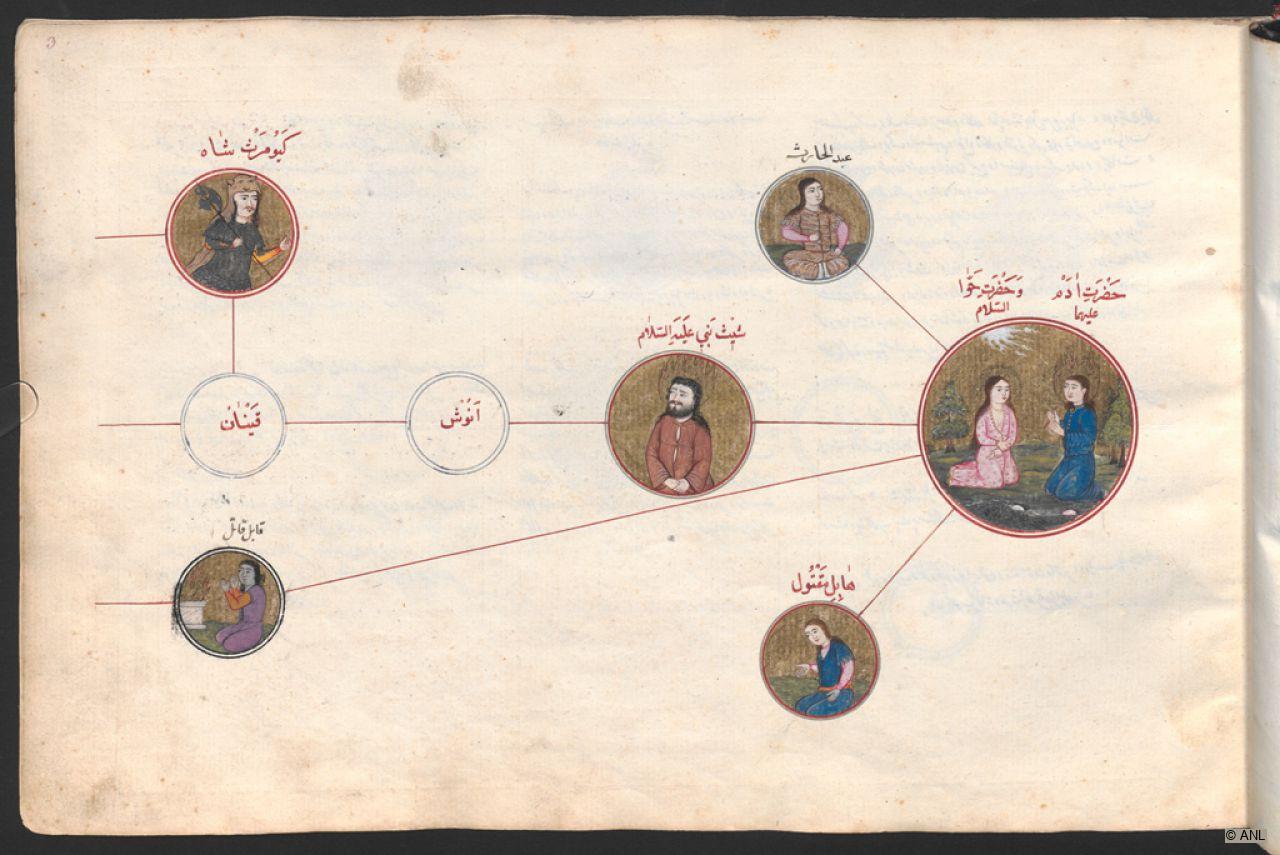

Fol. 3a displays eight medallions chronologically read from right to left, of which six are filled with paintings while the other two simply include names. On the far right, a medallion with Adam and Eve marks the beginning of the genealogy, and four lines extend from their image to four other medallions. The two figures in three-quarter profile are kneeling before a stream, facing each other within a green landscape with trees and a golden sky: interestingly, Adam and Eve are both fully clad in blue and pink, respectively. Adam has a fiery aureole, while Eve a round halo, denoting a sense of hierarchy between the two. Adam has his hands raised while Eve has hers crossed in front of her body. Above her, a fiery cloud of light extends its rays towards Adam, perhaps signifying the Godly presence. The highest line extending from Adam and Eves’ medallion leads to a painting of their son, 'Abdalharit, clad in light brown and seated in a cross-legged manner in a green landscape. His youthful face is framed by long brown hair. Underneath him, the following medallion reveals the half-figure portrait of Nabi Shith (Seth), a bearded prophet, with a golden-flame halo. At the very bottom, Habil Maqtul (Abel) is shown kneeling on a green ground, inclining his head, and having his right hand slightly raised with his palm turned upwards. His brother Qabil Qatil (Cain), in contrast, is shown to the left of Habils’ medallion, kneeling before a burning altar of sacrifice with his hands raised. His purple robe contrasts with the grey skin colour on his youthful, beardless face, perhaps a reflection of his prior bad deeds. In the left corner, the painting depicts Kayumarth (Gayumars), the first Persian ruler who introduced the furrier craft; hence, he has a lion-skin cape draped over his silver armour. He appears to be in a more dynamic position – potentially running – and holds an attribute, a battle axe, in his right hand.
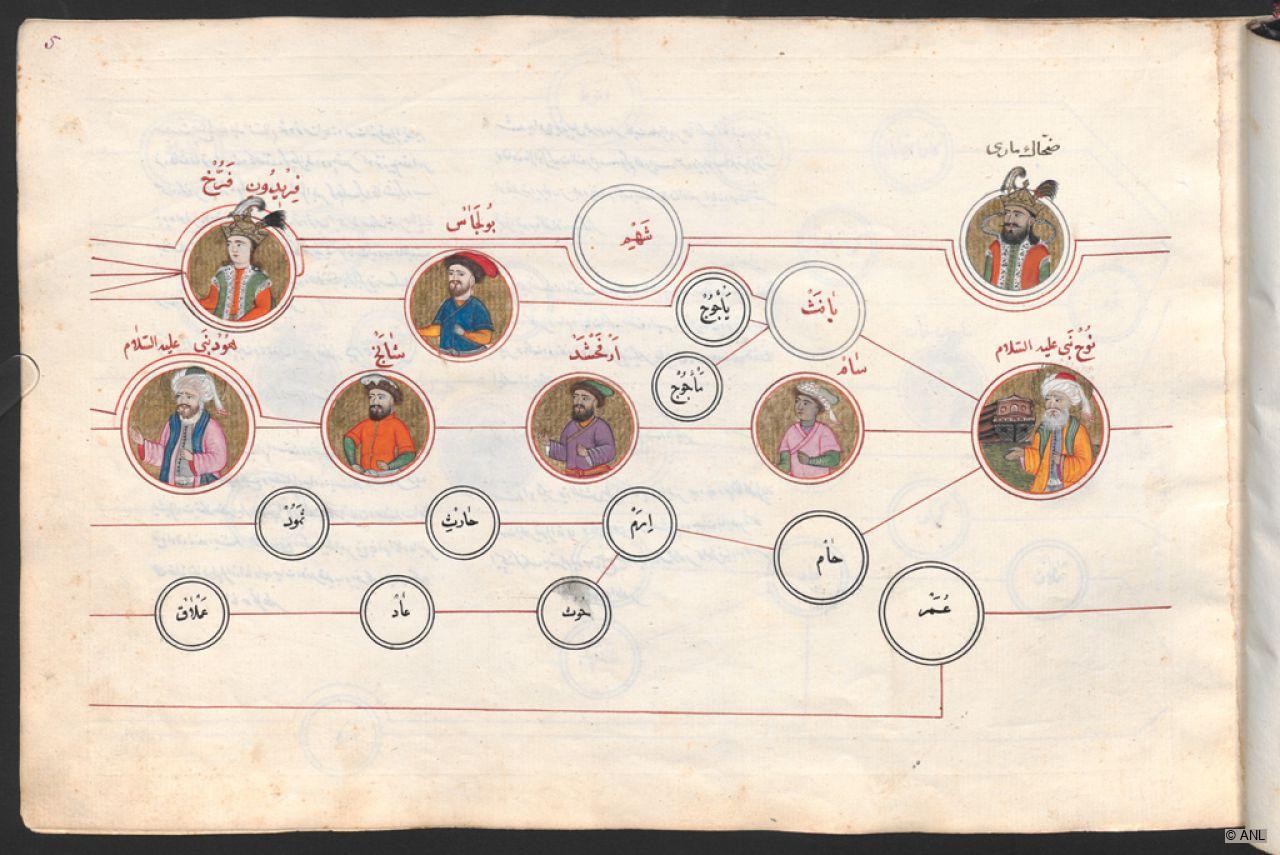
Following the genealogy on fol. 5a from right to left, multiple medallions containing a portrait or a name are included. The first medallion on the top right features Zahhak Mari, a legendary Persian ruler – indicated by the golden crown with elaborate decoration and luxurious garments in green with a fur-lined red vest – with two serpents extending from his shoulders, as seen here in this image. Following the lines connected to him, on the far left is Faridun Farrukh, another legendary Persian ruler who defeated Zahhak. In contrast to the bearded Zahhak, Faridun is shown as a youthful king with a similarly elaborate crown and the same style of dress, of which only the colours were inverted. Following a different genealogical line on the right, Nuh (Noah) is depicted as the ancestor of the Turks in a half-figure portrait with the arc as his attribute in the background. He is shown as an elderly man with white hair, a turban, and a flaming aureole, having his hands slightly raised as if in conversation, or in referral with his ancestors. On the line connecting Nuh and Faridun, a figure named Bulajas (Abulja Khan, Uljay or Bulja) is depicted. He is the son of Japheth (Yafath), the ancestor of the Oghuz Turks, and wears a fur-trimmed red cap. On the central line extending from Nuh, the portrait of Sam (Shem), Nuh’s son, follows. He has a youthful appearance, clad in a pink robe and wearing a cap with a white band. Sam’s son Arfahshad is depicted next, as a bearded man with a green fur-lined cap and a purple robe. To his left is Sha'ikh (Shabikh), Sam’s great-grandson, who is depicted in a similar manner. To the far left, Hud (Heber) is shown, who was an Arab prophet. As such, a flaming aureole is indicated around his turban.
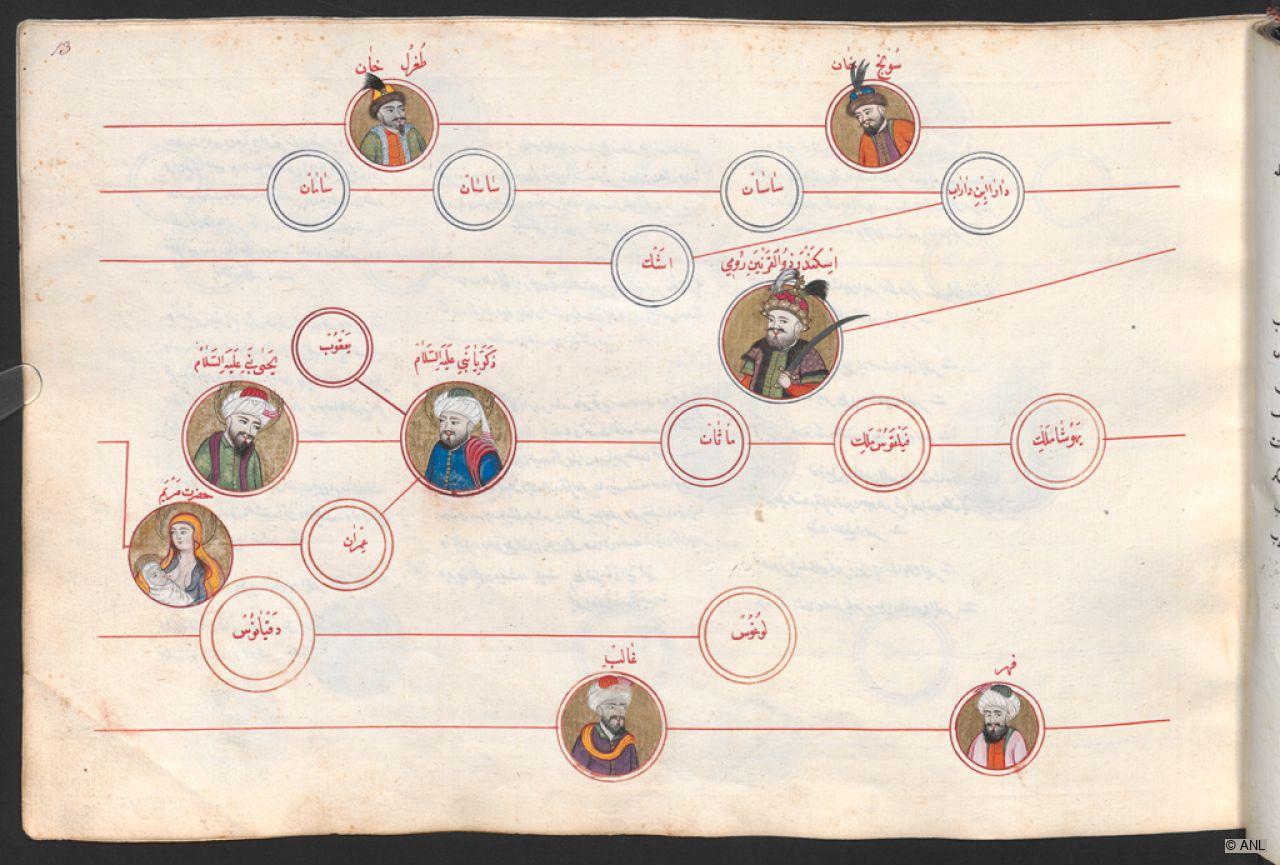
Fol. 13a depicts eight medallions with portraits, together with multiple name-roundels. At the top, Sevinj Khan, a Turkish ancestor, is shown with a fur-trimmed blue cap and three feathers. To his left, Toghrul Khan, a legendary Turkish ancestor, is depicted wearing a fur-trimmed yellow cap with a hat ornament. Underneath them, in a slightly bigger roundel, Iskandar Zu'l-qarnayn Rumi (Alexander the Great) is shown. He dons a particularly splendid crown, an elaborate multi-layered robe and holds a sabre in his raised left hand. To the left, the prophet Zakariyya (Zacharias), clad in a blue robe and red shawl, is depicted with a flaming halo around his turban. He is facing the figure to the left, Yahya (John the Baptist): this prophet also has a fiery aureole around his turban. Underneath him, Maryam (Mary) is shown with an exposed breast, nursing the baby Jesus, both bearing flaming aureoles. She wears an orange veil, a blue robe, and a pearl necklace, while the child is wrapped in a white cloth. At the bottom, two men are shown: Fihr, the progenitor of the tribe of the Quraysh on the right, and a person named Ghalib in a purple robe, facing the other man.
On fol. 17a, the upper section with blue name-medallions is distinguished from the bottom section which is written in red. At the very top, two Turkish ancestors are portrayed: Qara Bugha Khan is shown wearing a fur-trimmed red cap on the right, while Qumri Khan on the left dons a similarly fur-trimmed blue cap. In the red section, a row of four men in larger medallions are depicted, starting with the Prophet Muhammad on the right. He wears a black turban with a fiery halo around it, and his face is covered by a green veil. His portrait is completely encircled by golden flames extending from the medallion. He is turned towards the men to the left who face the Prophet Muhammad. These three portraits represent Abu Bakr, 'Umar/'Omar, and 'Uthman/'Osman. They are all depicted in a similar manner but with alternating colours of their cap, their garments, and their beard.
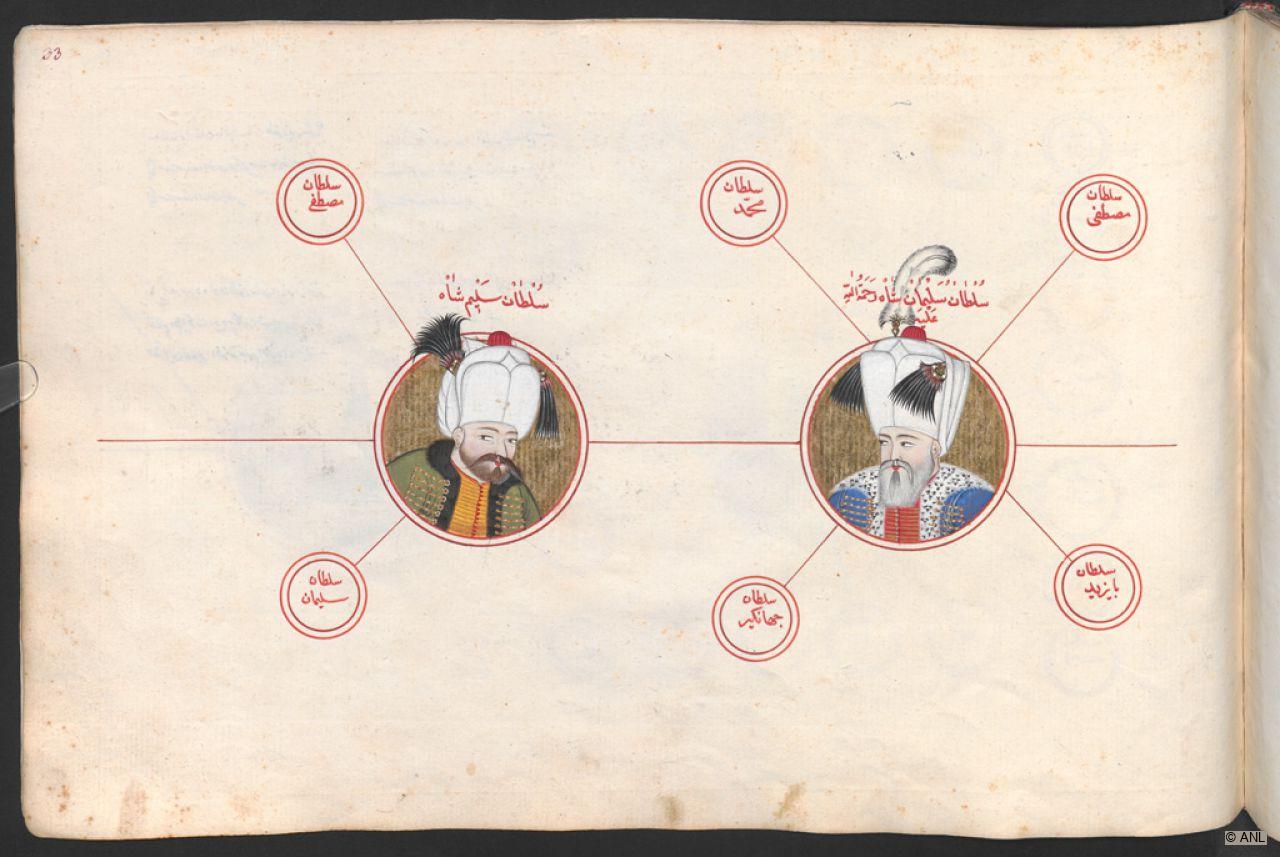
Fol. 33a features two large medallions, namely that of Suleyman I Qanuni, who was the Ottoman Sultan from 926 AH / 1520 AD to 974 AH / 1566 AD, who has a grey-white beard, and wears a richly decorated high white turban and an elaborate ermine fur collar over a blue coat. To his left, Selim II is depicted, who was the Ottoman Sultan from 974 AH / 1566 AD to 832 AH / 1574 AD. He has a short brown beard, a similarly decorated high white turban, and a fur-trimmed green cloak.
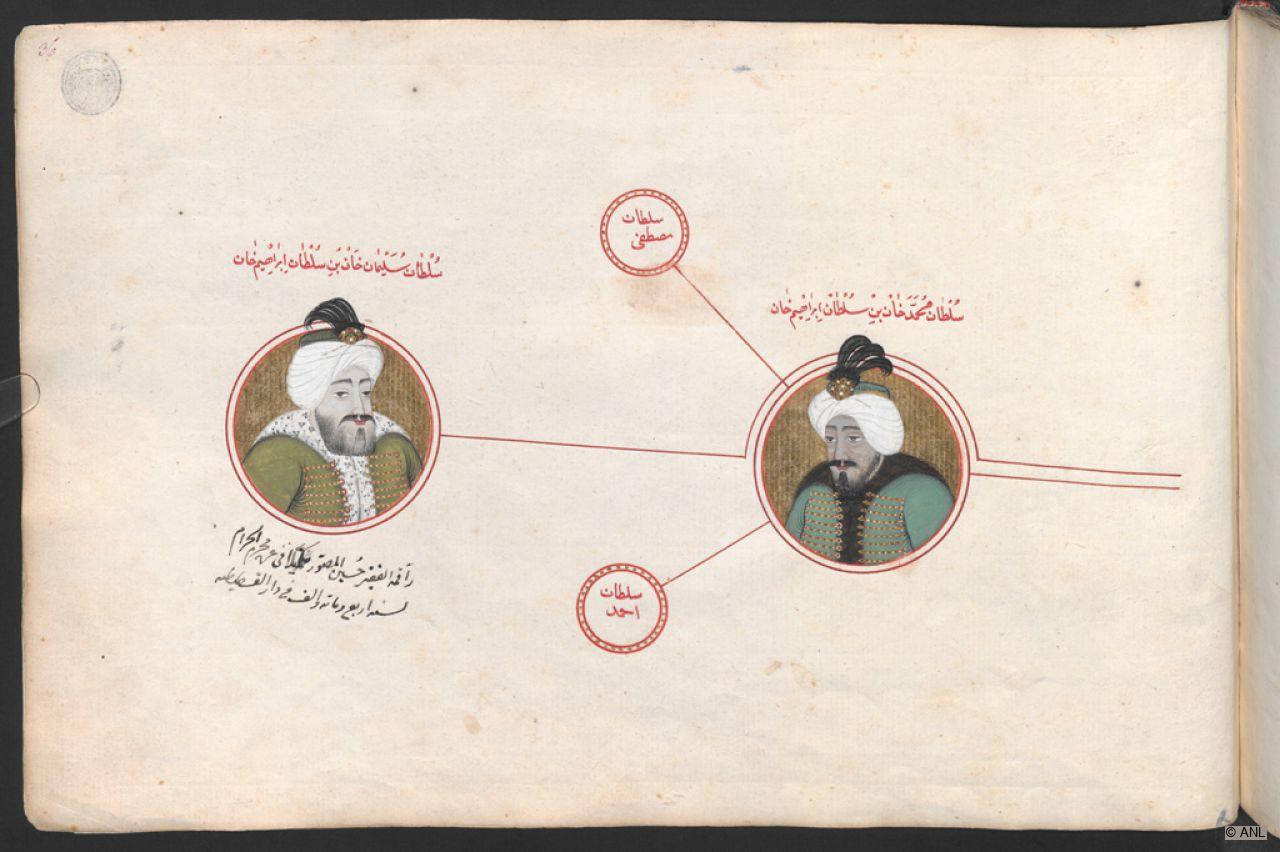
On fol. 36a, two large medallions portray the two last ruling sultans before the genealogy was completed. On the right, Mehmed IV, Ottoman Sultan from 1058 AH / 1648 AD to 1099 AH / 1687 AD, wears a low white turban decorated with black feathers and a green cap that both match with his luxurious garments. Interestingly, his face is modelled in an expressive and naturalistic manner with a greyish-pink skin colour. The area underneath the eyes is accentuated with deep wrinkles. To the left, Suleyman II, Ottoman Sultan from 1099 AH / 1687 AD to 1102 AH / 1691 AD, also has naturalistically executed features on a pale greyish face. The white turban under a green cap with feather decoration as well as the elaborate garments are similar to those of his predecessor. The detailed execution of these sultans’ facial features may reveal that the painter had direct models at his disposal, or that he wanted to visually comment on the rulers of the immediate past.
This item has been added to the Database within the Explore Islamic Art Collections project. Information is available in: English, Arabic.
Name of Object:
Silsile-name ('Chain book' or Genealogy)
Location:
Vienna, Austria
Holding Museum:
Austrian National Library (ANL)
About Austrian National Library (ANL), Vienna
Date of Object:
1104 AH /1692 AD
Scribe(s):
Huseyin
Museum Inventory Number:
A.F. 17
Material(s) / Technique(s):
Ink, colour and gold on paper. Small Turkish naskh in three columns up to 20 lines per page.
Dimensions:
225 x 345 mm (170 x 250 mm), ff. I*, 36 folios
Period / Dynasty:
Ottoman
Place of production:
Istanbul
Binding:
The brown-black leather binding has a stamped arrangement of a central medallion with two pendants on the sides, as well as profiled corner fillings. The decorative motifs present reddish floral arrangements and stylised cloud bands over a gold background. While the delicate ornamentation on the binding still reflects 16th-century traditions, it was likely made at the end of the 17th century.
Description:
This Silsile-name, meaning chain book or genealogy, was completed by the scribe and painter Huseyin in 1104 AH / 1692 AD in Istanbul, according to the colophon. It was acquired in Turkish Ottoman territory soon after by Count Luigi Ferdinando Marsili (died 1730 AD) and listed in the printed catalogue of his personal library in 1702, his coat of arms appearing as embossed stamps on two folios (fol. 2a, 36a). However, it was acquired by the Austrian National Library in the early 18th century and restored in 1921, as an inscription on fol. 1a indicates. Family trees and their graphical representation in the form of linked circular medallions - hence the name - have had a long tradition in Islam since the early 14th century. The literary form of such genealogies referring to ancestors, however, originated under Suleyman the Magnificent in the 16th century. Starting with Adam and Eve, these manuscripts develop from the great biblical prophets and legendary rulers of Iran to the most important Arabic, Mongol, Persian, and Turkish dynasties, concluding with the contemporaneous Ottoman rulers. The genealogies were often conceived as scrolls, and here this appearance is even reflected in book form with the connecting lines between profiles continuing horizontally across the page from right to left. These family trees are of great cultural and art-historical interest as they exist in large numbers and reveal manifold artistic source material that even draw on European models. Moreover, their political objective to legitimise the Ottoman rule based on past history reveals the manner of self-representation of Ottomans as well as their visual evaluation regarding specific ancestral figures. As these genealogies are traced back to pagan or biblical times, the names of saints become part of a dynastic claim of legitimacy and historical awareness. Genealogies with paintings in medallion form can be divided into two categories: one creating manuscripts of the highest quality in an Istanbul studio working for the court, and the other one of slightly lower quality produced by workshops of the Mevleviye Order, which were either located in Istanbul or in various places in the Ottoman province such as Baghdad at the turn of the 16th and 17th centuries. This particular copy was likely made by a workshop close to the court, stylistically relating to a similar manuscript located in Warsaw, Poland (Biblioteka Narodowa, BOZ 183). Its 36 folios are in horizontal landscape format, with inscriptions accompanying the tondo-shaped miniatures that were carefully crafted by the otherwise unknown painter Huseyin in the Ottoman court style from the end of the 17th century. Depending on the importance of the person depicted, the diameter of the circular medallions varies; moreover, the flame aureoles of saintly figures stand out amongst their mortal counterparts. While the biblical ancestors and the Turkish tribal fathers are depicted in small roundels, the medallions increase in size starting with the Prophet Muhammad, his successors, the Abbasid caliphs, and the Mongol rulers, reaching its biggest form in the depiction of the first Ottoman sultan (fol. 30a). The great variety of the elaborate robes and of the headdresses adorned with numerous decorative elements point to the luxury of the commission. European painting conventions are reflected in the shading, the colour scape, and the modelling of the skin, masterfully combined with Ottoman artistic traditions. However, while the prophets and past rulers are shown as ideal portraits following traditional models in a uniform scheme, the depictions of later Ottoman sultans have individual, portrait-like features. This reveals that the painter may have had access to portrait miniatures from the sultan’s collection at court.
How date and origin were established:
One colophon: 1104 AH / 1692 AD
How Object was obtained:
Unknown but part of the Austrian National Library since the early 18th century.
How provenance was established:
Acquired in Turkish Ottoman territory in 1692 or 1699 by Count Luigi Ferdinando Marsili (died 1730 AD) and listed in the 1702 printed catalogue of his library as no. 1 of Turkish manuscripts. On fol. 2a and fol. 36a, likely the count’s coat of arms appears as an embossed stamp. On fol. 1a, there is an old signature as well as an inscription outlining that it was restored in June 1921.
Link to catalogue/digitisation in Holding Institution’s database:
https://data.onb.ac.at/rec/AC14387495
Selected bibliography:
Duda, Dorothea, Islamische Handschriften II/2. Persische Handschriften, Die illuminierten Handschriften und Inkunabeln der Österreichischen Nationalbibliothek, vol. 5/2, Vienna: Verlag der Österreichischen Akademie der Wissenschaften, 2008: 15-26.
Citation of this web page:
Theresa Zischkin "Silsile-name ('Chain book' or Genealogy)" in Explore Islamic Art Collections. Museum With No Frontiers, 2026.
https://islamicart.museumwnf.org/database_item.php?id=object;EPM;at;Mus24;19;en
Prepared by: Theresa Zischkin
Copyedited by: Sophie-Anne Mullen
MWNF Working Number: AT4 19
RELATED CONTENT
Islamic Dynasties / Period
On display in
Exhibition(s)
Download
As PDF (including images) As Word (text only)