

 Back
Back







Fol. 2b features the beginning of the dedication inscription to Sultan Murad III, dating to Istanbul and around 1572-74. The frame board consists of a finely modelled floral design on a blue background in two shades of gold. A border with pink floral cartouches encompasses another border consisting of gold interlace, which frames two rectangular title cartouches at the top and bottom of a central square inscribed with a circular panel. The inscription is written in black naskh script in white cloud bands, except the verse of the Qur’an and the sultan’s name that are written in gold script. In-between, pink blossoms are shown on gold ground between the cloud shapes, and blue roundels are used as punctuation marks. Around the gold interlace frame, the four spandrels are decorated with golden arabesques and multi-coloured blossoms on flowery vines are shown on a blue background, also visible in the rectangular cartouches. The dedication double-page was probably made by the two makers of the album mentioned on fol. 5b-5a, Muhammad Jandarajizada and the calligrapher Haidar al-Husaini after Murad III ascended the throne as it pays homage to him as the reigning ruler.
On fol. 4b, the paper-cut calligraphy of Muhammad Tahir, dated to 961 AH/1553-54 AD in Istanbul is visible within a frame board of light pink with a golden lattice and floral design. Within multiple rectangular frames in various colours, the naskh and nasta’liq scripts are cut out of white and yellow paper on a dark blue paper ground. Pasted diagonally and vertically, the text includes two verses of a ghazal by Jami. The corner fillings include yellow shapes on a blue ground with polychrome flowery vines on top. The upper right-hand corner includes a praise of God (huwa al-malik al-karim), and on the lower left-hand corner, the following is written: 'Cut out by the servant Muhammad Tahir, the magnanimous bookbinder, in the year 961' (AH/1553-54 AD). This could be the bookbinder named Muhammad Jelebi, who is said to have been chief bookbinder to Sultan Suleiman the Magnificent and/or Selim II.
Fol. 5a includes the painting of an angel, likely from c. 946-50 AH/1539-43 AD, made in Tabriz. The frame board is the same as fol. 4b, with light pink with a golden lattice and floral design surrounding the multitude of coloured rectangular frames around the central painting. The black-haired angel with an elaborate tied-up hairdo is wearing a gold cloak with brown fur lining over an orange dress, a greyish undergarment and blue- and black-striped trousers decorated with floral tendrils, as well as gold jewellery and pearls. The fanned-out, light-blue wings with pinkish feathery ends protrude slightly over the frames. The figure is holding both a handkerchief as well as a single flower raised to the face as if to look at it or smell it. Single portraits of beautiful ladies, angels, or peris are frequently painted in Persianate works in the 16th century. Stylistically, this angel is closely related to those in the mi’raj painting of a Khamsa of Nizami (British Library, Or. 2265, fol. 195r). The carpet on which the angel is sitting is purple-pink and densely coloured, therefore it is likely a result of overpainting or a later addition to the painting. Additionally, the nose, mouth and chin are outlined in pencil by a later hand, and above the head is a paper glue spot, which may be old restorations from the 18th century.
On fol. 6a, the second part of the album preface, outlining the creation of the album in continuation of fol. 5b, is written down within a dense frame of ornamentation. The text within the large script medallion was created in 980 AH/1572-73 AD in Istanbul. The arabesque corner fillings in blue and two shades of gold are overlaid with a network of floral vines. The preface is written in black nasta’liq with specific names rendered in gold. The letters are inscribed in white cloud bands, and the interstices are dotted in red. The frames in yellow, blue, and gold include interlace bands and elongated medallions decorated with flowers. The frame board shows a border of golden trefoils against a dark blue ground that has golden vines in different shades of gold within. On the outer margin, a palmette-shaped and richly articulated design extends outside the golden serrated border with red and blue blossoms. Its contours and ornamental background appear to have been repaired with blue paint in the 18th century. The preface itself includes an exaltation and outlines the benefits of calligraphy using specimens of which constitute the majority of material within the album, as well as details of the album’s genesis. Qur’anic quotes and hadith are penned in gold for visual differentiation. The first part is a direct copy of a Safavid calligraphy album preface (Topkapi Sarayi H. 2156), and a 15th-century Timurid preface. This points to a tradition of the genre of album prefaces within the practice of album making. The later part of the text mentions the artistic compiler of the album, Muhammad Jandarajizada and that the work on the album was completed in 980 AH / 1572-73 AD in Constantinople, as the scribe Haidar al-Husaini states. The name of the former could be derived from the word for ‘bookbinder's press’ and translated as ‘son of the pressman’. However, the family name of Jendejizade had already existed in the second half of the 15th century, making the compiler perhaps a descendant of this family. The latter, Mir Sayyid Haidar al-Husaini hailed from Bukhara yet lived in Tabriz, as reflected in extant signed works; another of his texts can also be found in the Austrian National Library (Cod. N. F. 340).
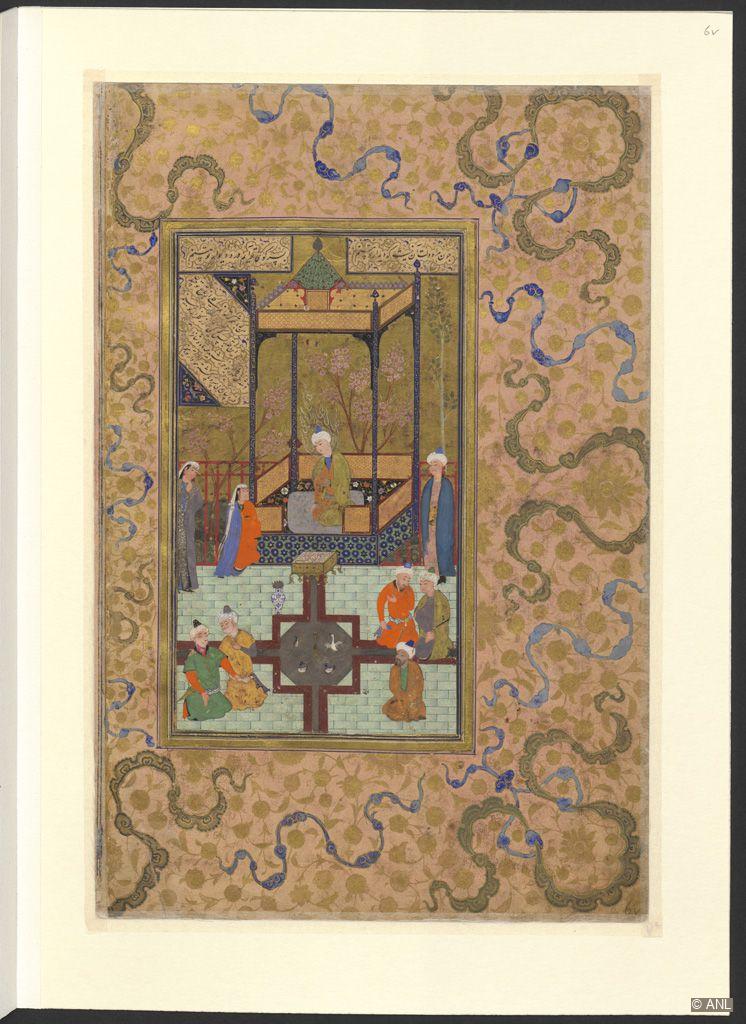
Fol. 6b includes a painting of the Egyptian Joseph on the throne, dated to 963 AH/1555-56 AD in Bukhara. The frame board reflects golden floral spiral tendrils and stylised blue and green cloud bands against a pink background. Yusuf, the Egyptian Joseph is mentioned in the subsequently attached ten half-verses of a ghazals of Jami at the top of the image. Below, he is clad in yellow-orange and is sitting on a fenced garden terrace behind a square water basin with water channels arranged crosswise to it. A high, richly decorated and turreted canopy rises above Yusuf, elevating him above his surrounding congregation. Yusuf's holiness and dignity as ruler is emphasised by a flaming halo around his head. To the left of the canopy sits Zulaikha in an orange-red dress and a bright blue cloak, her left veiled hand raised to her chin while Yusuf appears to be leaning towards her. On either side of them, against the frame, a servant and a lady-in-waiting are standing. In the foreground, seated around the basin enlivened by ducks, are groups of conversing men. The landscape in the background is indicated by delicate flowering trees with pink blossoms before a golden background. The border decoration as well as the text itself indicate that this painting and the one on fol. 29a had originally formed a double page in the album and were probably separated in the 18th century when the album was re-bound. The paintings are stylistically very similar and likely painted by the same artist in Bukhara, who signed as Mahmud Mudahhib on fol. 29a and also included the date of 963 AH / 1555-56 AD. He was the most famous book painter of Bukhara and was described as a mudahhib, meaning ‘gilder’ or ‘illuminator’. Mahmud seems to have worked first in Herat at the court of Sultan Husain Bayqara, where he must also have known Behzad, by whom he was visibly inspired. He is known from historical sources and numerous works attributed to him or signed by him still survive. After the decline of the Timurid dynasty in Herat, many artists, including Mahmud, came to the Shaybanid court in Bukhara, through which the courtly style and that of Behzad were transferred from Herat to Bukhara.
On fol. 7a, the portrait of a young European from the first quarter of the 17th century in, potentially, Isfahan, is pasted into an elaborate frame board. The frame is richly and colourfully decorated with Ottoman floral and foliate designs – including palmettes, flowering buds, and leafy branches – in gold, red, purple, green, blue, and black. This frame only appears once in the album and was probably created in the 18th century. The transitional frame consists of gold arabesque bands on a blue background. The painting shows a figure within a background filled with delicate gold tendrils, standing with slightly bent knees. The young man is wearing a black hat, white ruff around the neck, and yellow armbands on a light green jacket, which correspond to traditional European costume of the time. The rest of the clothing is rather Persian in style, including a blue robe, pink trousers, and golden slippers. Judging by this costume, it could be the representation of either a Portuguese or a Dutchman. He holds a slightly opened golden book in his crossed hands and gazes pensively into the distance. On the right, approximately at knee height, is a delicate inscription: katabahu Riza (‘Written by Riza’). This is a foreign attribution, as the famous painter named Riza-i 'Abbasi was neither in the habit of signing in this unusual formulation, nor does the signature reflect his writing. The painting was likely made by an artist in the school of Isfahan.
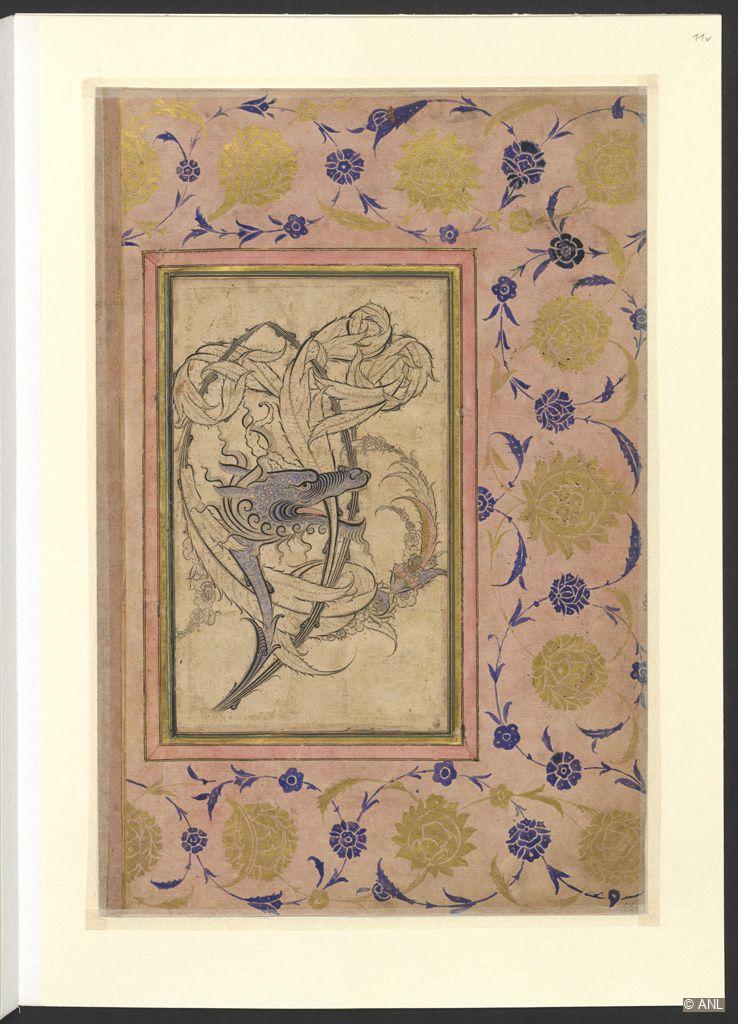
Fol. 11b includes a tinted reed pen drawing of a dragon’s head in foliage from c. 1550-70 made in Tabriz or Istanbul, surrounded by a pink frame board with vines, flowers, and palmettes alternating in blue and gold. The blue-tinted dragon’s head is inscribed within an elaborately curved and rolled lancet foliage with flower umbels that are partially coloured in pink, growing out of a single branch at the bottom left corner. It is a dynamic interplay of forms that needs to be visually deciphered by the viewer. The dragon’s curly mane, the wrinkly snout, and the horn protruding from its forehead reveal that the dragon is related to East Asian models. It is biting into a leaf and framed by a longer branch for emphasis.
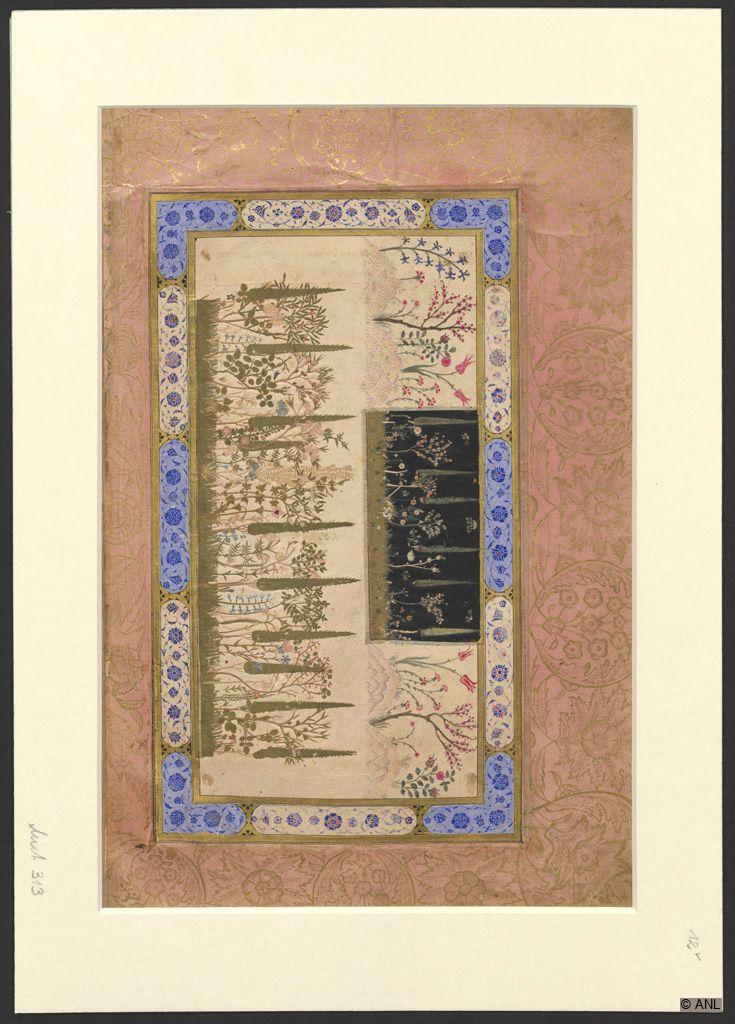
On fol. 12b, two coloured paper-cut compositions with complementary paintings are shown, dating to late-16th or early-17th-century Istanbul. The frame board consists of large golden floral motifs including palmettes and leafy branches on a pink ground. The transitional framing consists of floral tendrils in alternating white and light blue cartouches interspersed with gold. The paper cut-outs within were likely not created specifically for this album but removed from their original context and pasted in in such a way that it is necessary to turn the page in order to view them horizontally. The smaller composition in the top zone is centrally executed on black paper and inserted into the large white sheet, which has been cut out rectangularly for this purpose. This oblong composition shows a grassy ground line with flowers as well as alternating high cypress trees and flowering trees. A small heron and other creatures such as a frog and butterfly can be seen between the plants. Small and stylized Chinese-style clouds hover above the garden. It is accompanied on both sides by related floral decorations that are painted on the sheet. The drawings include individual coloured flowers on tiny hills that can be botanically recognizable. In the zone below, another row of cypresses, flowers, and flowering shrubs on a lawn line are pasted in close succession on the paper ground. The delicacy of the work reveals its minute execution: the individual petals and stamens of some flowers were not only glued next to each other but also on top of each other, thus creating a delicate relief effect. For the sake of its ornamental character, the depiction defies any proportional scale. It is possible that these unsigned depictions were made by the famous Turkish scissor cutter named Fakhri. He hailed from Bursa, worked for the Sultans Ahmad I and Murad IV, and is said to have died in 1027 AH/1618 AD. As such, they could have also been added to the album at a later point.
Fol. 14a includes an ensemble of calligraphies, likely from various sources in 16th-century Persia or Istanbul, surrounded by a frame board of black geometric lattice work with polychrome or gold Ottoman composite flowers and leafy vines, some delicately coloured. In its division and decoration, it is the counterpart to fol. 13b: a richly decorated central field with diagonally arranged nasta’liq script. The large script is written over the delicate gold painting of a large palmette, and the triangular spandrels are richly coloured with flowers and arabesques. An ornate frame with smaller and larger hexagonal cartouches also including nasta’liq script surrounds the main field. The calligraphy sections have been cut out individually, pasted on, and supplemented with decoration. Neither the vertically placed verses in large script nor the smaller verses could be identified. However, the writing in the main field is signed by 'Ali al-Katib in the lower left corner spandrel. This is Mir 'Ali al-Harawi al-Husaini as-Sultani, who was probably born in Herat towards the end of the 15th century. He was later located in the workshop of Sultan 'Ali al-Mashhadi in Mashhad, then lived again in Herat until the city was conquered by 'Ubaid Khan Uzbak in 935 AH/1528-29 AD. Afterwards, he came to Bukhara as a prisoner of war, where he lived and worked until his death. A work signed by him is in the British Library (Or. 5302), and other calligraphic specimens can also be found in this particular album. Moreover, the calligrapher of the smaller verses can be identified as Shah Mahmud an-Nisaburi, called Zarinqalam (Gold Pen), who was born c. 892 AH/1486-87 AD in Nishapur and first lived in Tabriz at the court of Shah Tahmasp. When the latter turned away from artistic matters, the calligrapher went to Mashhad, where he died after some years of fruitful activity in 972 AH/1564-65 AD. He is one of the most important Persian calligraphers of the Safavid period and left numerous works; his signature – here at the bottom centre in a small triangle – can also be found on other pages of this album, for example fol. 13b.
On fol. 18b, a tinted drawing of the story of Rustam pulling the Khaqan of China with a noose from the elephant can be seen, dating to late-16th or early-17th-century Tabriz. It was pasted into a frame board of light blue with gold diamond-shaped lattice design through which tendrils in a different hue of gold are winding. This scene is from the Shahnama (‘Book of Kings’) where Rustam, in his characteristic tiger caftan and leopard helmet, is charging forwards on his horse and has thrown his rope around the head of the emperor of China, who sits enthroned on an elephant with a small servant sat behind him. The drawing is executed in black ink and grey wash against the paper background, which is decorated with scattered flowery shrubs and stones. The saddles and armour are partly coloured in pink and gilded. On the lower right is the signature Qalam-i Kamal (‘From the pen of Kamal’). Whether the signature is authentic or a later attribution cannot be determined. Kamal from Tabriz was the pupil of Mirza 'Ali, the latter son and pupil of the painter Sultan Muhammad, who was the court painter of Shah Tahmasp in Tabriz. Kamal and his teacher were particularly known for their drawing technique. He was working in Tabriz from the end of the 16th to the beginning of the 17th century, when this drawing was made. The drawing was clearly inserted into the album in a later phase of decoration as it does not quite fill the overall central space; at the top, a small panel in coloured paper with golden decoration is visible. Moreover, the page needs to be turned in order to see the drawing in its horizontal format. Above and below the reed pen drawing, undecorated lines in nasta'liq script reveal a ghazal of the Diwan of Husaini (Sultan Husain Bayqara), belonging to the verses of the previous pages and also pasted onto later folios. These were perhaps already cut out in the 15th century, or at least before 911 AH/1506 AD. The cut-outs are part of an incomplete manuscript of the Aya-Sofya Library in Istanbul together with an album page (no. 404) in the Chester-Beatty-Library in Dublin, Ireland.
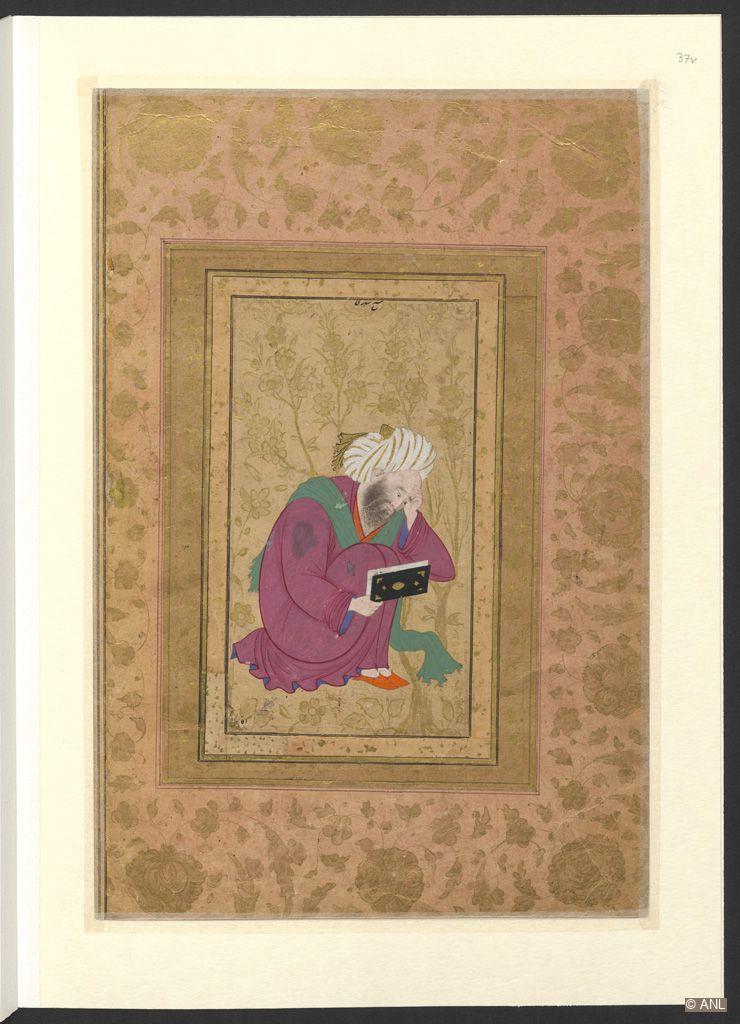
Fol. 37b shows the depiction of an old man reading, from mid-17th-century Isfahan. It is pasted into a frame board of gold floral design on a pink background. The inscription at the top reads ‘Shaikh Sa’di’; however, since this poet had already been dead for 400 years at the time the painting was made, this must be an attempt at identification at a later time. The elderly man is depicted in a sitting position, with his knees brought to his chest, in an abstracted golden landscape underneath towering flowers and clouds. He wears a large turban, a purple dress, a turquoise shawl, and orange slippers. He is holding an open book with black covers and gilded embossing in his right hand, and touches his forehead in a pensive gesture with his left hand. His facial features, including the long beard, are delicately painted, revealing the painting’s highly accomplished execution. The painting appears to have later been attributed to Riza-i 'Abbasi, as the word Aqa is added at the bottom left corner, as the painter was also referred to as Aqa Riza. However, the artist did not sign his works with this name. It is likely that the painting was made by one of the artist’s pupils as it is different in movement, colour, and transparency from the master’s works.
On fol. 42a, two drawings are pasted into the central space, surrounded by a frame board of ivory-coloured, gold-sprinkled paper including five, differently coloured cartouches partly glued on or inserted into it. The multiple transitional frames include another border of blue-coloured gold-sprinkled paper. The reed pen drawings are pasted on a greyish and pink background. The drawing at the top in hexagonal format shows a battle between a dragon and a lion in a circular, very decorative arrangement, which was gilded in some places. The dragon’s long body is wrapped around the lion, yet the lion also has also sunken his claws and teeth into the dragon’s body who is trying to bite off the lion’s hind leg. Both animals are related to Eastern Asian models. The drawing was likely made in the second half of the 16th century in either Tabriz or Istanbul, potentially a motif intended for a different medium. The drawing underneath is an ink drawing with grey washes, showing the visit to the hermit in a vertical landscape composition with towering rocks, a large gnarly tree and clouds in the background, and the scene of three figures in the foreground. An old man and a boy on the left are conversing with the bearded, slightly emaciated, ascetic hermit on the right. Between the visitors and the ascetic, a small stream lined with flowers is visible. A gazelle buck is witnessing the scene from behind the rocks in the top right corner. It may be a scene from the story of Layla and Majnun. The very finely executed drawing appears unfinished, and was probably made in Qazwin around 1560.
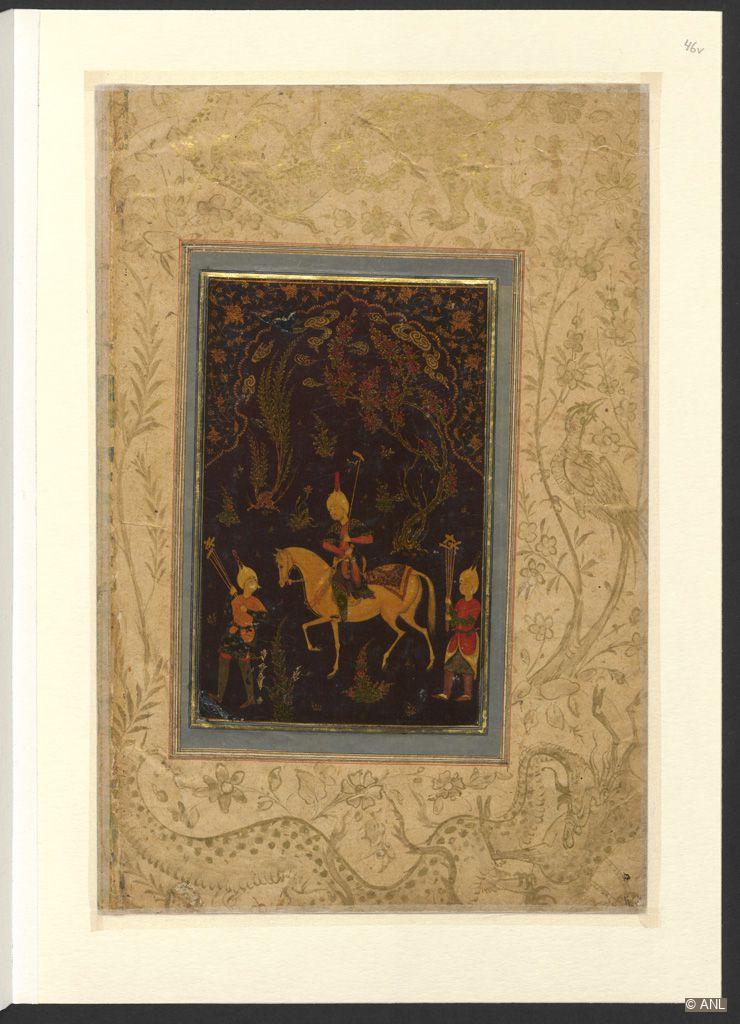
Fol. 46b reveals a lacquer painting of a horseman with two servants on the way to a polo match, likely created in Tabriz in around 933-940 AH/1527-33 AD. It is pasted within a frame board with gold painting of plant life, birds as well as a dragon and a lion attacking a gazelle each. The painting has an elaborate multi-pronged ‘Indian’ arch with delicate reddish-golden floral patterns above the main scene on a black ground. Underneath, a rider on a golden-bridled white horse is riding through a lush landscape with two servants on foot in front and behind him. While the rider is only carrying one polo stick, the two attendants are carrying multiple ones. Their faces are finely modelled. The landscape includes decoratively arranged trees with bent branches and blossoms as well as flowery shrubs. Chinese-style clouds are visible at the top. The contours of the plants and the men’s robes are drawn in gold paint; the red, orange and gold tones shimmer warmly on the black-brown lacquer ground. It is one of seven lacquer paintings in the album that are stylistically close to the artistic circle around Behzad, for example the painters Sultan Muhammad and Shaikh-zada, although Sultan Muhammad's inspiration seems to dominate. The painting is comparable to the Fogg Art Museum's Diwan of Hafez, executed for Sam Mirza (923-984 AH/1517-1576-77 AD), son of Shah Isma'il, in around 933-40 AH/1527-33 AD, probably in Tabriz. The polo player in the centre may potentially be a portrait of Prince Sam Mirza, who is even depicted twice in the Diwan, once even including the inscription of his name. This specimen is among the earliest surviving figurative lacquer paintings in Persianate art. Their maker may have been Muhammad Bek, a son and disciple of Sultan Muhammad. Their original purpose is unclear; however, since the other lacquer paintings also show symmetrically and decoratively assigned figures or animals, whereby their number visibly plays a role, it is possible that they represent playing cards or models for such cards. Exactly corresponding early Persian playing cards have not yet been found. Playing cards were unknown in Turkey in the 16th century and for a long time thereafter, which makes it understandable that they were put in the album as works of art.
This item has been added to the Database within the Explore Islamic Art Collections project. Information is available in: English, Arabic.
Name of Object:
Muhammad Jandarajizada (?), Muraqqa' (Album)
Location:
Vienna, Austria
Holding Museum:
Austrian National Library (ANL)
About Austrian National Library (ANL), Vienna
Date of Object:
980 AH /1572-73 AD+G5
Scribe(s):
Haidar al-Husaini
Museum Inventory Number:
Mixtus 313
Material(s) / Technique(s):
Ink, colour and gold on paper.
Dimensions:
333 x 222 mm, 52 folios
Period / Dynasty:
Ottoman
Provenance:
Istanbul
Binding:
The binding with which the album came to the Austrian National Library was one of red morocco with gold-pressed decoration, originating from 18th-century Turkey.
Description:
This muraqqa‘ (album) was compiled for the Ottoman Sultan Murad III (reigned 1574-1595) in Istanbul in 980 AH/1572-73 AD. The term muraqqa’ (‘patched garment’) refers to the patchwork character of the collection of calligraphy, drawing, and painting in codex-format, which was significant for Safavid and Ottoman cultures as a means of collecting and displaying artworks. Likely created according to a systematic and aesthetic process of selecting materials, the specimens of this album were arranged in a particular order. It includes 18 ornamental pen-and-ink drawings, eight figural pen-and-ink drawings, 16 paintings, eight figural lacquer paintings, eleven pages with paper cutting, and 54 pages with calligraphy as the main motif. These specimens are mounted within perforated boards of variously decorated frames. The introduction to the album names a certain Muhammad Jandarajizada as its artistic compiler, while the scribe’s name is Haidar al-Husaini. The dedication to Sultan Murad III can be found on fol. 2b, and it appears that it was gifted to him at least two years after its completion. A red lacquer seal of Franz von Ottenfels-Gschind, the Austrian internuntius in Constantinople, on fol. 1a reveals the person who brought the album to Austria as a diplomatic gift for the Austrian emperor, after which it became part of the Austrian National Library in 1833-34.
How date and origin were established:
One colophon: 980 AH / 1572-83 AD
How Object was obtained:
Baron Franz von Ottenfels-Gschind, Austrian Internuntius at Constantinople, donated the album to the Austrian National Library in 1833/34.
How provenance was established:
On fol. 2b, dedication to the reigning Sultan Murad Khan ibn Sultan Selim Khan. On fol. 48b, a cut-out and affixed owner's stamp of a so-called Mustafa as-Selaniki with the date 978 AH / 1570-71 AD. On Fol. 1a, red lacquer seal of Baron Franz von Ottenfels-Gschind incnluding the name Ottenfels and an Arabic motto in Arabic script.
Link to catalogue/digitisation in Holding Institution’s database:
http://data.onb.ac.at/rec/AC14387500
Selected bibliography:
Duda, Dorothea, Islamische Handschriften I. Persische Handschriften, Die illuminierten Handschriften und Inkunabeln der Österreichischen Nationalbibliothek, vol. 4, Vienna: Verlag der Österreichischen Akademie der Wissenschaften, 1983: 109-160.
Froom, Aimée, A Muraqqa' for the Ottoman Sultan Murad III (r. 1574-1595). Österreichische Nationalbibliothek, Codex Mixtus 313, New York: New York University ProQuest Dissertations Publishing, 2001.
Citation of this web page:
Theresa Zischkin "Muhammad Jandarajizada (?), Muraqqa' (Album)" in Explore Islamic Art Collections. Museum With No Frontiers, 2026.
https://islamicart.museumwnf.org/database_item.php?id=object;EPM;at;Mus24;24;en
Prepared by: Theresa Zischkin
Copyedited by: Sophie-Anne Mullen
MWNF Working Number: AT4 24
RELATED CONTENT
Islamic Dynasties / Period
On display in
Exhibition(s)
Water in Islam
The Symbolism of Water in sacred Texts, secular Literature, and Science | Water in Human Creativity: Literature, Poetry, and EpicsDownload
As PDF (including images) As Word (text only)