

 Back
Back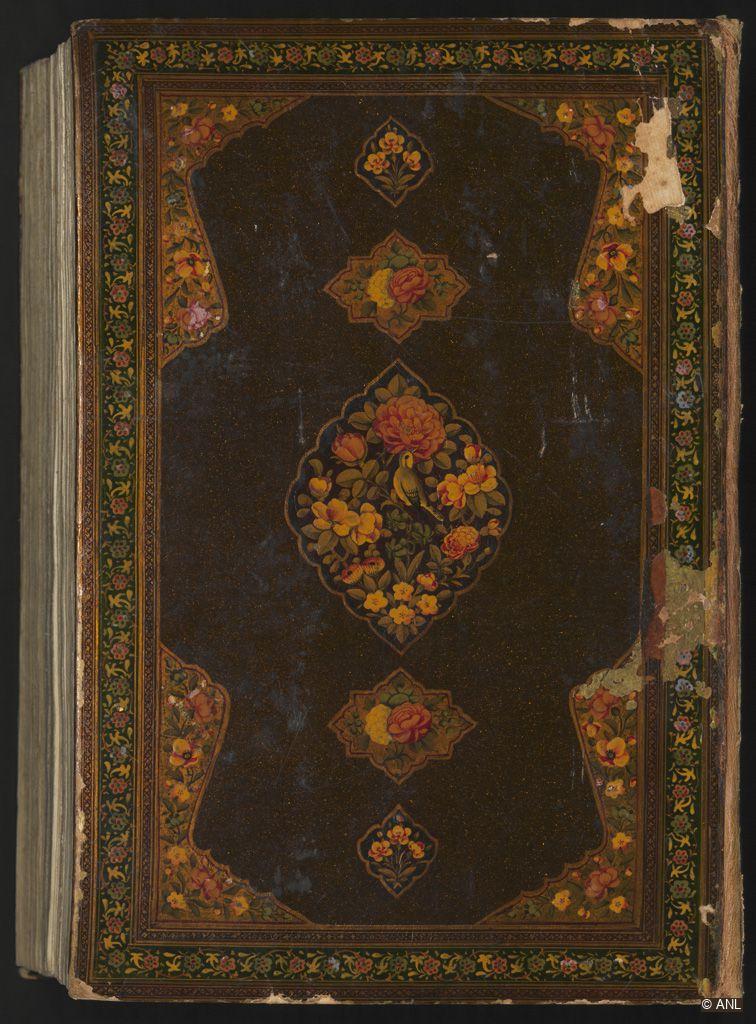
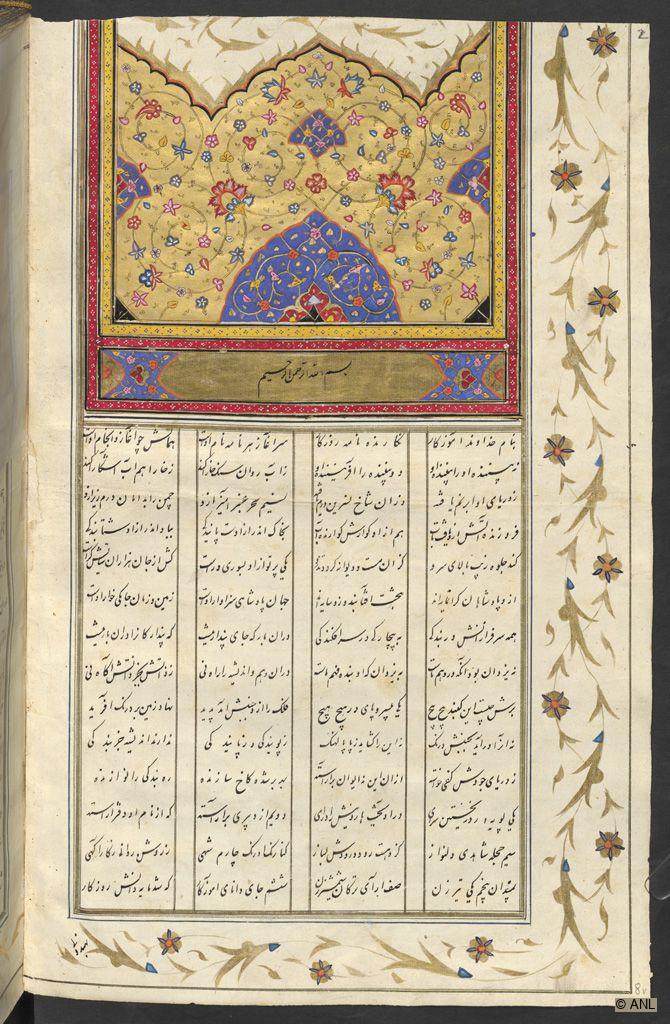
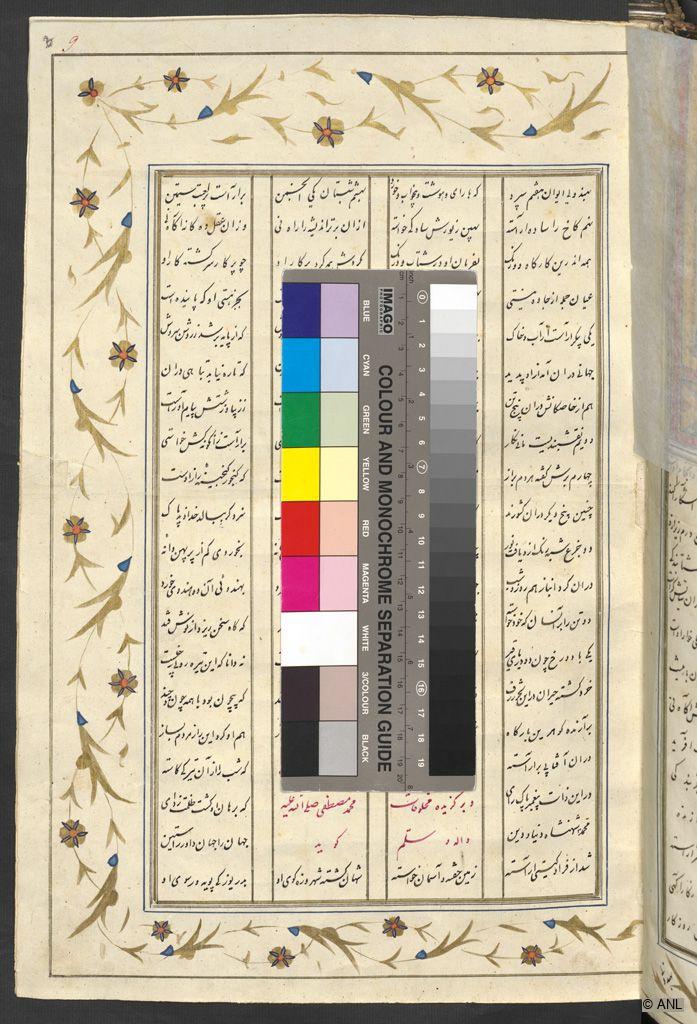
On fol. 8b, an initial decorative field ('unwan/sarlauh) is visible above the four columns of text. The decoration within the serrated gold field is overlaid by blue diamond motifs and spirals decorated with blue and pink flowers. Underneath it, the title cartouche is shown with similar ornamentation, and in the outer and lower margins, golden flowery vines are delicately drawn.
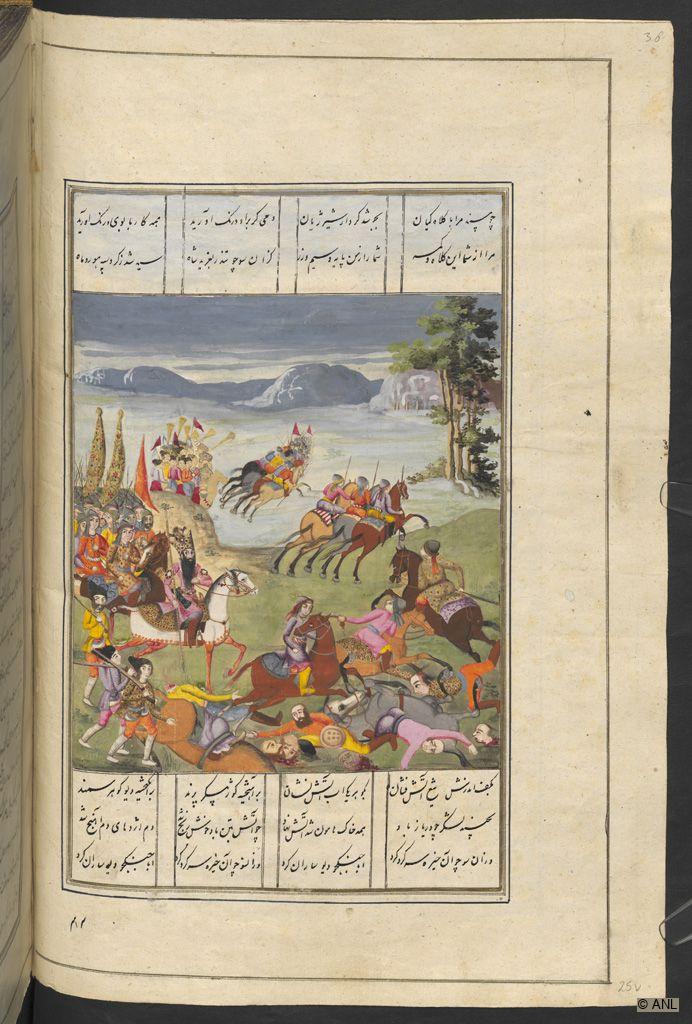
Fol. 25b incorporates a large rectangular painting in the centre of the text block, with two lines of text at the top and three lines of text at the bottom of the page. The painting depicts the battle between Fath ‘Ali Shah and Sadiq Khan Shaqaqi near Qazwin, Iran. Sadiq Khan was an insurgent who was defeated by the Shah. Within a pale green foreground and a greyish landscape in the background, a lively battle is taking place. On the left, Fath ‘Ali Shah is shown on a white horse that is partly dyed red with henna. He is wearing a crown, luxurious garments, and his characteristically long beard. A group of helmeted riders with standards as well as foot soldiers with guns are following behind him. More troops are charging forward in the background, cheered on by trumpeters. In the immediate foreground, chaos unfolds with the depictions of fallen and galloping horses, beheaded men and rolling heads, which conveys the wild fighting in bright colours.
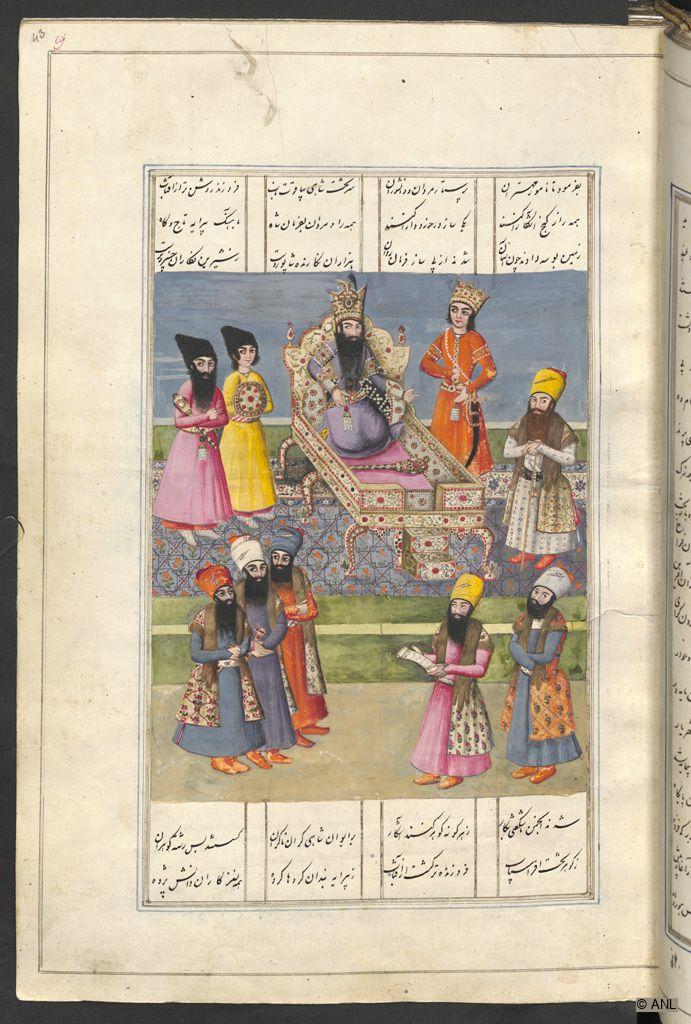
On fol. 29a, a large rectangular painting is shown in the centre of the text block, with three lines of text at the top and two lines of text at the bottom of the page. Fath 'Ali Shah, in a purple robe, on the peacock throne, with his son next to him, clad in orange and wearing a crown. Fath 'Ali Shah is depicted gesturing towards his heir, yet his gaze is directed to the two attendants bearing ornate objects to the left. The court master of ceremonies is standing with a cane on the right side. In front of the green foreground and grey-blue background, the court officials and the secretary stand out vibrantly, with the latter holding a diploma from the Shah, announcing the forthcoming enthronement festivities.
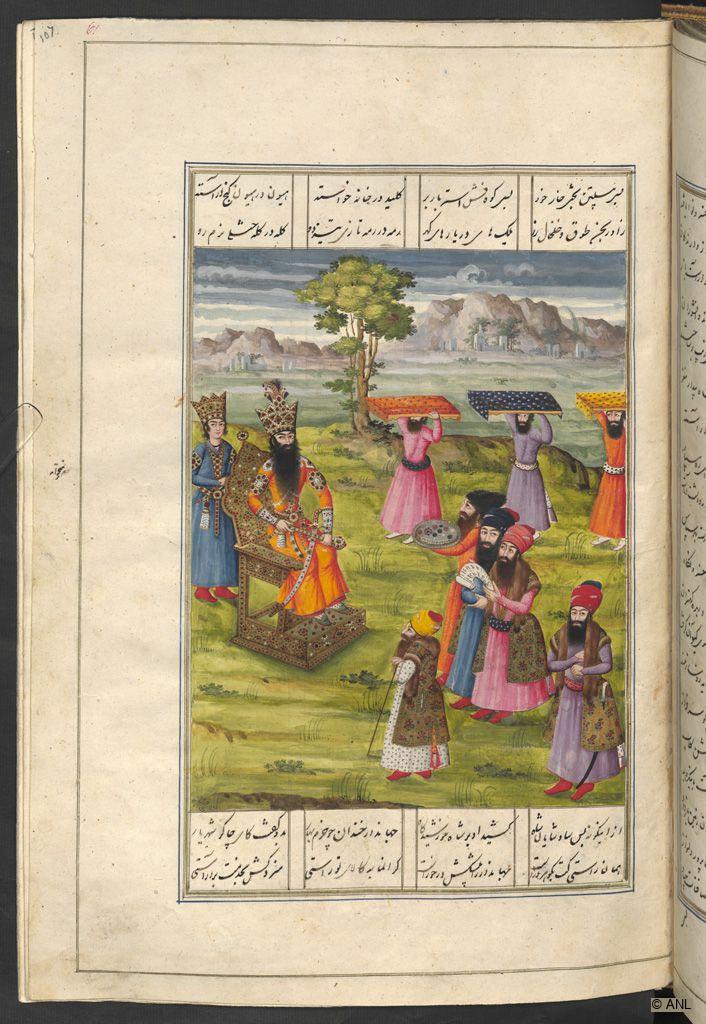
Fol. 61a incorporates a large rectangular painting in the centre of the text block, with two lines of text above and below the illustration. The painting depicts Mirza Rida Quli Munshi al-mamalik, entertaining and presenting gifts to the Shah in Sawdasht during a journey. Fath 'Ali Shah is seated on the famous Naderia Throne, a gemmed and enamelled throne made by his order. He is wearing elaborate decorated orange garments and a high crown with suitable ornaments. Behind him stands a prince with a similar, yet less elaborate crown. The grassy fore- and middle-ground is populated by groups of figures on the right side, facing and walking towards the Shah. The courtiers in gold brocades and colourful robes or pink, purple, orange-red and blue present gifts such as textiles and gems, one man even bearing an opened scroll. from which he may be reading. In the distance, a blue-green blurred landscape in European-style painting, with a small village or ruins, can be seen.
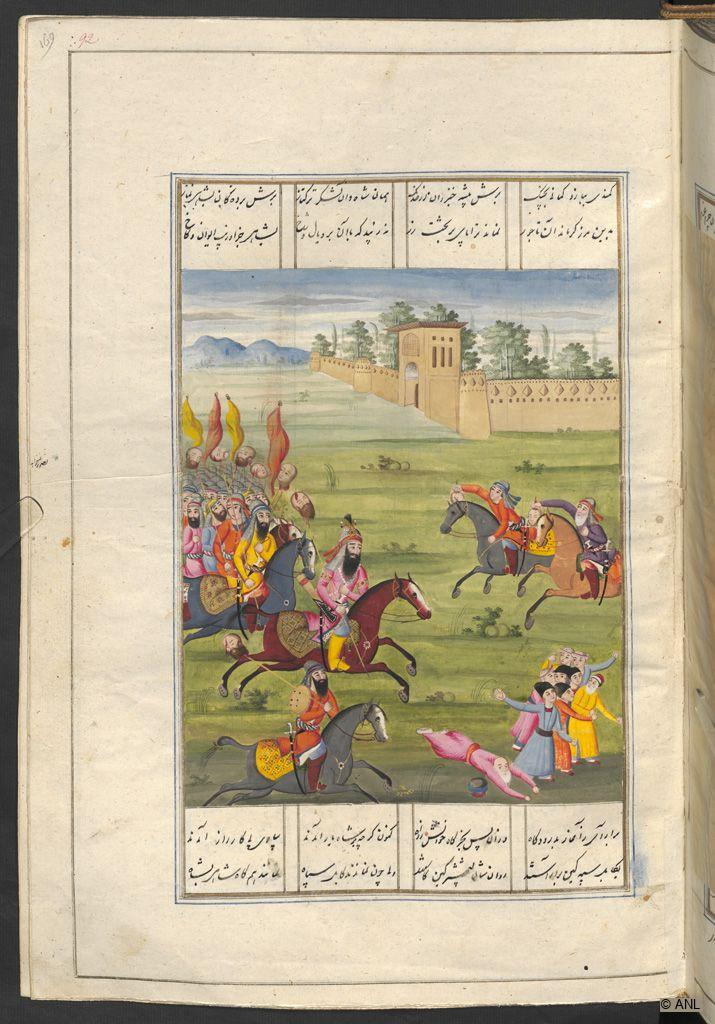
On fol. 92a, a large rectangular painting is shown in the centre of the text block, with two lines of text at the top and bottom. It depicts a scene from the time of Fath 'Ali Khan Qajar (1686-1726), the great-grandfather of Fath 'Ali Shah, who is said to have entered Isfahan with the severed heads of his enemies as victory trophies. Fath 'Ali Khan Qajar defeated the Afghan dynasty, which had struggled for power with the last Safavids and the Zand dynasty. He is seen at the head of his army outside the city walls pictured in the background, charging forward with the heads of his enemies raised on long spikes that he and men of his army are carrying. Two riders gallop towards them, also holding up severed heads. In the bottom right corner, citizens of the city appear to be in turmoil and fleeing from the violence. One elderly man with a long white beard has already fallen, his turban lying next to him.
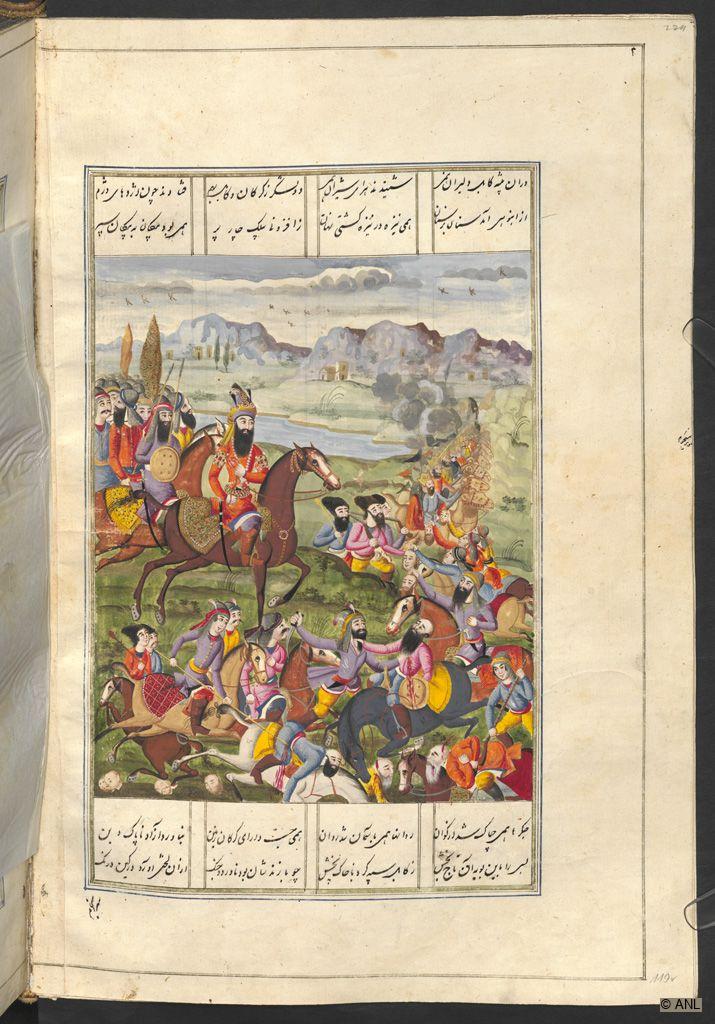
Fol. 119b incorporates a large rectangular painting in the centre of the text block, with two lines of text at the top and bottom of the illustration. The painting depicts a battle between Muhammad Hassan Khan Qajar (1715-59), the grandfather of Fath 'Ali Shah, and his enemy Azad Khan Afghan (d. 1781). The shah approaches with his troop from the left, in luxurious garments with a bejewelled turban. In the immediate foreground, the battle is already in full effect, with blood spraying from injured bodies. Some riders hold up severed heads as if presenting them to the shah. In front of the European-style background with small buildings, a group of camel riders extends in a lined-up position into the distance. The dynamically dense battle scene is accompanied by vividly coloured garments in pink, purple, blue, red, orange, and yellow.
This item has been added to the Database within the Explore Islamic Art Collections project. Information is available in: English, Arabic.
Name of Object:
Fath 'Ali Khan Shaba of Kashan, Shahanshah-nama (The Book of the King of Kings)
Location:
Vienna, Austria
Holding Museum:
Austrian National Library (ANL)
About Austrian National Library (ANL), Vienna
Date of Object:
c. 1225 AH / 1810 AD
Scribe(s):
'Abd al-Wahhab Musawi, Muhammad Husain(i) al-Haqir (?) Bahir ibn Hasib-Allah
Museum Inventory Number:
A.F. 1
Material(s) / Technique(s):
Ink, colour and gold on paper. Calligraphic cursive nasta'liq script of 20 or more lines per page.
Dimensions:
390 x 260 mm (280 x 175 mm), 439+1 folios
Period / Dynasty:
Qajar
Provenance:
Isfahan
Binding:
The lacquer binding has a light-brown leather spine. A floral band with corner fillings incorporating multi-coloured flowers frames the central medallions with two pendants each at the top and bottom on the front cover. In the medallion, a small bird’s nest is seen amongst peonies and other flowers on a black background. In the pendants situated above and below the centre medallion, more peonies and pansies are depicted. The undecorated parts of the cover are black-brown with gold speckling. The back cover is attached upside down and is identical to the front cover apart from the bird depiction in its centre. It is made in the Qajar style, likely in early-19th-century Isfahan.
Description:
The Shahanshah-nama (‘The Book of the King of Kings’) is a copy of an epic poem in honour of Fath 'Ali Shah (1772-1834), written by Fath 'Ali Khan Shaba of Kashan (d. 1238 AH / 1822-23) around 1225 AH / 1810 AD in Isfahan, Iran. There is no colophon, however, at the end of the preface, a certain 'Abd al-Wahhab Musawi from Isfahan names himself as the scribe in calligraphic cursive nasta’liq script. Another small note in shikasta script states the name of a certain Muhammad Husain(i) al-Haqir Bahir ibn Hasib-Allah. The manuscript was presented to Emperor Franz I in Vienna as a gift from Fath 'Ali Shah by the Persian ambassador. The 26 paintings included throughout the book were executed in the European-inspired Qajar style around 1225 AH / 1810 AD. The depictions of Fath 'Ali Shah and his court consist of portrait-like features, and the ruler’s insignia as well as the court costume are of great cultural-historical interest.
How Object was obtained:
Presented to Emperor Franz I in Vienna as a gift from Fath 'Ali Shah by the Persian ambassador.
Link to catalogue/digitisation in Holding Institution’s database:
http://data.onb.ac.at/rec/AC14412032
Selected bibliography:
Duda, Dorothea, Islamische Handschriften I. Persische Handschriften, Die illuminierten Handschriften und Inkunabeln der Österreichischen Nationalbibliothek, vol. 4, Vienna: Verlag der Österreichischen Akademie der Wissenschaften, 1983: 13-15.
Citation of this web page:
Theresa Zischkin "Fath 'Ali Khan Shaba of Kashan, Shahanshah-nama (The Book of the King of Kings)" in Explore Islamic Art Collections. Museum With No Frontiers, 2026.
https://islamicart.museumwnf.org/database_item.php?id=object;EPM;at;Mus24;25;en
Prepared by: Theresa Zischkin
Copyedited by: Sophie-Anne Mullen
MWNF Working Number: AT4 25
RELATED CONTENT
Islamic Dynasties / Period
On display in
Exhibition(s)
Download
As PDF (including images) As Word (text only)