

 Back
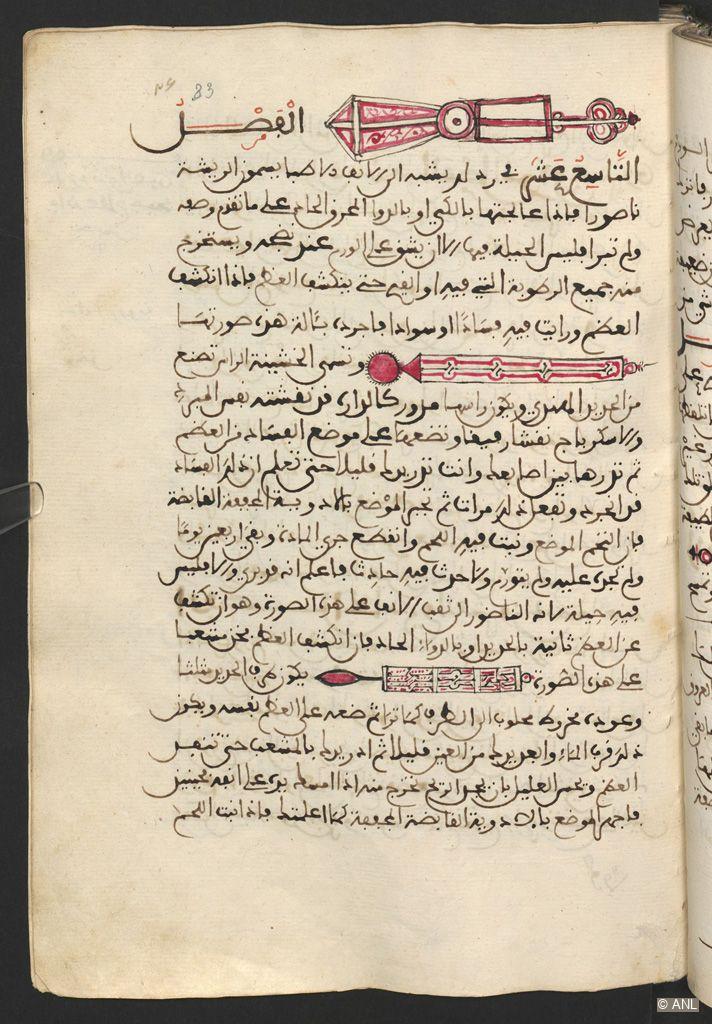
On fol. 33a we see three surgical instruments that are decorated with red ink. The depictions are placed in the middle of the text, doubling as placeholders between the different parts of the text as well as providing a visual representation of the parts of the text they are put next to.
The upper instrument depicts scissors that are to be used for eye surgery. Meanwhile the two other instruments are designed to remove fistulas from the nose.
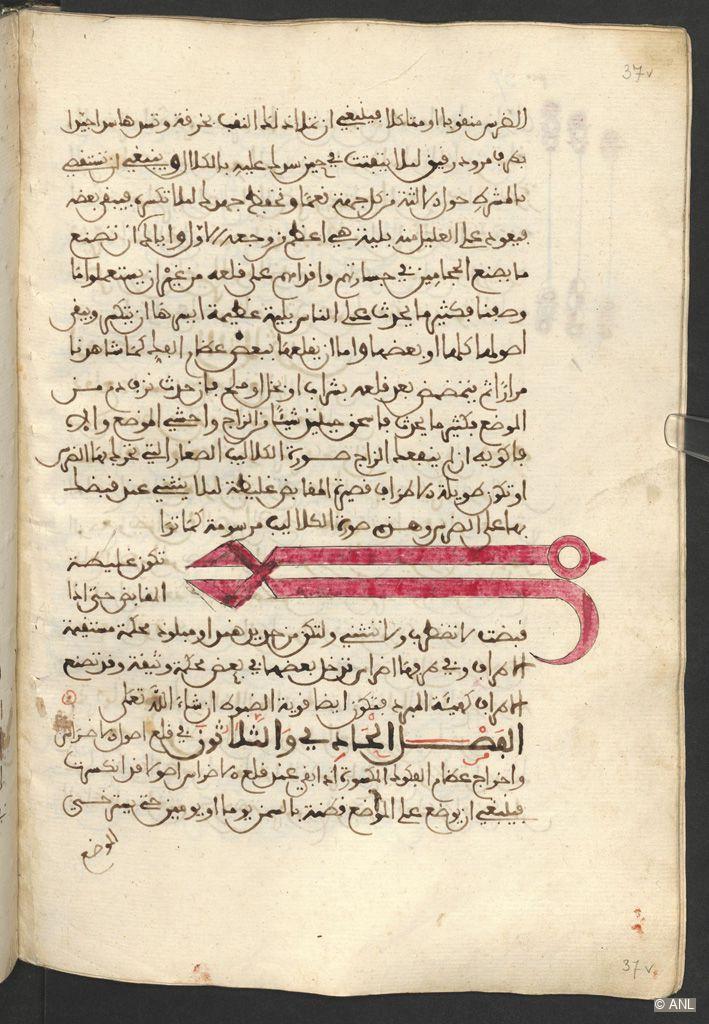
The illustration on fol. 37b is placed right underneath the two upper thirds of the text. It seems as though the text was disrupted at this point intentionally as a new chapter starts there. Such a break in the text is further emphasised by the elaborate font underneath the illustration, that throughout this manuscript is typically adopted at the beginning of new chapters.
The illustration depicts a pair of dental pliers that look fairly similar to the ones that are still in use today. Due to the precise execution of the straight lines and arches, It is apparent that alongside a ruler, a pair of compasses was also utilised for this illustration.
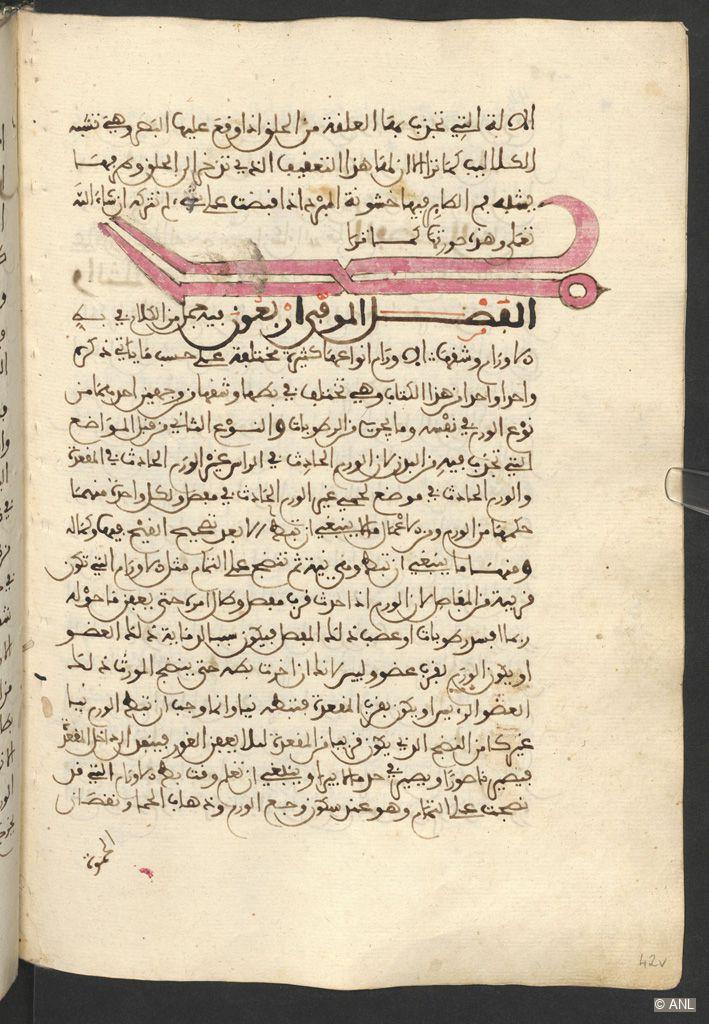
Fol. 42b depicts yet another pair of pliers, however this one is instead designed to perform tonsillectomies and several other kinds of throat surgeries. As is the case with the dental pliers on fol. 38a, amazingly the pliers in question, with their slanted tips, are not too dissimilar from those used in modern day tonsillectomies.
Given that the instrument is right above the title of a chapter, it makes it look as though it is more of an aesthetic choice to accentuate it rather than a separate illustration.
Evidently, this particular image must have been partly done with the help of geometric tools, as the lines and the upper handle of the pliers are rendered with great accuracy. However, the lower handle, due to its more uneven character, seems to have been painted freehand.
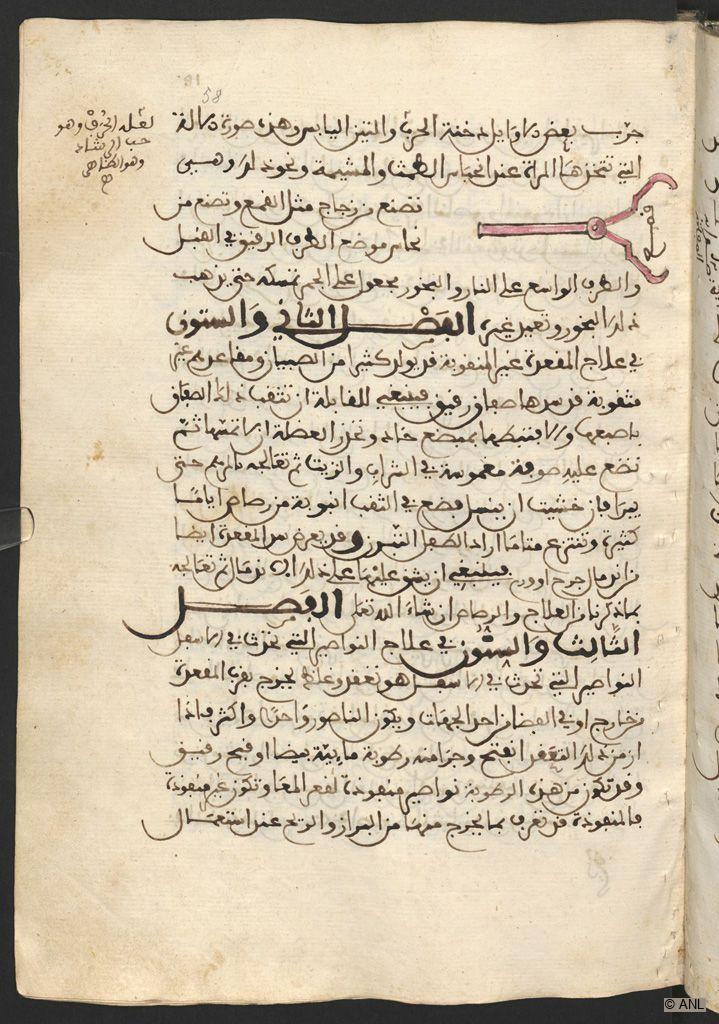
On fol. 58a there is an illustration of an opened obstetric forceps. Al-Zahrawi constructed many instruments for childbirth, including intricate devices which could be used as an aid during a caesarean-section. He was also the first known physician to describe an abdominal pregnancy in his works, as well as a birthing position that would be much later on known as the "Walcher position" in the field of obstetrics.
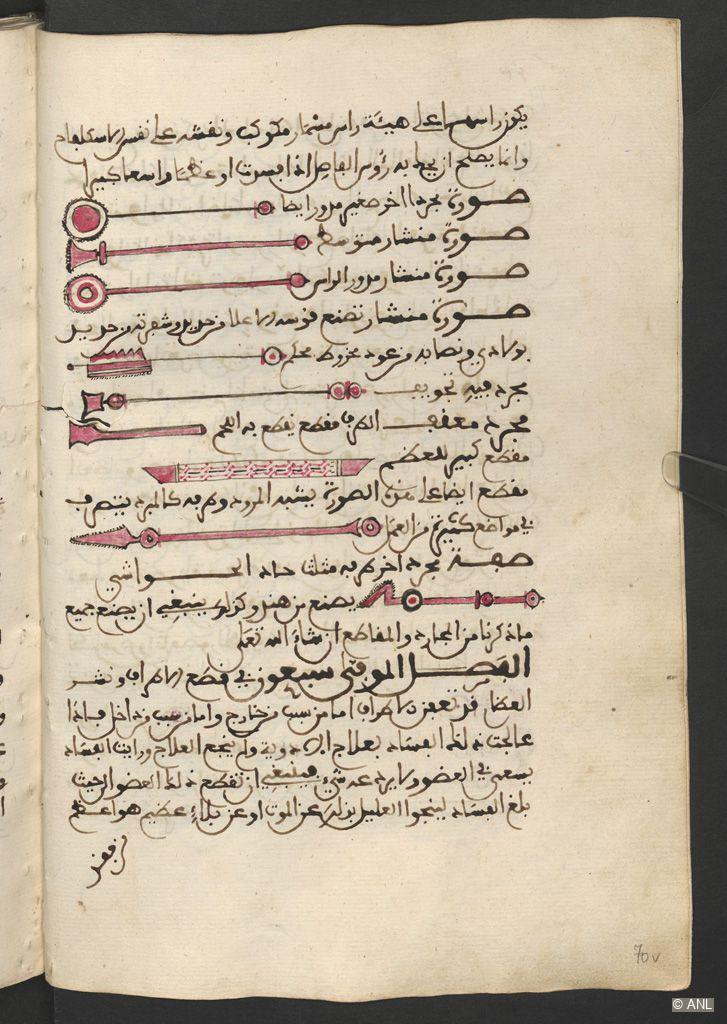
Fol. 70b serves as a display for an illustrated collection of nine different instruments used for surgery on the abdomen, bones or varicose veins. The instruments shown seem to be different kinds of scalpels and surgical saws.
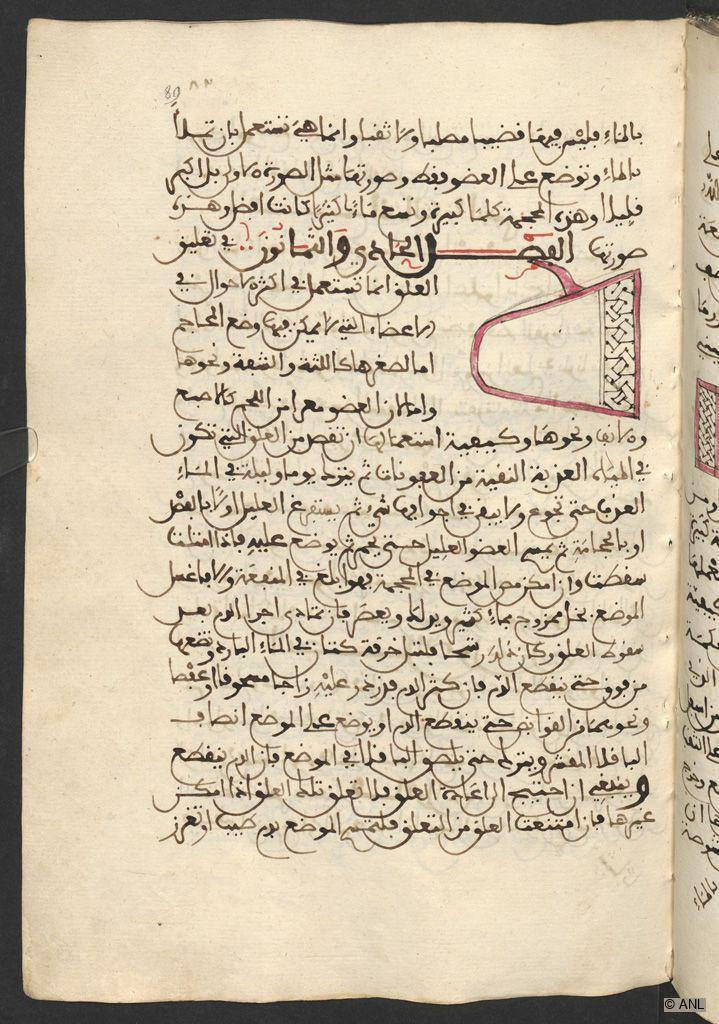
The cupping glass portrayed on fol. 89a is depicted from the side. Along its rim it is decorated with geometrical ornaments. Attached to the cupping glass is a kind of handle, that might be designed to help release the vacuum underneath the glass to remove it from a patient’s skin.
This item has been added to the Database within the Explore Islamic Art Collections project. Information is available in: English, Arabic.
Name of Object:
Kitab al-Tasrif li-man 'ajiza 'an al-ta'lif fi al-tibb (The arrangement of manifold medical knowledge for one who is not able to compile a book for himself: on surgery and instruments)
Also known as:
The method of medicine
Location:
Vienna, Austria
Holding Museum:
Austrian National Library (ANL)
About Austrian National Library (ANL), Vienna
Date of Object:
Late 11th century AH / late 17th century AD
Museum Inventory Number:
N.F. 476a
Material(s) / Technique(s):
Red, purple and black ink on paper. Calligraphic maghrebi script of 20 lines per page.
Dimensions:
300 x 210mm (220 x 145mm), 116 folios
Provenance:
Most likely Morocco
Binding:
Both front and back cover of this brown, Moroccan leather binding are decorated with an intricately cut out oval medallion that is embossed with floral ornaments. Further to this is a flap that also has an embossed medallion with floral ornaments on it, albeit a bit smaller and rounder than the ones on the covers.
Description:
Abu al-Qasim Khalaf ibn al-'Abbas al-Zahrawi al-Ansari, more commonly referred to as Al-Zahrawi, made a name for himself through the discoveries he made in the fields of surgery. This manuscript is the last volume of Al-Zahrawi's 30-part encyclopaedia on medicine and the human body that he compiled over the course of 50 years. In this volume the Arab-Andalusian surgeon goes into great detail about the techniques of surgery and the suitable instruments to perform various medical interventions, many of which he invented himself.
This particular manuscript contains some 158 illustrations of surgical equipment whose purpose seems to have been demonstrative in nature. Such an interpretation can be made due to the way in which these images were executed, suggesting that the motive for their inclusion had a more practical approach than an artistic one. Even so, despite this apparent lack of attention to technical drawing, this manuscript is of immeasurable value because of the impact its text had on the history of medicine as a whole. Al-Zahrawi was a pioneer in his field and paved the way for modern day surgery.
How date and origin were established:
The date and origin were established based on the style of the binding and the script of the manuscript.
How Object was obtained:
It is noted on fol. II that the manuscript was bought for the Imperial Court Library in Paris, for 15 guilders in 1860.
Link to catalogue/digitisation in Holding Institution’s database:
http://data.onb.ac.at/rec/AC14422207
Selected bibliography:
Al Samman, Tarif, "Medizin" in O. Mazal (ed), Kultur des Islam: Orientalische Handschriften der Österreichischen Nationalbibliothek, Vienna: Österrichische Nationalbibliothek, 1980: 152-153.
Duda, Dorothea, Islamische Handschriften II/1. Die Handschriften in arabischer Sprache, Die illuminierten Handschriften und Inkunabeln der Österreichischen Nationalbibliothek, vol. 5/1, Vienna: Verlag der Österreichischen Akademie der Wissenschaften, 1992: 139-141.
Citation of this web page:
Leonie Fernsebner "Kitab al-Tasrif li-man 'ajiza 'an al-ta'lif fi al-tibb (The arrangement of manifold medical knowledge for one who is not able to compile a book for himself: on surgery and instruments)" in Explore Islamic Art Collections. Museum With No Frontiers, 2026.
https://islamicart.museumwnf.org/database_item.php?id=object;EPM;at;Mus24;32;en
Prepared by: Leonie Fernsebner
Copyedited by: Jonathan Turnbull
MWNF Working Number: AT4 32