

 Back
Back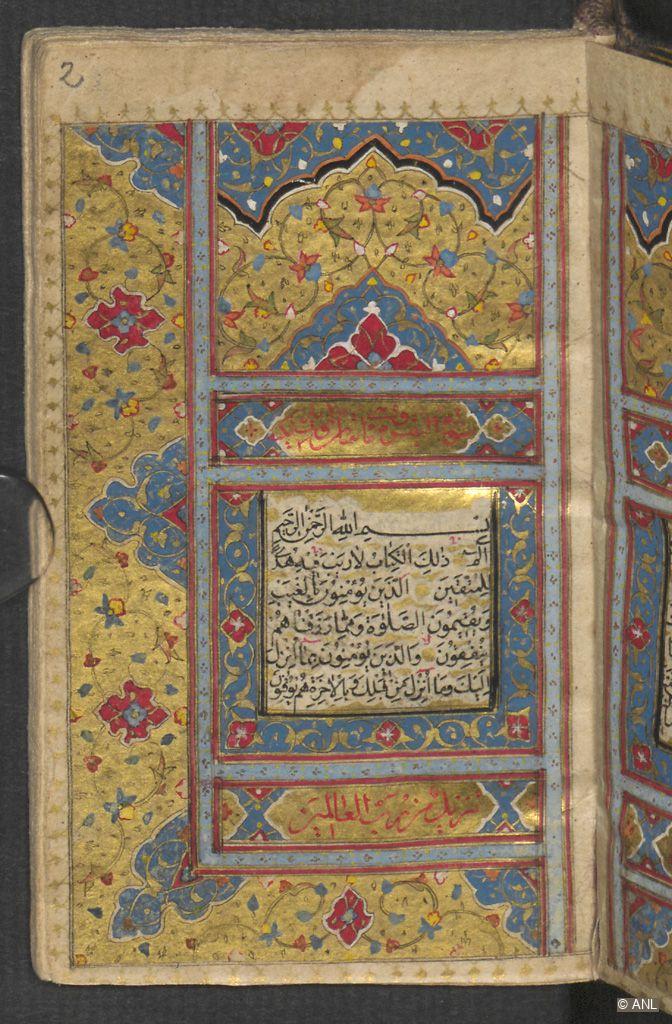
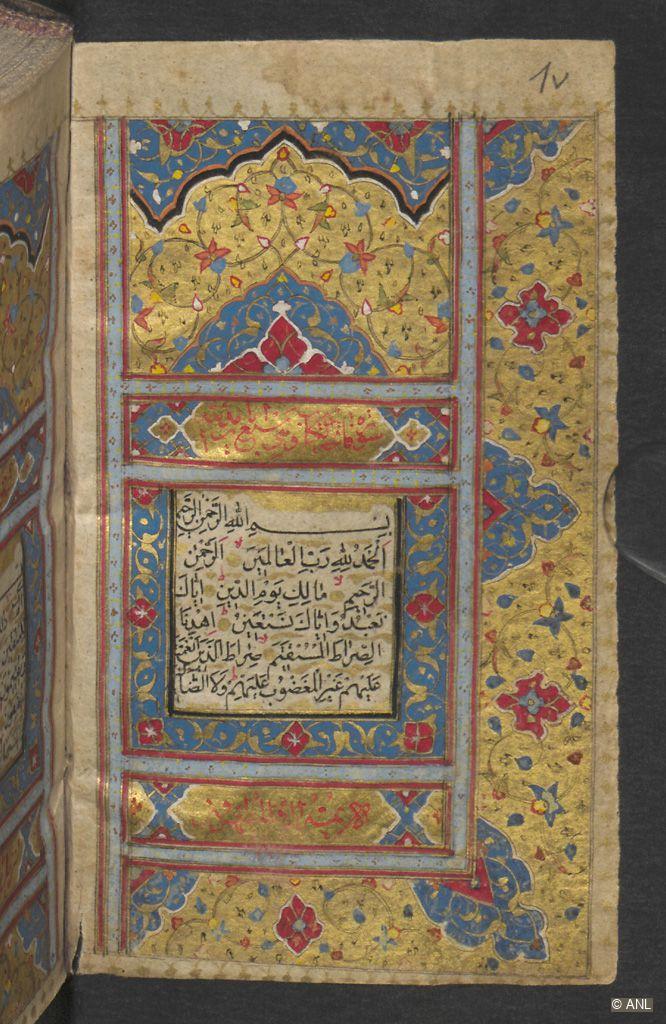
On fol 1b-2a, the symmetrical double-page opening is almost entirely gilt and covered with delicate floral designs within and outside of the text block. The rectangular text block consists of heading panels with red thuluth script at the top and bottom, and a black text before a golden within a square format. Around this text, the floral border of gold arabesques with red medallions before a blue ground reflects the same decorative colour scheme of the title panels and the marginal decoration. Overlapping serrated arches in red, blue and gold extend toward the top where reflections of the same ornaments on a blue background reside, incorporating floral buds in white and yellow. The lateral and lower margins are connected through a broad golden background with floral spiralling vines incorporating richly profiled blue quarter- and half-medallions as well as small dark red palmette medallions in alternating rows. The delicate golden trefoil row on the outer rim of this border is reminiscent of a ray pattern.
On fol 1b-2a, the symmetrical double-page opening is almost entirely gilt and covered with delicate floral designs within and outside of the text block. The rectangular text block consists of heading panels with red thuluth script at the top and bottom, and a black text before a golden within a square format. Around this text, the floral border of gold arabesques with red medallions before a blue ground reflects the same decorative colour scheme of the title panels and the marginal decoration. Overlapping serrated arches in red, blue and gold extend toward the top where reflections of the same ornaments on a blue background reside, incorporating floral buds in white and yellow. The lateral and lower margins are connected through a broad golden background with floral spiralling vines incorporating richly profiled blue quarter- and half-medallions as well as small dark red palmette medallions in alternating rows. The delicate golden trefoil row on the outer rim of this border is reminiscent of a ray pattern.
This item has been added to the Database within the Explore Islamic Art Collections project. Information is available in: English, Arabic.
Name of Object:
Miniature Qur’an
Location:
Vienna, Austria
Holding Museum:
Austrian National Library (ANL)
About Austrian National Library (ANL), Vienna
Date of Object:
AH 1172 / 1758 AD
Scribe(s):
Muhammad Hashim al-Isfahani
Museum Inventory Number:
Mixtus 1543
Material(s) / Technique(s):
Ink, colour and gold on paper. Calligraphic small naskh script of 20 lines per page.
Dimensions:
81 x 48mm (59 x 35mm), 231 folios
Period / Dynasty:
Likely Zand
Place of production:
Iran, likely Isfahan
Provenance:
Iran
Binding:
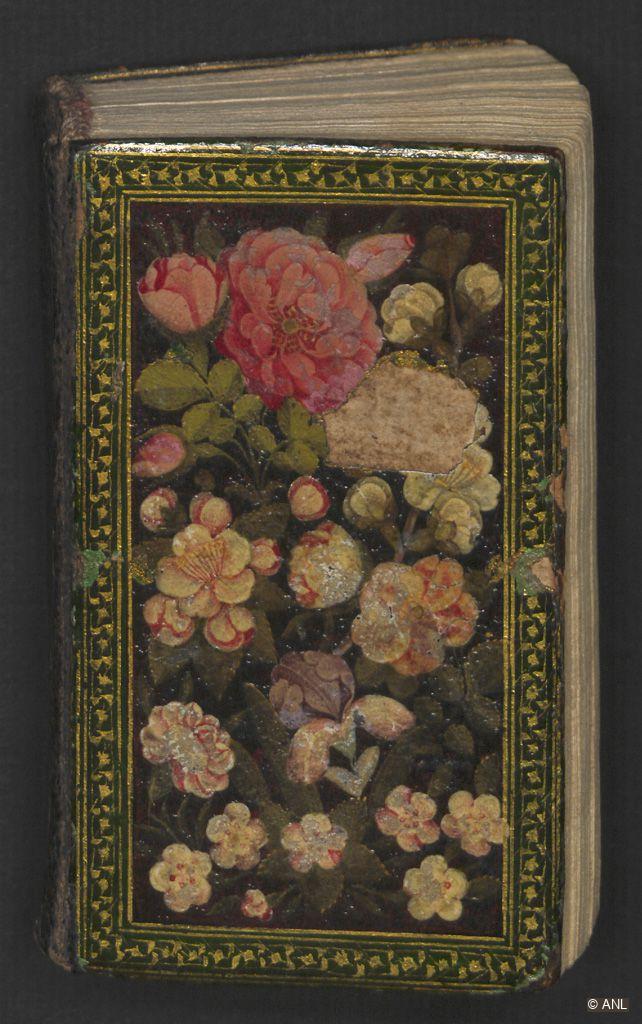
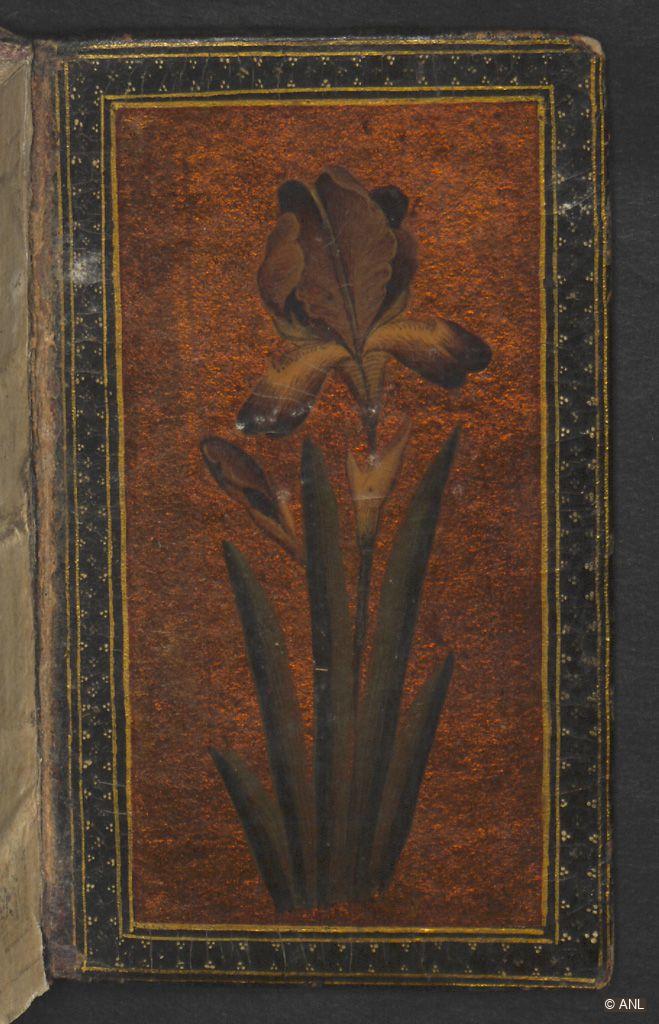
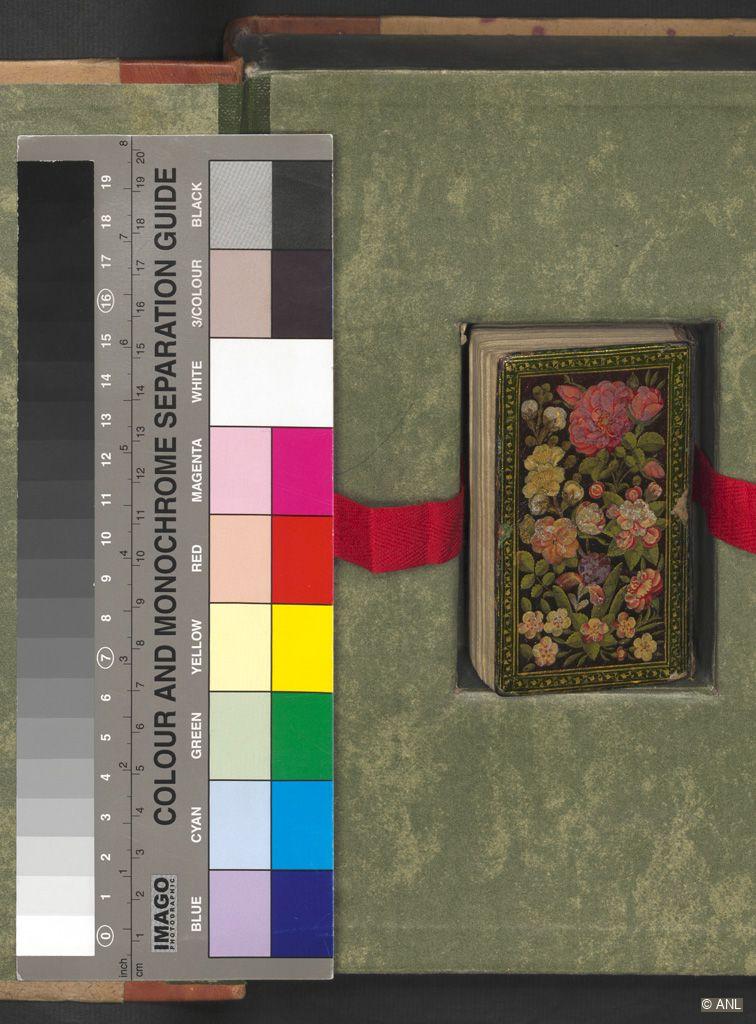
This lacquer binding with a brown leather spine is made of cardboard with leather edges. Despite its small dimensions, the binding corresponds to larger formats of Persian lacquer bindings from the early 19th century; since the marginal decoration of fol. 1b-2a is trimmed, it is apparent that the binding was produced later than the manuscript itself. The outer covers are symmetrically painted with naturalistic, bright flower compositions on a black ground within a gold leaf border before a green background. Orange-red and pink roses, yellow jasmine-like flowers, reddish-violet irises, red-yellow carnations and primroses within green foliage are depicted. The lacquered doublures are also symmetrically decorated with a grey-violet-yellow tinted iris containing a bud and stylised green leaves. The black border decorated with small three-dot motifs surrounds the large flower before a reddish-golden ground.
Description:
This miniature Qur’an was copied in 1758 in Iran, likely in the city of Isfahan under the Zand dynasty, by the scribe Muhammad Hashim al-Isfahani. A densely decorated double page in a blue, gold and red colour scheme introduces the text. The calligraphic small naskh script is vocalised in red, while golden rosettes signal the end of each verse. The text block is framed by a gold border with golden diamond-, palmette-, and bud-shaped medallions in the margins containing the verse count. While text and illumination in this popular small format were created in the 18th century, the extant lacquer binding can be dated to the early 19th century. This Qur’an was enfolded in a white sewn cotton cloth with a hand-printed red and blue floral design fastened with a gold filigree hook clasp. The cotton case gives an indication of how these manuscripts might have been stored or how their covers could be protected during travel.
How date and origin were established:
One colophon: AH 1172 / AD 1758
How Object was obtained:
Purchased from the Mechitarist Order in Vienna in 1940.
Link to catalogue/digitisation in Holding Institution’s database:
http://data.onb.ac.at/rec/AC14420187
Selected bibliography:
Duda, Dorothea, Islamische Handschriften II. Persische Handschriften, Die illuminierten Handschriften und Inkunabeln der Österreichischen Nationalbibliothek, vol. 5, Vienna: Verlag der Österreichischen Akademie der Wissenschaften, 1992: 248-249.
Citation of this web page:
Theresa Zischkin "Miniature Qur’an" in Explore Islamic Art Collections. Museum With No Frontiers, 2026.
https://islamicart.museumwnf.org/database_item.php?id=object;EPM;at;Mus24;9;en
Prepared by: Theresa Zischkin
Copyedited by: Sophie-Anne Mullen
MWNF Working Number: AT4 09
RELATED CONTENT
Islamic Dynasties / Period
On display in
Exhibition(s)
Download
As PDF (including images) As Word (text only)