

 Back
Back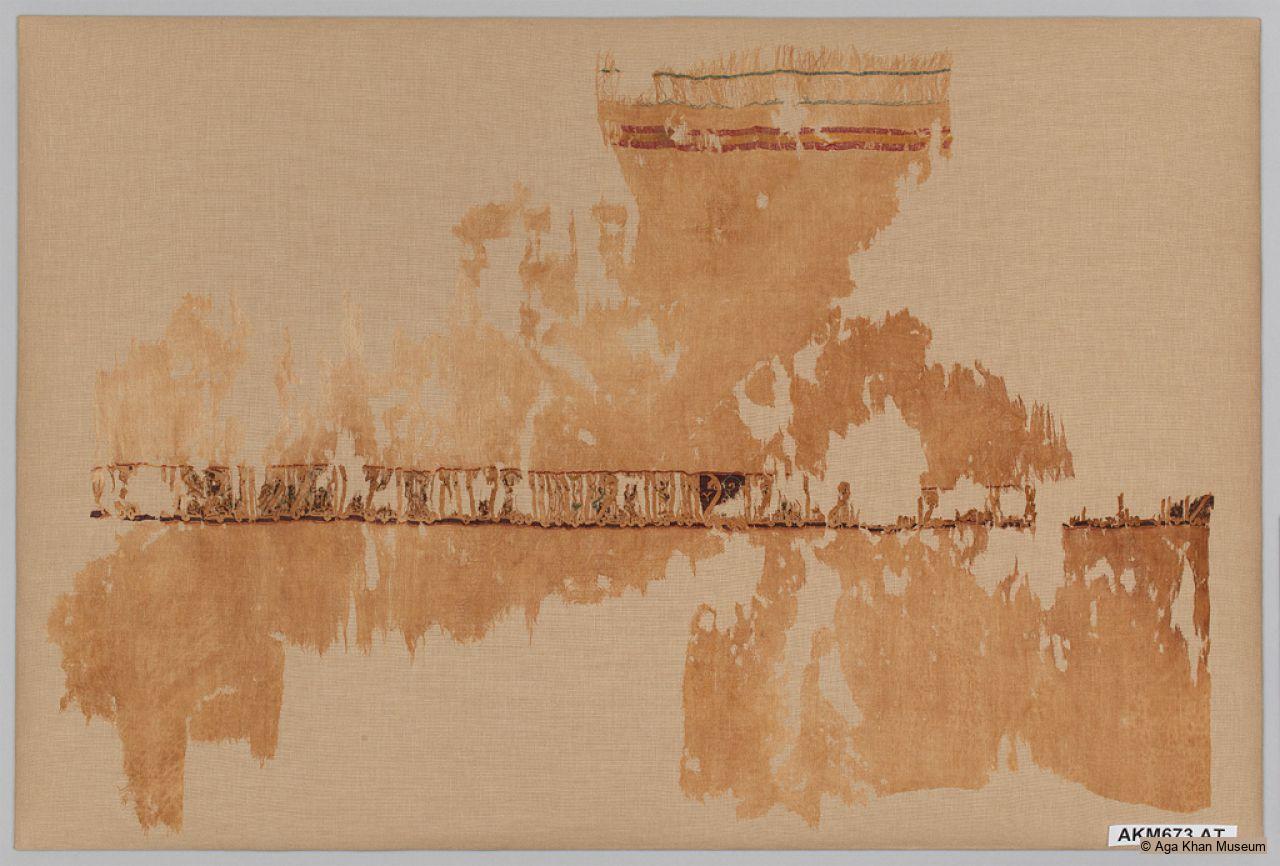
This item has been added to the Database within the Explore Islamic Art Collections project. Information is available in: English, Arabic.
Name of Object:
Tiraz Textile
Location:
Toronto, Ontario, Canada
Holding Museum:
Aga Khan Museum
About Aga Khan Museum, Toronto
Date of Object:
Second half of 11th century
Museum Inventory Number:
AKM673
Material(s) / Technique(s):
Linen tabby; with purple, yellow, and blue silk, and undyed linen tapestry-woven inscription
Dimensions:
82 x 57cm
Period / Dynasty:
Fatimid
Provenance:
Egypt
Description:
This linen textile with its regal purple inscription naming the Fatimid caliph al-Mustansir has lost much of it original length due to its use as a burial shroud. However, it preserves almost its full width, spanned by the decorative inscription band. Known as a “tiraz” textile, it is unusually wide and was perhaps a shawl. The term “tiraz” actually means “embroidery,” but came to denote an inscription band as one sees on these textiles and on anything else, including architecture. Most of the medieval textiles discovered in excavations in Egypt had been used as burial shrouds and have suffered similar deterioration. Only those that found their way into European church treasuries are well preserved and give us an idea of how the full garment appeared. Tiraz textiles, despite their Arabic inscriptions, were highly valued in Europe as relics of the Holy Land and appear as the costumes of Christ and the Virgin in Italian Renaissance paintings.
How Object was obtained:
Purchased at auction
Citation of this web page:
Alessandra Cirelli "Tiraz Textile" in Explore Islamic Art Collections. Museum With No Frontiers, 2026.
https://islamicart.museumwnf.org/database_item.php?id=object;EPM;ca;Mus21;8;en
Prepared by: Alessandra Cirelli
MWNF Working Number: CA1 08
RELATED CONTENT
Islamic Dynasties / Period
On display in
Exhibition(s)
MWNF Galleries
TextilesDownload
As PDF (including images) As Word (text only)