

 Back
Back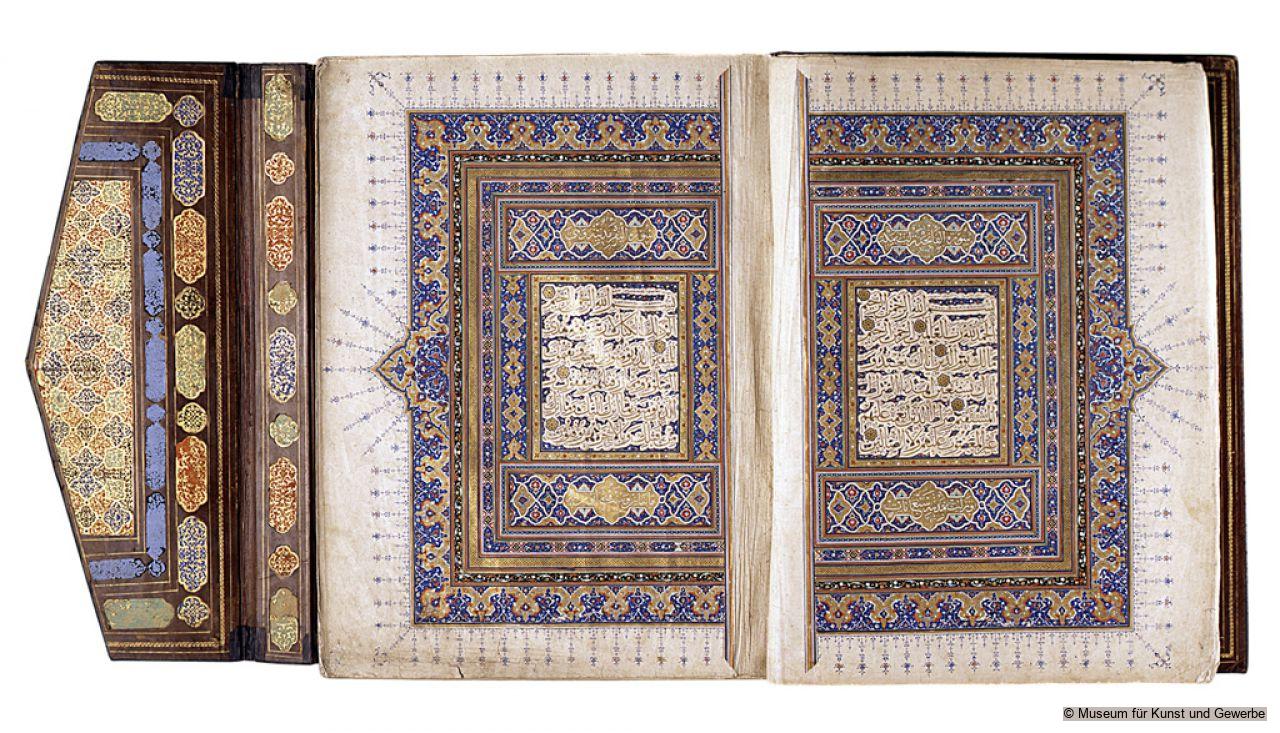
This item has been added to the Database within the Explore Islamic Art Collections project. Information is available in: English, Arabic.
Name of Object:
Splendour Qur'an
Location:
Hamburg, Germany
Holding Museum:
MKG Museum for Applied Arts
About MKG Museum for Applied Arts, Hamburg
Date of Object:
Hegira 971 / AD 1564
Museum Inventory Number:
1893. 250
Material(s) / Technique(s):
Leather binding with gold tooling and inscriptions from the Qur'an; interior: filigree ornamentation in leather on coloured paper; ink and gold leaf on paper.
Dimensions:
Height: 49.5cm, Length: 36.5cm
Period / Dynasty:
Safavid
Provenance:
Iran
Description:
This richly illuminated Qur’an, formerly owned by Ottoman Sultan Ahmad III (1703-13), was produced in 16th-century Iran. The text is elegantly written in muhaqqaq script with alternating lines in gold and black, a characteristic of Qur’ans from the period. Several folios are elaborately decorated in gold, blue, and red ink, such as the first illuminated verses which are copied in gold thuluth script. The book is bound in embossed leather with gold plates decorated in floral patterns and inscriptions.
The overall decoration and colour scheme of this book is characteristic of manuscripts from 16th-century Iran. Compared to earlier examples of the Safavid period, this Qur’an is demonstrative of later, bolder manuscripts in which the motifs and colour schemes became more pronounced. Though blue and gold were still the predominant colours, other hues, including red, black and, white, were also incorporated, resulting in a rich, more varied palette.
The manuscript's calligrapher and place of production can be identified in a colophon: “Executed by Muhammad ibn Ahmad al-Tabrizi al-Khalil at Tabriz, north-western Iran, as 22nd piece finished in the month of Sha’ban 972 H. (i.e., March 1565).” Although Muhammad ibn Ahmad al-Tabrizi is not mentioned in any historical source, several manuscripts were signed by him between 1554 and 1581. Additional manuscripts attributed to this calligrapher are held in the Museum of Turkish and Islamic Art, Istanbul (TIEM 180, 211, 248, 422, 423). In addition to Tabriz, cities like Shiraz, Qazvin, Mashhad, and Herat were the most prolific centres for the production of Qur’an copies.
How date and origin were established:
'Colophon: “conducted by Muhammad ibn Ahmad al-Tabrizi al-Khalil in Tabriz, Northwest-Iran, as 22. piece finished in month Scha’ban 972 H.“(March 1565).
How Object was obtained:
Purchased in 1893.
How provenance was established:
1717 dated owner's mark: Ottoman Sultan Ahmed III. (1703-1730); G. Neidlinger bought it from D. Kélékian, Paris.
Selected bibliography:
Deroche, F. and von Gladiss, A., Buchkunst zur Ehre Allahs: Der Prachtkoran, Berlin: Museum für Islamische Kunst, 1999.
Farhad, M. and Rettig, S., The Art of the Qur'an: Treasures from the Museum of Turkish and Islamic Arts, Washington, D.C.: Arthur M. Sackler Gallery, 2016: 260.
Karolewski, J. and Köse, Y., "Wunder der erschaffenen Dinge: Osmanische Manuskripte in Hamburger Sammlungen," Manuscript Cultures, 9 (2016): 175-190.
Rebhan, H., Prachtkorane aus tausend Jahren: Handschriften aus dem Bestand der Bayerischen Staatsbibliothek München, Munich: Bayerischen Staatsbibliothek, 1998.
Schimmel, A. et al., Islamic Calligraphy, New York: Metropolitan Museum of Art, 1992.
Citation of this web page:
"Splendour Qur'an" in Explore Islamic Art Collections. Museum With No Frontiers, 2026.
https://islamicart.museumwnf.org/database_item.php?id=object;EPM;de;Mus21;2;en
Copyedited by: Caitlin Link
MWNF Working Number: DE1 02
RELATED CONTENT
Islamic Dynasties / Period
On display in
Exhibition(s)
MWNF Galleries
ManuscriptsDownload
As PDF (including images) As Word (text only)