

 Back
This item has been added to the Database within the Explore Islamic Art Collections project. Information is available in: English, Arabic.
Name of Object:
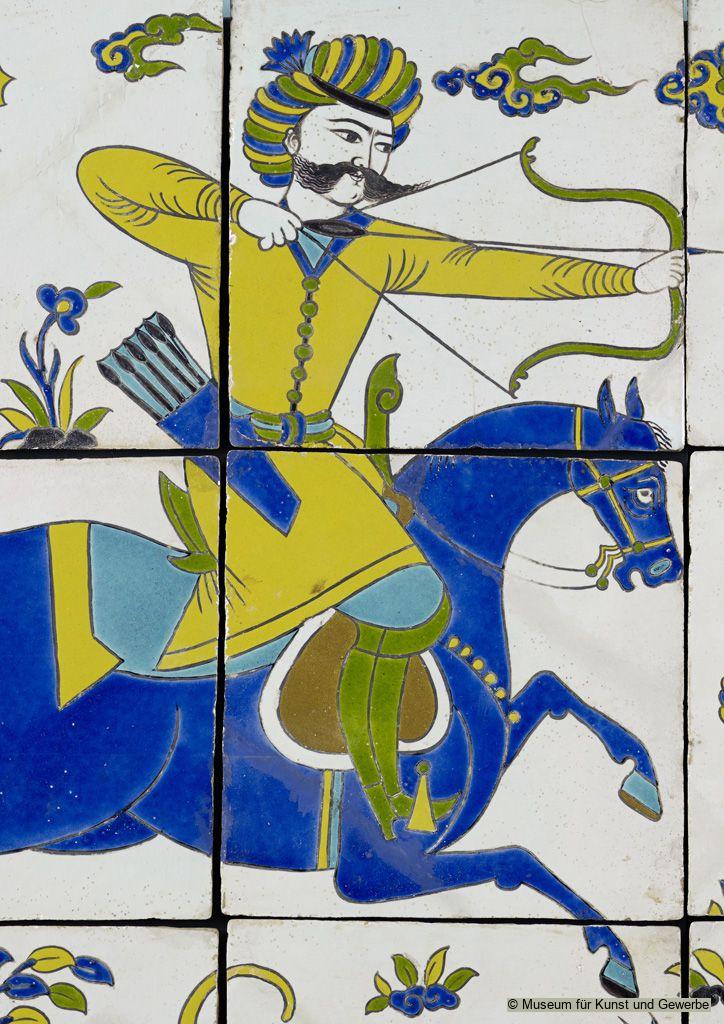
Tile Panel with a hunting scene
Location:
Hamburg, Germany
Holding Museum:
MKG Museum for Applied Arts
About MKG Museum for Applied Arts, Hamburg
Date of Object:
Hegira 1085-1111 / AD late 17th century
Museum Inventory Number:
1980.8
Material(s) / Technique(s):
Fritware; painted in cuerda seca technique
Dimensions:
Height: 132cm, Length: 346cm
Period / Dynasty:
Safavid
Provenance:
Iran, Isfahan
Description:
This tile panel depicts a hunting scene. Produced during the Safavid period in Isfaha, the tile was made using a cuerda seca technique in which designs were outlined by an oily substance mixed with manganese, leaving a dark outline after firing. This prevented the coloured pigments from bleeding into each other. During the Timurid and Safavid periods, this technique was widely used and later introduced to Turkey. This tile panel most likely decorated a hunting palace.
How date and origin were established:
The arch is from a palace near Isfahan. This scene is modelled on Persian book illumination.
How Object was obtained:
Purchased in 1980.
How provenance was established:
Saeed Motamed.
Citation of this web page:
"Tile Panel with a hunting scene" in Explore Islamic Art Collections. Museum With No Frontiers, 2026.
https://islamicart.museumwnf.org/database_item.php?id=object;EPM;de;Mus21;3;en
Copyedited by: Caitlin Link
MWNF Working Number: DE1 03
RELATED CONTENT
Islamic Dynasties / Period
On display in
Exhibition(s)
MWNF Galleries
CeramicsDownload
As PDF (including images) As Word (text only)