

 Back
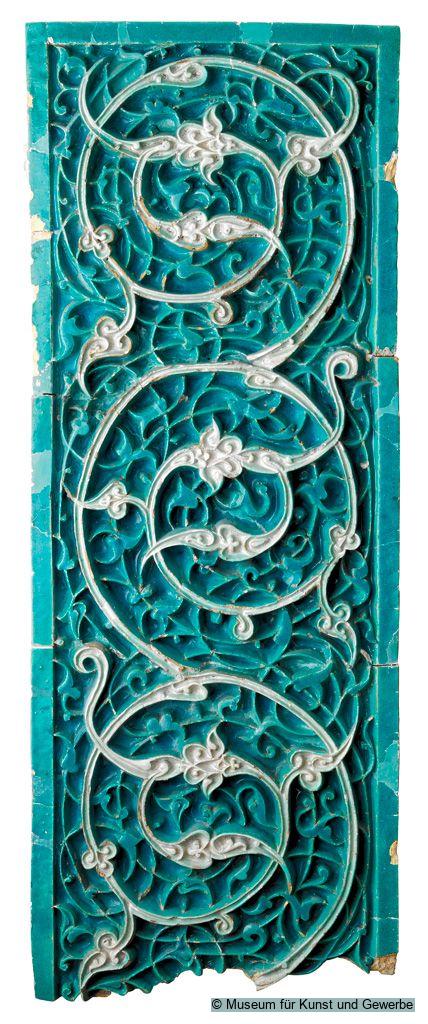
This item has been added to the Database within the Explore Islamic Art Collections project. Information is available in: English, Arabic.
Name of Object:
Tiles of the Buyan Kuli Khan
Location:
Hamburg, Germany
Holding Museum:
MKG Museum for Applied Arts
About MKG Museum for Applied Arts, Hamburg
Date of Object:
Hegira 8th century / AD 14th century
Museum Inventory Number:
1908.472
Material(s) / Technique(s):
Glazed ceramic
Dimensions:
Length: 125cm x Width: 59cm
Period / Dynasty:
Chagatai Khanate
Provenance:
Uzbekistan, Fatahabad near Buxoro
Description:
These tile fragments are from the mausoleum of Buyan Qulï Khan in Bukhara. The turquoise glazed tile is decorated with an intricate vine pattern in white. The ornament is not painted, but cut as a relief into the clay using a complex technique.
These tiles were a part of the decoration program of the mausoleum of Buyan Kuli Khan, who was murdered in 1358. He was the 25th successor of Genghis Khan (1155/62 / 67-1227) and ruled over the Chagatay Khanate empire. His tomb is situated in Bukhara, present-day Uzbekistan, and was covered with tiles both inside and out. The present fragment was initially installed on the outer facade. The Victoria and Albert Museum also possesses several tiles from the mausoleum.
How date and origin were established:
These tiles are from the mausoleum of King Buyan Kuli Khan. They were acquired in 1903 by Justus Brinckmann in Kabebdjan Galleries in Paris.
How Object was obtained:
Endowment in 1908.
How provenance was established:
Gift from Alfred Beit, London, through Ounik Kalebdjian, Paris.
Selected bibliography:
Haase, C.-P., "Buyan Quli Chan—Baudekor," Damaszener Mitteilungen, 11 (1999): 205-225.
Citation of this web page:
"Tiles of the Buyan Kuli Khan" in Explore Islamic Art Collections. Museum With No Frontiers, 2026.
https://islamicart.museumwnf.org/database_item.php?id=object;EPM;de;Mus21;43;en
Copyedited by: Caitlin Link
MWNF Working Number: DE1 43
RELATED CONTENT
On display in
Exhibition(s)
The Use of Colours in Art
Primary Colours and Emotions | Primary Colours in Architectural MonumentsDownload
As PDF (including images) As Word (text only)