

 Back
Back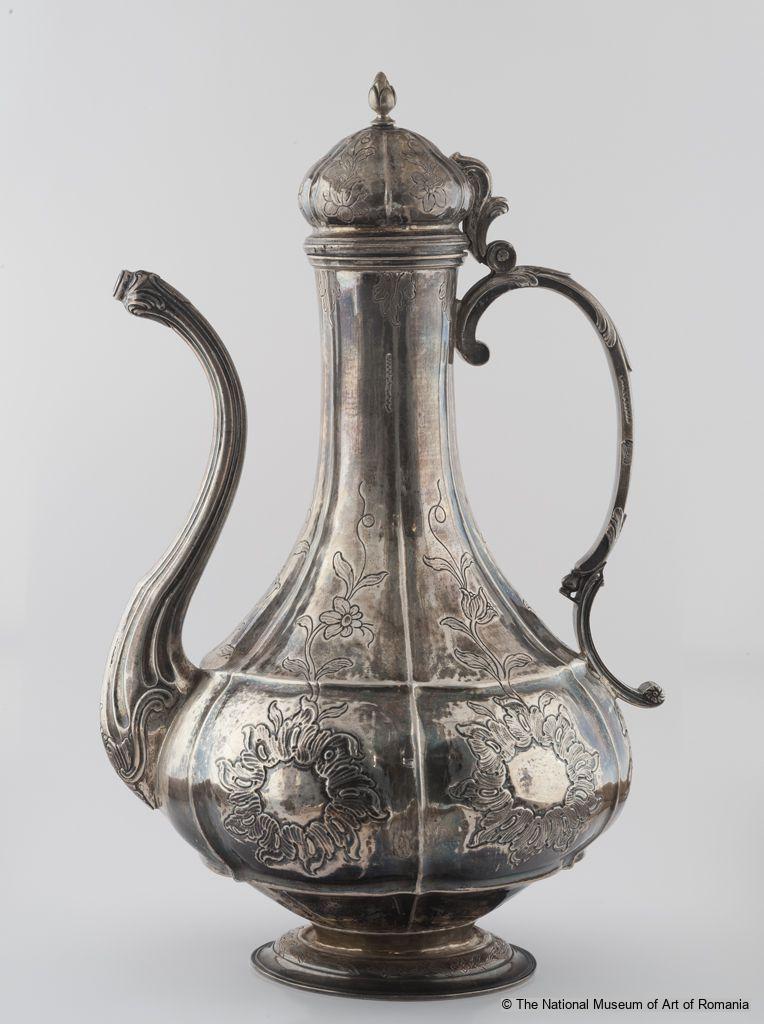
This item has been added to the Database within the Explore Islamic Art Collections project. Information is available in: English, Arabic.
Name of Object:
Ewer (ibrik)
Location:
Bucharest, Romania
Holding Museum:
The National Museum of Art of Romania
About The National Museum of Art of Romania, Bucharest
Date of Object:
Hegira 1187 – 1203 / AD 1773 – 1789
Museum Inventory Number:
20770 / 1734
Material(s) / Technique(s):
Silver; hammered, engraved and chiselled; cast silver (handle)
Dimensions:
Height: 34.5cm
Period / Dynasty:
Ottoman
Provenance:
Turkey
Description:
The pyriform body of the ewer rests on a circular base; it has a curved spout and a volute-shaped handle whose upper part is attached to the cover surmounted by a pine cone. The decoration, with large floral motifs on the belly and delicate scrollwork on the neck, is perfectly adapted to the shape. The handling of the ornamental motifs and certain shape-related details betray the influence of Western design, which marked the emergence of the so-called Turkish baroque.
How date and origin were established:
Tughra marks of Sultan Abdülhamid I (1773-1789)
How Object was obtained:
Transferred from the Ministry of Finance in 1958.
How provenance was established:
Tughra; stylistic analysis
Selected bibliography:
Dunca, M., Islamic Art at the National Museum of Art of Romania, Bucharest: National Museum of Art of Romania, 2015: 64, no. 22.
Kürkman, G., Ottoman Silver Marks, Istanbul: Mathusalem Publications, 1996.
Citation of this web page:
Mircea Dunca "Ewer (ibrik)" in Explore Islamic Art Collections. Museum With No Frontiers, 2026.
https://islamicart.museumwnf.org/database_item.php?id=object;EPM;rm;Mus21;18;en
Prepared by: Mircea Dunca
MWNF Working Number: RO1 18
RELATED CONTENT
Islamic Dynasties / Period
On display in
Exhibition(s)
MWNF Galleries
MetalworkDownload
As PDF (including images) As Word (text only)