

 Back
Back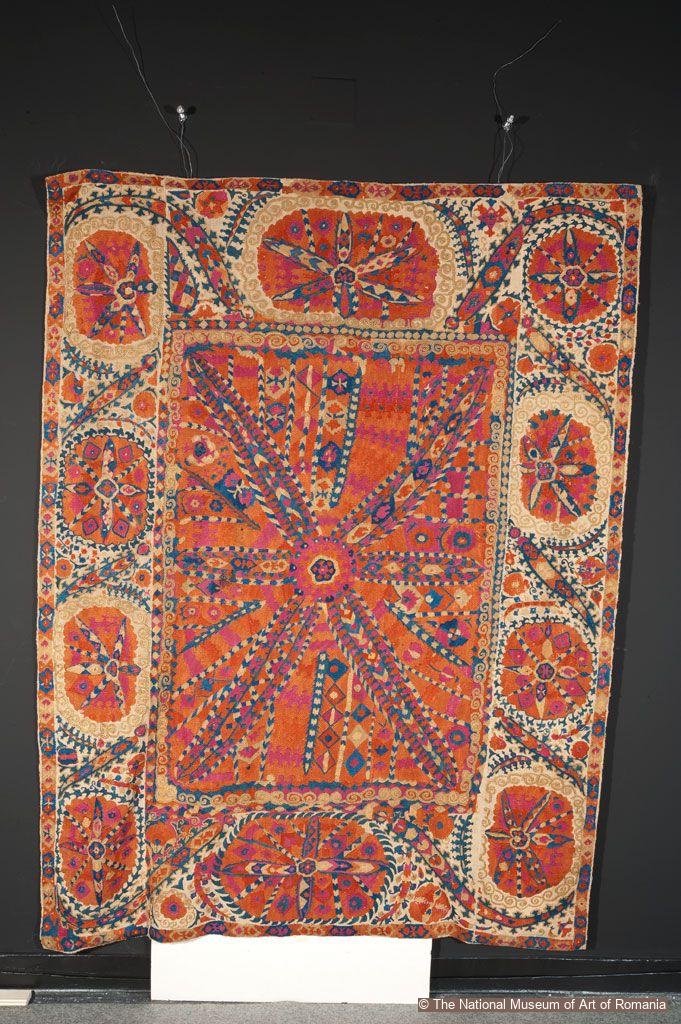
This item has been added to the Database within the Explore Islamic Art Collections project. Information is available in: English, Arabic.
Name of Object:
Suzani
Location:
Bucharest, Romania
Holding Museum:
The National Museum of Art of Romania
About The National Museum of Art of Romania, Bucharest
Date of Object:
Hegira 13th century / AD 19th century
Museum Inventory Number:
93207 / 942
Material(s) / Technique(s):
Cotton embroidered with silk (4 pieces stitched together)
Dimensions:
Length: 194cm, Width: 146cm
Provenance:
Bukhara, Uzbekistan
Description:
Largely known as ‘Bukhara embroideries’, suzanis were much prized in Romania. The term, derived from the Persian suzan, which means ‘needle’, is applied to a type of embroideries produced in urban workshops from a region in present-day Uzbekistan. As part of the bride’s dowry suzanis vary in size and design, and may serve different purposes. They involve the joint effort of several artisans. At first the composition is drawn on the fabric which is then cut into several pieces in order to be embroidered by other women. Subsequently the embroidered pieces are stitched together; the resulting irregularities add to the particular charm of the ensemble. In spite of obvious stylistic differences between the suzanis made in Bukhara, Tashkent, Shahrisabz, or Nurata, a definitive provenance may prove difficult to establish. Irrespective of the manufacturing centre all suzani embroideries share a specific chromatic exuberance reminiscent to a certain degree of the Mughal and Ottoman art, and quite unlike the restricted colour range of Central Asian carpets. The present embroidery belongs to the group of so-called ‘large-medallion suzanis’, more precisely to an extremely rare subgroup limited until recently to only three other examples. The Persian and Hellenistic motifs treated in a free, unrestrained manner recall the rich cultural heritage of Central Asia, which witnessed the rise and fall of great civilizations.
How date and origin were established:
Stylistic analysis
How Object was obtained:
Purchased by the Museum in 1982.
How provenance was established:
Stylistic analysis
Selected bibliography:
Beldescu, I.-A., Broderii orientale, Bucharest: National Museum of Art of Romania, 2001: 20, cat. no. 8.
Dunca, M., Islamic Art at the National Museum of Art of Romania, Bucharest: National Museum of Art of Romania, 2015: 50, no.17.
Kalter, J., The Arts and Crafts of Turkestan, London: Thames and Hudson, 1984.
Citation of this web page:
Mircea Dunca "Suzani" in Explore Islamic Art Collections. Museum With No Frontiers, 2026.
https://islamicart.museumwnf.org/database_item.php?id=object;EPM;rm;Mus21;32;en
Prepared by: Mircea Dunca
MWNF Working Number: RO1 32
RELATED CONTENT
On display in
Exhibition(s)
MWNF Galleries
TextilesDownload
As PDF (including images) As Word (text only)