

 Back
Back
This item has been added to the Database within the Explore Islamic Art Collections project. Information is available in: English, Arabic.
Name of Object:
Septum Nose Ring
Also known as:
Arawak or arabek
Location:
Saint Petersburg, Russia
Holding Museum:
Saint Petersburg Museum of Islamic Culture
About Saint Petersburg Museum of Islamic Culture, Saint Petersburg
Original Owner:
Muradullo Saidov (1935–2013 (?)), Uzbek Arab by origin. In 1970th – 1980th he held senior positions in various agricultural and state institutions in Uzbekistan. In 1990–1994 Saidov was elected as a member of the Supreme Council of the Republic of Uzbekistan, the Hero of Uzbekistan (2002). He was the founder and the head of the International Arab Culture Center in Jeynov
Date of Object:
18th century (?) [Dating determined by Muradallo Saidov based on personal expertise]
Museum Inventory Number:
MIC 03-2
Material(s) / Technique(s):
Silver, unidentified semi-precious and ornamental stones; Wire drawing, wire twisting, soldering, rough cutting, polishing, drilling
Dimensions:
Height: 2.0cm, Width: 2.4cm, Weight: 144.79gm
Place of production:
The settlement of Jeynau, Myrishkor District, Qashqadaryo Region (Uzbekistan)
Provenance:
The outskirts of the city of Qarshi (Qashqadaryo Region, Uzbekistan)
Description:
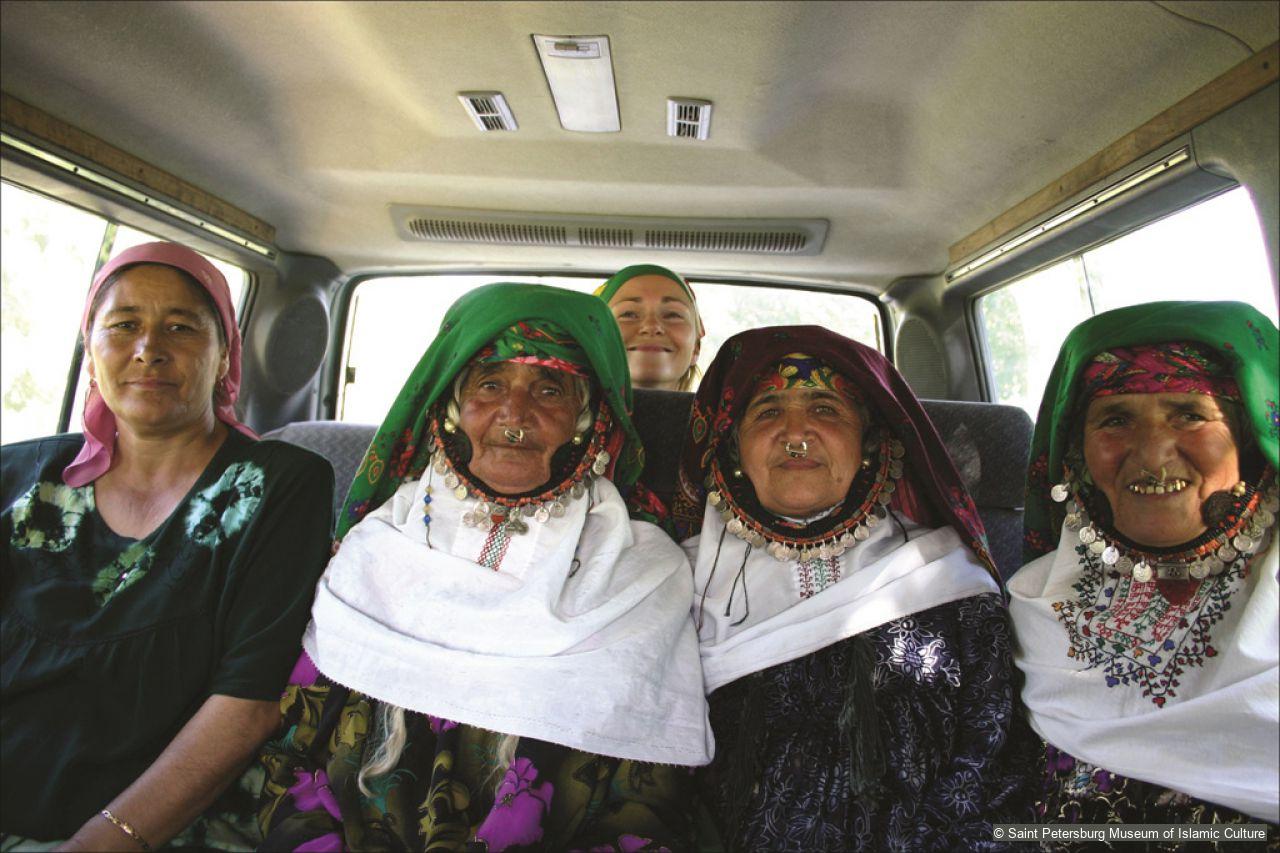
This is a nose ring worn through the nasal septum, known as an arawak or arabek. Such nose rings serve as a marker of ethnic identity and marital status among elderly Arabic women in the settlement of Jeynau. According to Jeynau residents, this type of jewellery distinguishes them from other Central Asian ethnicities. The section of the ring that passes through the septum is made of flattened silver wire that forms a crescent shape, resembling a bow. One end of the septum section is left unattached, and this open end is inscribed with cuneiform carvings and notches. The other end of the septum section is soldered to a length of silver wire that forms the base of the ring. Rather than connecting to the open end of the septum section, the wire curves back upwards and twists around the septum section to form a loop. Within this loop of wire, beads decorate the ring. First, there is a large bead made of a cobalt-coloured semi-precious stone. In nose rings of this kind, the largest blue or green bead is called latwa tash (“the guarding stone”), as the nose ring is traditionally understood to be a guarding amulet. Working outwards from the latwa tash, there is also a spiral of silver wire, a smaller bead made of a coral-like stone, and another spiral of silver wire. Typically, the septum nose ring can be used to secure a face veil. Some Jeynau women instead wear a chain connecting their nose ring to their temple pendant as a symbolic replacement of the face veil; veils are not widespread in Bedouin communities.
Arab settlers brought the tradition of the septum nose ring to Central Asia. Due to the Arab conquests, Arab tribes established settlements in northwest Arabia, along the Great Silk Road, and ultimately in the region now known as Uzbekistan by the 10th/16th century. These tribes can be traced back to modern-day Afghanistan, specifically the cities of Aghan Balkh, Shibarghan, and Andkhoy. A close parallel to Jeynau septum nose rings was recorded in the Dhofar Governorate (the Sultanate of Oman). The Dhofar septum nose ring is called a khasafa or khasama, and it indicated girls’ marital status; at puberty a girl's nasal septum was pierced for the nose ring she would wear once wed.
How date and origin were established:
In private conversation with Muradullo Saidov
How Object was obtained:
Donated by Muradullo Saidov to Efim Rezvan in 2004
How provenance was established:
In field interview with Muradullo Saidov
Selected bibliography:
Brochure, “Jeynov—We Arrived,” “The Expeditions are not Over,” Peter the Great Museum of Anthropology and Ethnography (the Kunstkamera) at the Russian Academy of Sciences, Saint Petersburg, Russia (2004).
Rezvan, E., “A Contribution Towards the History and Origin of the Katta-Langar / St. Petersburg “Qur’an of ‘Uthman”, Manuscripta Orientalia, 23:2 (2017): 3-9.
Yanes, M., “Women's Nose Jewellery from Central Asia in the Collections of MAE RAS (on the Issue of the Origin and Functional Role)”, Manuscripta Orientalia, 14:2 (2008), 63-68.
Citation of this web page:
Dr. Anna Yu. Kudriavtceva, Prof. Dr. Sc. Efim A. Rezvan "Septum Nose Ring" in Explore Islamic Art Collections. Museum With No Frontiers, 2026.
https://islamicart.museumwnf.org/database_item.php?id=object;EPM;rs;Mus21;2;en
Prepared by: Dr. Anna Yu. KudriavtcevaDr. Anna Yu. Kudriavtceva
Saint Petersburg Museum of Islamic Culture, Prof. Dr. Sc. Efim A. RezvanProf. Dr. Sc. Efim A. Rezvan
(Born 1957), Director of St. Petersburg Museum of Islamic Culture, Editor-in-Chief of “Manuscripta Orientalia, International Journal for Oriental MSS Research”, author of 14 monographs and more than 300 scholarly works published in the Russian, English, Arabic, French, German, Japanese, Italian, Uzbek, Finnish, Chinese and Persian languages. His exhibition projects have been shown in many cities of Russia, as well as in Austria, Hungary, Holland, Greece, Latvia, Slovakia, Slovenia, USA, Finland, France, Czech Republic, Switzerland, Estonia. He was awarded with honorable awards in Russia, Japan, Iran, CIS countries and holds several UNESCO awards.
Copyedited by: Sophie Dora Tulchin
MWNF Working Number: RS1 02