

 Back
This item has been added to the Database within the Explore Islamic Art Collections project. Information is available in: English, Arabic.
Name of Object:
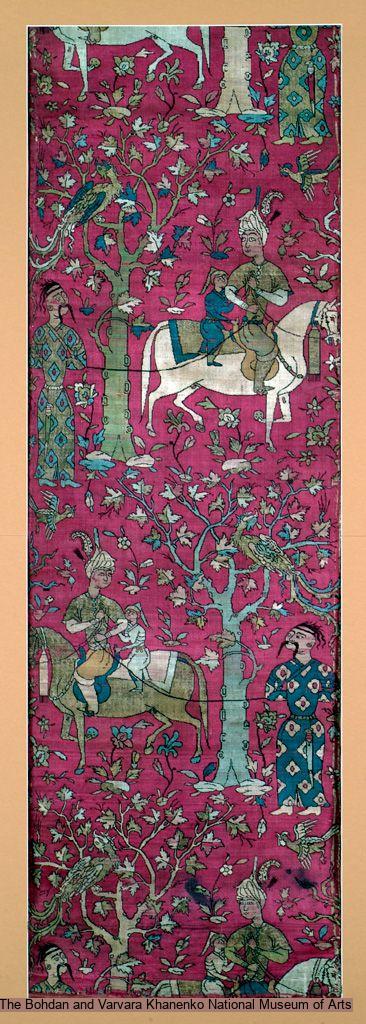
Fragment of golden lampas with capture scene
Location:
Kyiv, Ukraine
Holding Museum:
The Khanenko Museum
About The Khanenko Museum, Kyiv
Current Owner:
The Khanenko Museum
Date of Object:
AD 16th century
Museum Inventory Number:
365 БВ
Material(s) / Technique(s):
Silk, metal-wrapped thread; lampas weaving
Dimensions:
Length: 109cm, Width: 34cm
Period / Dynasty:
Safavid
Provenance:
Iran
Description:
Silk figured fabrics (patterns of which included images of people) were at the peak of the Safavid court fashion. A remarkable example of the type is this fragment of a golden lampas depicting a scene of captivity. One of the most technologically sophisticated and costly fabrics in Iran, the golden lampas provided up to 10 silk threads of different colours in the pattern. The inclusion of threads wrapped in gold or silver foil suggest that the fabric could be produced in karkhane – imperial workshops.
The fragment is one of the two largest pieces among seven dispersed parts of a very costly man’s robe that probably belonged to some member of the Iranian Shah family. The scene featured on the lampas has long aroused great interest among researchers. Around a tree (sycamore or maple), where a large fairy bird is sitting on the branch, rides a horseman leading a prisoner. A little child sits behind the rider. Above the people a rooster flies towards a tree.
The horseman is depicted in the characteristic Safavid outfit of the AD 16th century: a turban is wound around a tall Taj cap, the number of turban bangs symbolizes 12 righteous Shi‘ite imams.
The idea to treat the scene as a political manifesto of the victorious campaigns of Shah Tahmasp I to Georgia (1540, 1553) was complemented by alternative Sufi interpretation of the subject. The scene of captivity was seen as an allegory of man on his spiritual path to God. Thus the horseman stands for the Teacher who leads the Disciple (captive) through the complex ways of learning towards a divine truth personified by the mythical ancient Iranian bird, Simurg (fairy bird).
How date and origin were established:
Stylistic analysis by Leon Guzalian (examination, 1955); Galina Lasikova (2003).
How Object was obtained:
Purchased by Bohdan and Varvara Khanenkos. Donated by Varvara Khanenko in 1918, nationalised by Bolshevik regime in 1919.
How provenance was established:
Ассording to the entry in the Old Museum Inventory Register (1919-1940).
Selected bibliography:
Bier, Carol (ed), Woven from the Soul, Spun from the Heart: Textile Arts of Safavid and Qajar Iran, 16th–19th Centuries, exhibition catalogue, Washington, D.C.: Textile Museum, 1987.
Bilenko, H. and Rudyck (Rudyk), H., Oriental Collection, guidebook, Kyiv: The Khanenko Museum, 2005.
Lasikova, Galina, "“The bird’s language” on the Safavid khil’at with capture imagery in Khanenkivski Chytannya", in Proceedings of the International Museum Conference, Kyiv: The Khanenko Museum, 2003.
Rudyk, H. (ed), Charisma of Iran. Persian art of 12th–19th centuries from museum collections of Ukraine, Kyiv: The Khanenko Museum, 2017.
Thompson, Jon and Canby, Sheila, R. (eds), Hunt for Paradise: Court Arts of Safavid Iran 1501–1576, Milan: Skira, 2003.
Citation of this web page:
Antonina Makarevych, Hanna Rudyk "Fragment of golden lampas with capture scene" in Explore Islamic Art Collections. Museum With No Frontiers, 2026.
https://islamicart.museumwnf.org/database_item.php?id=object;EPM;uc;Mus21;11;en
MWNF Working Number: UC1 11
RELATED CONTENT
Islamic Dynasties / Period
On display in
Exhibition(s)
Download
As PDF (including images) As Word (text only)