

 Back
Back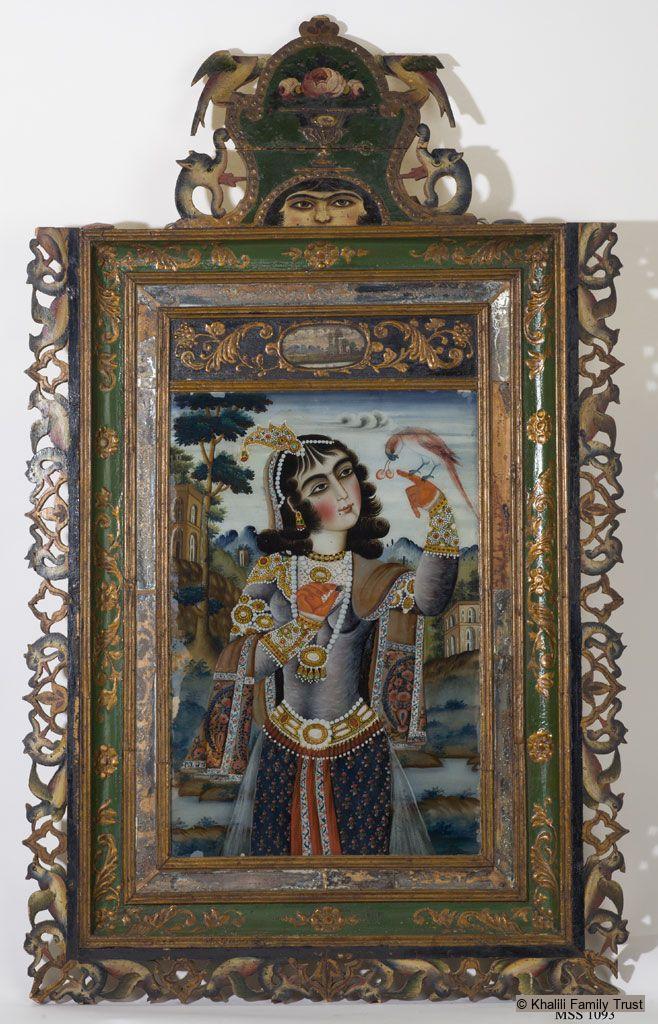
This item has been added to the Database within the Explore Islamic Art Collections project. Information is available in: English, Arabic.
Name of Object:
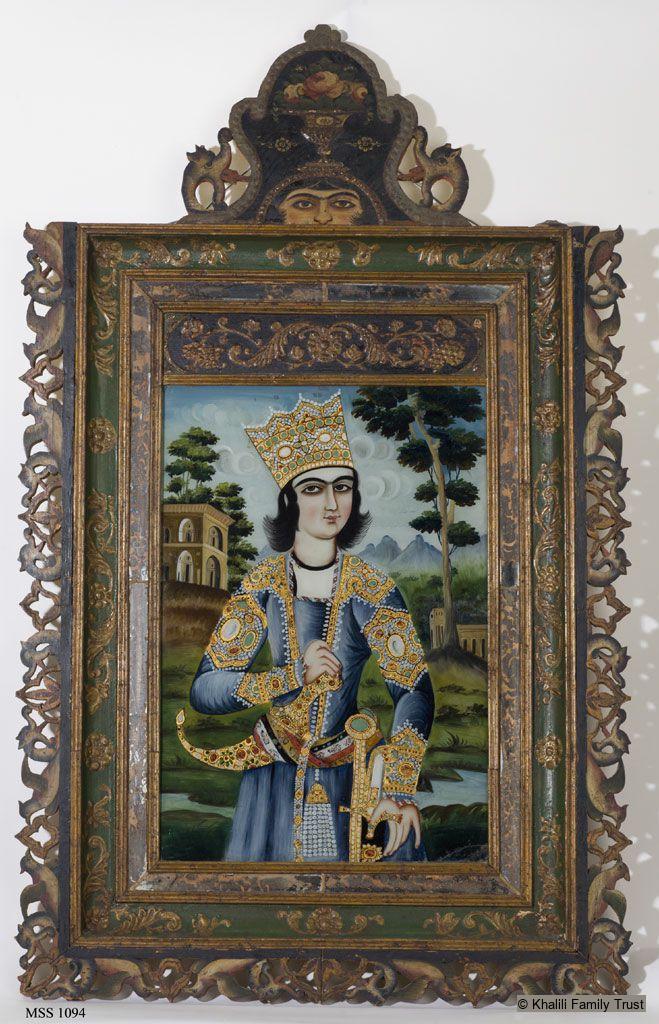
A set of two reverse-glass paintings
Location:
London, United Kingdom
Holding Museum:
Khalili Family Trust – Nasser D. Khalili Collection of Islamic Art
About Khalili Family Trust – Nasser D. Khalili Collection of Islamic Art, London
Date of Object:
Early 19th century
Museum Inventory Number:
MSS 1093, MSS 1094
Material(s) / Technique(s):
Watercolours on glass, executed in the reverse-glass or églomisé technique; in contemporary carved, painted and gilded wooden frames
Dimensions:
Paintings: 55 x 36.5cm and 57.5 x 39cm; frames, max: 116 x 71cm and 118 x 73.5cm
Period / Dynasty:
Qajar
Provenance:
Iran
Description:
The technique of reverse-glass, or églomisé, painting became popular in Iran in the early 19th century, possibly as a result of imports from Europe. In this technique, the paint is applied behind the glass in reverse order, with the highlights and details applied before the background colours. The technique had also been practised in China since the 18th century.
Both the prince and the courtesan are depicted in bejewelled Qajar costume against European-inspired landscapes which are typical of Qajar paintings of the period. The paintings are not signed but have been compared to paintings by Mirza Baba, who may have been responsible for a cycle of reverse-glass paintings in the Marble Throne Hall of the Gulistan Palace in Tehran.
The carved and richly painted frames, with their bird-and-dragon openwork scroll borders, are contemporary.
How date and origin were established:
Date and provenance are based on stylistic grounds.
Selected bibliography:
Diba L.S., and Ekhtiar, M. (eds), Royal Persian Paintings. The Qajar Epoch, 1785–1925, exhibition catalogue, New York: Brooklyn Museum of Art, New York, 1998: no.63, pp.212–3.
Citation of this web page:
Nahla Nassar "A set of two reverse-glass paintings" in Explore Islamic Art Collections. Museum With No Frontiers, 2026.
https://islamicart.museumwnf.org/database_item.php?id=object;EPM;uk;Mus21;33;en
Prepared by: Nahla Nassar
MWNF Working Number: UK1 33
RELATED CONTENT
Islamic Dynasties / Period
On display in
Exhibition(s)