

 Back

Name of Object:
Doorknocker
Location:
Berlin, Germany
Holding Museum:
Museum of Islamic Art at the Pergamon Museum
About Museum of Islamic Art at the Pergamon Museum, Berlin
Date of Object:
Hegira beginning of 7th century / AD beginning of 13th century
Museum Inventory Number:
I. 2242
Material(s) / Technique(s):
Bronze, cast, engraved.
Dimensions:
Height 27.5 cm, width 24 cm
Period / Dynasty:
Zangid
Provenance:
Southeast Anatolia (Turkey).
Description:
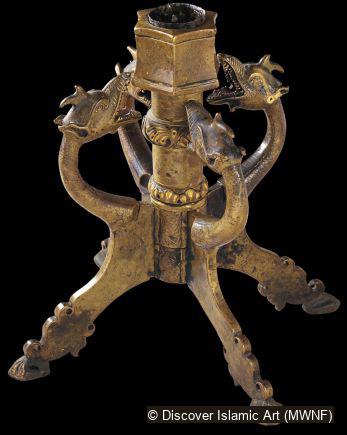
This doorknocker consists of two fantastical winged dragons opposing one another; their front legs are connected and their heads turned backwards. Their jaws are wide open, and they look as if they are about to swallow their own wings. The ends of their tails are entwined together and end in griffin heads. The dragons are connected with a single lion’s head with a long pin, which allows the knocker to be attached to a door. The surfaces of the dragons’ sculpted bodies are engraved. There is no known counterpart to this doorknocker; however, a very similar doorknocker used to exist in the Ulu Cami (Great Mosque) in Cizre in southeast Anatolia and is housed today in Istanbul in the Museum of Turkish and Islamic Art.
Wooden doors that were nearly five metres in height, adorned with expensive bronze fittings, were considered objects of interest from the start. They were also chronicled with admiration in medieval sources, such as the book by the engineer Isma'il b. ar-Razzaq al-Jazari who wrote, during this period, about the great doors of the Artuqid Palace in Diyarbakır.
Representations of winged dragons, facing each other with wide-open jaws, were thought of at the time as charms or amulets to ward off evil. The forms used in this doorknocker illustrate Zangid ideas about magic and a supernatural symbolism of the world. Such ideas appear also in other places and genres. Examples include the Talisman Gate of AH 617–18 / AD 1221–2 in Baghdad; the reliefs on the citadel of Konya (Turkey) of the same year (which is today in the Ince Minareli Madrasa Museum, Konya); or the title pages of manuscripts from around 1200, such as the book on antidotes written in AH 595 / AD 1199, now in the National Library in Paris, which symbolically features the moon on its front cover. Secondary literature has emphasised that such motifs on doors were supposed to prevent undesirable visitors from crossing the threshold.
This doorknocker shows two fierce dragons that seem to swallow their own wings and whose entwined tails end in griffin heads. The dragons are joined together by a lion’s head, which has a long pin to fix the knocker to a door. Dragons such as these were thought to protect a building from evil.
How date and origin were established:
The existence of similar doorknockers from the Ulu Cami (Great Mosque) in Cizre, and other similar examples, suggests that this object dates from the beginning of the 7th / 13th century.
How Object was obtained:
From an art dealer in Tbilisi, Georgia. Obtained in 1912 as a gift from A. Francke.
How provenance was established:
As this doorknocker, acquired in Tbilisi, Georgia, displays very close parallels to doorknockers from the Ulu Cami (Great Mosque) in the southeast Anatolian town of Cizre, and also by comparisons in the recent literature, it is believed to have originated from southern Anatolia.
Selected bibliography:
Hattstein, M. and Delius, P., Islam: Art and Architecture, Cologne, 2000, pp.384–5.
Hillenbrand, R., Islamic Art and Architecture, London, 1999, pp.111–37.
Museum für Islamische Kunst Berlin, Catalogue, Berlin, 1979, cat no. 14, p.17.
Museum für Islamische Kunst, Catalogue, Mainz, 2001, p.66.
Roxburgh, D. J. (ed.),Turks: a Journey of a Thousand Years, 600–1600, Exhibition catalogue, London, 2005, pp.130–1, cat. no. 87.
Citation of this web page:
Annette Hagedorn "Doorknocker" in Discover Islamic Art, Museum With No Frontiers, 2026.
https://islamicart.museumwnf.org/database_item.php?id=object;ISL;de;Mus01;20;tr
Prepared by: Annette Hagedorn
Translation by: Maria Vlotides, Brigitte Finkbeiner
Translation copyedited by: Monica Allen
MWNF Working Number: GE 26
RELATED CONTENT
Related objects



Related monuments

Islamic Dynasties / Period
On display in
Exhibition(s)
Download
As PDF (including images) As Word (text only)