

 Back
Back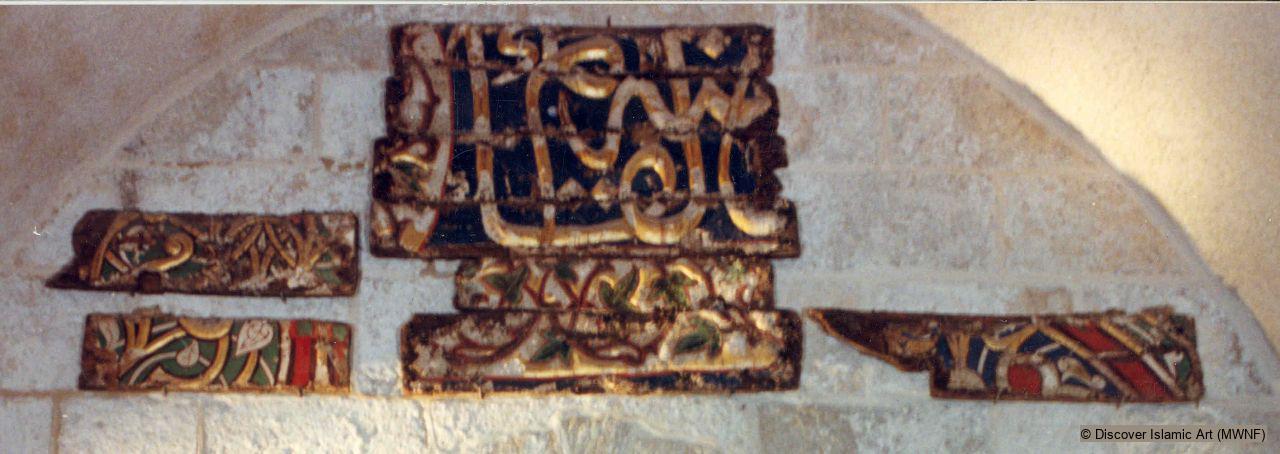
Name of Object:
Stucco-covered wooden side-rib
Location:
Jerusalem
Holding Museum:
Islamic Museum, al-Aqsa Mosque / al-Haram al-Sharif
About Islamic Museum, al-Aqsa Mosque / al-Haram al-Sharif, Jerusalem
Original Owner:
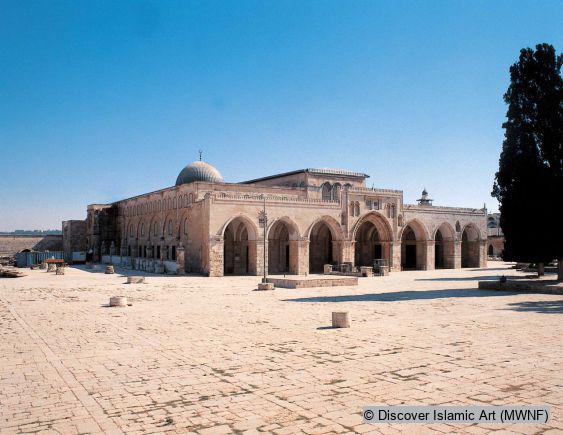
Al-Aqsa Mosque, Jerusalem
Date of Object:
Probably about hegira 424 / AD 1033
Museum Inventory Number:
143/40
Material(s) / Technique(s):
Wood covered with carved, painted and gilded stucco.
Dimensions:
Length 152 cm, width 140 cm, depth 4 cm
Period / Dynasty:
Probably Fatimid
Provenance:
Jerusalem.
Description:
A wooden side-rib belonging to a collection of pieces comprising wood covered with carved, painted and gilded stucco. The carvings of vegetal and geometric motifs and pseudo calligraphic script are gilded and painted using a palette of blue, red, green and white against a background of various colours but predominantly black.
The side-rib once formed part of the decoration of the interior dome of al-Aqsa Mosque, whose damaged parts were replaced in 1938 after gradual deterioration caused by moisture and water infiltration. The importance of this piece lies in its being practically the sole witness to the Fatimid restoration of the dome of al-Aqsa Mosque during the period of the Fatimid caliph al-Zahir bi- Amrillah (r. AH 411–27 / AD 1021–36). It is worth mentioning that other similar parts were lost as a result of a fire which broke out in the mosque in 1969; this led to the destruction of most of the parts of the wooden dome in addition to other sections of al-Aqsa Mosque.
The domes were typically composed, of an inner and outer shell. The inner shell consisted of a wooden skeleton, plated on the inside with circular wooden panels. Palm fibres were affixed to the wooden panels by means of wooden nails. The fibres were then covered with a layer of plaster (stucco) several centimetres thick. After that, the stucco was carved to form the requisite decorations which were painted with different colours and gilded. The outer shell consists of a wooden skeleton which is covered on the outside with metal plates. Lead is normally used, as noted in the dome of al-Aqsa Mosque today, but copper is sometimes employed as can be seen to this day in the Dome of the Rock. The dome of the Dome of the Rock is, however, no different from the dome of al-Aqsa Mosque in terms of its construction.
This rib from the interior dome of al-Aqsa Mosque features vegetal and geometric decoration and a gilded inscription against a coloured background. It is almost the sole witness to the restoration of the dome in the Fatimid period during the reign of Caliph al-Zahir. Other pieces of evidence were lost in the arson attack on the mosque in 1969.
How date and origin were established:
The piece was dated by comparison with the remaining parts from the same period still on site.
How Object was obtained:
The piece was transferred from al-Aqsa Mosque to the Museum during the restoration work carried out in 1938.
How provenance was established:
Jerusalem was narrowed down as the place of production because typically architectural pieces were made and decorated in situ.
Selected bibliography:
Hamilton, R. W., The Structural History of al-Aqsa Mosque: A Record of Archaeological Cleaning from the Repairs of 1938–42, London, 1949.
Citation of this web page:
Nazmi Al-Ju'beh "Stucco-covered wooden side-rib" in Discover Islamic Art, Museum With No Frontiers, 2026.
https://islamicart.museumwnf.org/database_item.php?id=object;ISL;pa;Mus01;8;en
Prepared by: Nazmi Al-Ju'behNazmi Al-Ju'beh
Nazmi Al-Ju'beh is an archaeologist and historian and Co-Director of RIWAQ, Centre for Architectural Conservation in Ramallah, Palestine. He studied at Birzeit University in Palestine and at Tübingen University in Germany. He taught at Birzeit University and at al-Quds University. He was Director of the Islamic Museum, al-Haram al-Sharif, Jerusalem, and directed various cultural heritage projects in Palestine, including surveys of archaeological and architectural sites. He was a major contributor to Pilgrimage, Sciences and Sufism: Islamic Art in the West Bank and Gaza (Vienna: MWNF, 2004) and is the author of numerous publications on the history, archaeology and cultural heritage of Palestine.
Copyedited by: Majd Musa
Translation by: Amal Sachedina (from the Arabic).
Translation copyedited by: Mandi GomezMandi Gomez
Amanda Gomez is a freelance copy-editor and proofreader working in London. She studied Art History and Literature at Essex University (1986–89) and received her MA (Area Studies Africa: Art, Literature, African Thought) from SOAS in 1990. She worked as an editorial assistant for the independent publisher Bellew Publishing (1991–94) and studied at Bookhouse and the London College of Printing on day release. She was publications officer at the Museum of London until 2000 and then took a role at Art Books International, where she worked on projects for independent publishers and arts institutions that included MWNF’s English-language editions of the books series Islamic Art in the Mediterranean. She was part of the editorial team for further MWNF iterations: Discover Islamic Art in the Mediterranean Virtual Museum and the illustrated volume Discover Islamic Art in the Mediterranean.
True to its ethos of connecting people through the arts, MWNF has provided Amanda with valuable opportunities for discovery and learning, increased her editorial experience, and connected her with publishers and institutions all over the world. More recently, the projects she has worked on include MWNF’s Sharing History Virtual Museum and Exhibition series, Vitra Design Museum’s Victor Papanek and Objects of Desire, and Haus der Kulturen der Welt’s online publication 2 or 3 Tigers and its volume Race, Nation, Class.
MWNF Working Number: PA 08
RELATED CONTENT
Related objects



Related monuments
Islamic Dynasties / Period
On display in
Exhibition(s)
Download
As PDF (including images) As Word (text only)