

 Back
Back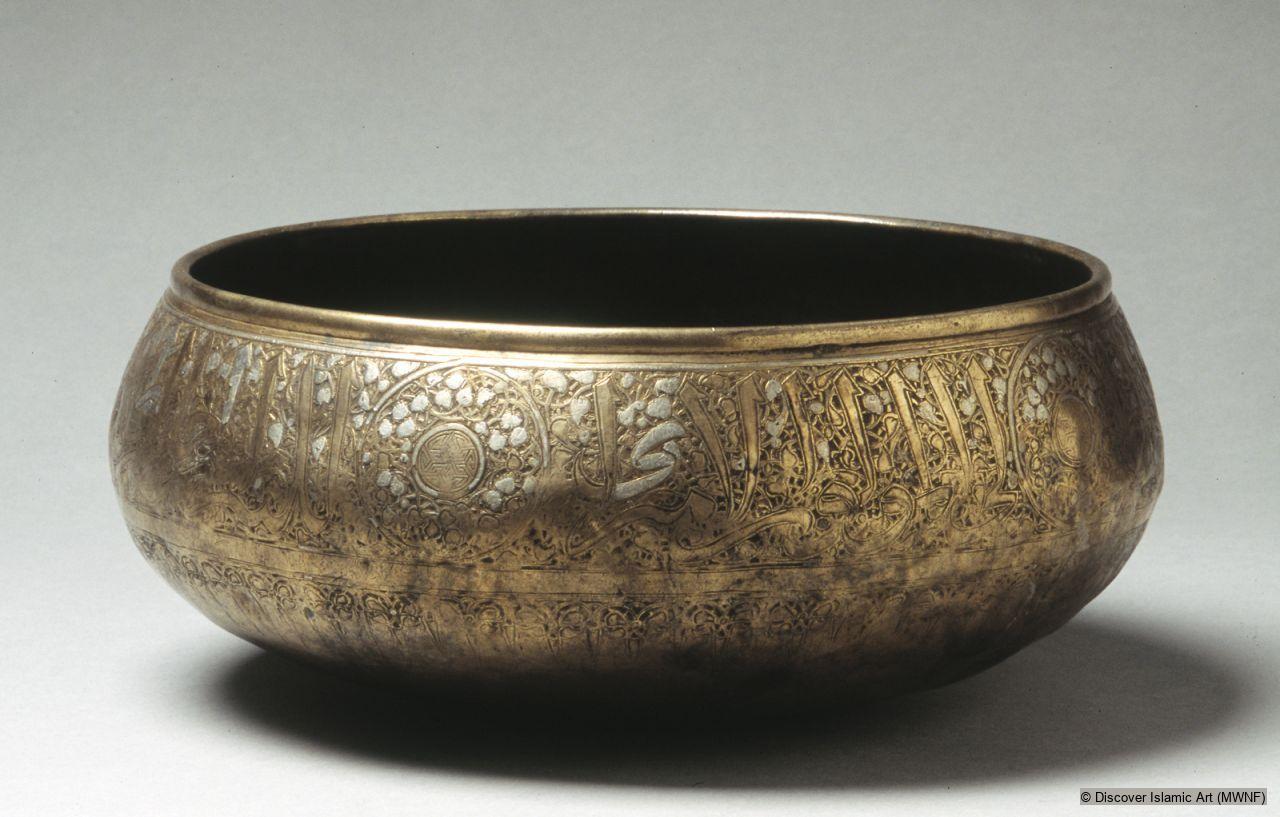
Name of Object:
Bowl
Location:
Stockholm, Sweden
Holding Museum:
Museum of Mediterranean and Near Eastern Antiquities (Medelhavsmuseet)
About Museum of Mediterranean and Near Eastern Antiquities (Medelhavsmuseet), Stockholm
Original Owner:
The original owner is not known, but in the narrow plain band beneath the inscription zone, the name of a later owner, al-Qasim ibn Ahmad, is engraved with the date AH 1093 (AD 1682)
Current Owner:
National Museum of Fine Arts, Stockholm. In order to reorganise the expanding collections, the main part of the Islamic collection has been on permanent loan to the Museum of Mediterranean and Near Eastern Antiquities since 1982
Date of Object:
Hegira 8th century / AD 14th century
Museum Inventory Number:
NM 0093/1935
Material(s) / Technique(s):
Brass, silver, black substance; engraved, inlaid.
Dimensions:
Height 11.9 cm, diameter 23.8 cm
Period / Dynasty:
Mamluk
Provenance:
Syria or Egypt.
Description:
The bowl has a rounded base, inward-sloping sides and a narrow vertical rim. The decoration of the exterior surface is divided into two horizontal zones based on floral, geometrical and epigraphic elements. In the wide upper zone, a large naskhi inscription is set against a background of arabesque scrolls and leaves interrupted by five roundels containing whirling rhombs within a border of arabesques. The inscription refers to an anonymous amir enumerating the usual titles such as highness, the lordly, the protector and defender of the frontiers or the fortified by God. To judge from the remains, the letters and floral elements were overlaid with silver and the depressed areas were filled with a black substance. Both colours, silver and black, were used to set off the design. Beneath the inscription, there is a narrow plain band, which contains the name of a later owner, al-Qasim ibn Ahmad, and the year AH 1093 (AD 1682) engraved in a cursive script. Towards the base the decoration is edged with an arabesque with lancet leaves. Inside the bowl is completely black. There is a hole drilled in the bottom.
View Short DescriptionBowl with a rounded base and a narrow rim. On the outside, the bowl is decorated with floral, geometrical and epigraphic motifs. The inscription refers to an anonymous amir. A narrow band below the inscription gives the name of a later owner, al-Qasim ibn Ahmad and the date AH 1093 (AD 1682).
How date and origin were established:
The shape of the bowl and the inscription were popular with Mamluk amirs throughout the 8th / 14th century in Egypt and Syria. Figurative motifs seem to have gone out of fashion at the end of the 7th / 13th century and the beginning of the 8th / 14th century in favour of bold naskhi inscriptions enumerating the titles of the sultans or amirs.
How Object was obtained:
Gift of the Swedish Crown Prince Gustaf Adolf to the National Museum in 1935. The bowl was purchased by him from Maurice Nahman in Cairo a year before.
How provenance was established:
The vessel has a form typical of Mamluk bowls. The bowl shape and the inscription were popular with Mamluk amirs throughout the 8th / 14th century in Egypt and Syria.
Selected bibliography:
Allan, J. W., Islamic Metalwork: The Nuhad Es-Said Collection, London, 1982.
Allan, J. W., Metalwork of the Islamic World: The Aron Collection, London, 1986.
Atil, E., Renaissance of Islam: Art of the Mamluks, Washington, 1981.
Baer, E., Metalwork in Medieval Islamic Art, New York, 1983.
Melikian-Chirvani, A. S., “Deux Chandeliers Mossouliens”, Bulletin des Musées et Monuments Lyonnais 3, 1970, pp.45–63.
Citation of this web page:
Friederike Voigt "Bowl" in Discover Islamic Art, Museum With No Frontiers, 2026.
https://islamicart.museumwnf.org/database_item.php?id=object;ISL;se;Mus01;14;en
MWNF Working Number: SE 15
RELATED CONTENT
Related objects


Islamic Dynasties / Period
On display in
Exhibition(s)
Download
As PDF (including images) As Word (text only)