

 Back
Back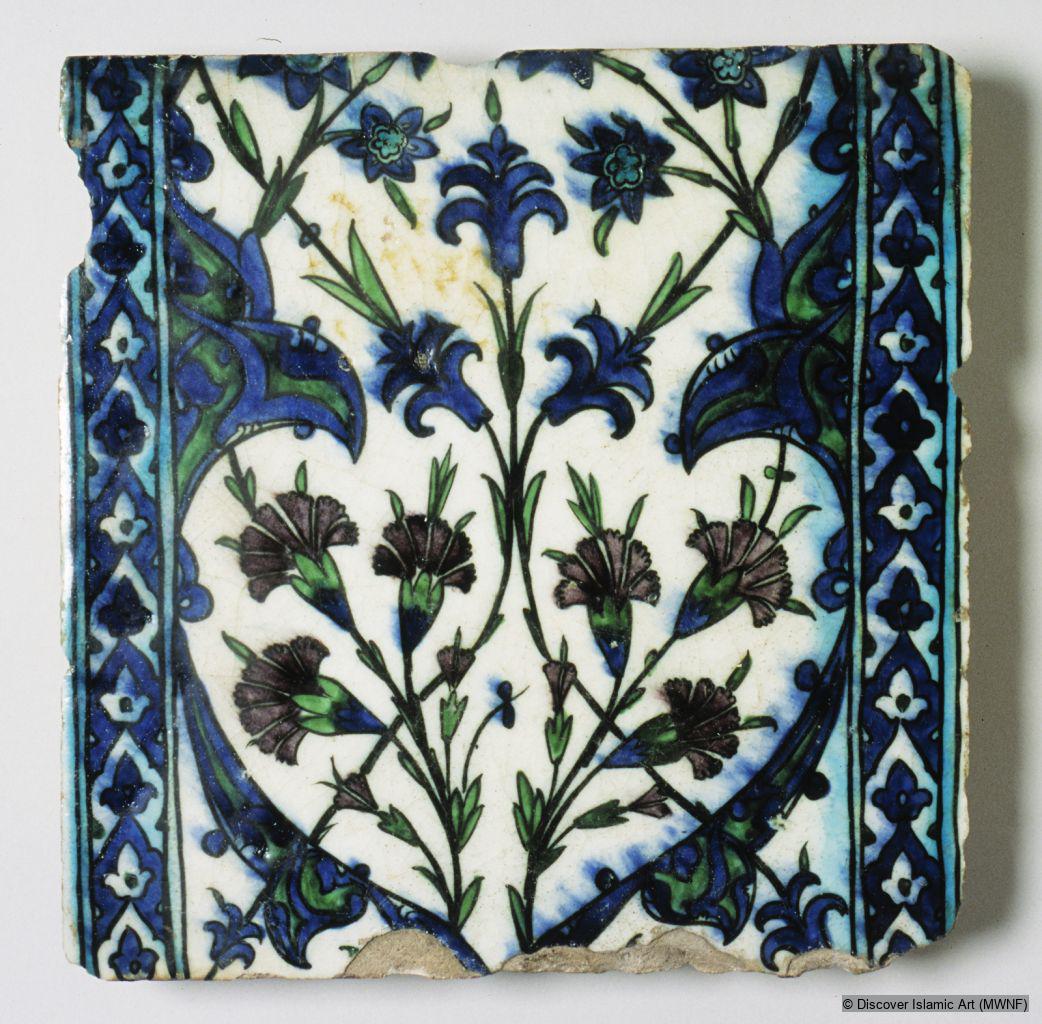
Name of Object:
Tile
Location:
Stockholm, Sweden
Holding Museum:
Museum of Mediterranean and Near Eastern Antiquities (Medelhavsmuseet)
About Museum of Mediterranean and Near Eastern Antiquities (Medelhavsmuseet), Stockholm
Date of Object:
Hegira mid-10th century / AD mid-16th century
Museum Inventory Number:
S.N.I. 001
Material(s) / Technique(s):
Ceramic; painted and glazed.
Dimensions:
Height 27 cm, width 27 cm, depth 1.8 cm
Period / Dynasty:
Ottoman
Provenance:
Iznik, Turkey.
Description:
The square-edge tile is decorated with a repetitive design painted in cobalt-blue, bright green, manganese purple and turquoise with deep black outlines under a transparent, colourless glaze on a white background. The blue and turquoise colours run and the glaze is crackled. Bands of alternating coloured trefoils between turquoise stripes frame the slightly damaged tile on the vertical sides. The design is symmetrically composed of two opposite arabesques linked with their points to half-trefoil motifs, both filled with arabesques. The area in between is filled with two sprays of carnations at the bottom, three lilies in the middle and two sprays of other flowers above. Two of the three lilies at the centre form an S-shaped tendril with stems growing out of the lower lilies and continue above with stems of flowers emerging from their blossoms. On the back, the tile is cut, showing that it was used in wall decoration.
View Short DescriptionSquare tile with underglaze painted decoration in blue, bright green and manganese. The symmetrically composed design shows arabesques forming an area filled with sprays of carnations, lilies and other flowers. The motif is framed with alternating coloured trefoils.
How date and origin were established:
The tile was dated from its colour scheme. In the 940s / 1540s Iznik underglaze painted tile work expanded its palette to include green and purple. Purple was replaced by red when it was introduced as an underglaze colour for tile work in the 950s / 1550s.
How Object was obtained:
There is no information about acquisition.
How provenance was established:
Attribution of pottery tiles showing this colour scheme is difficult since it was used by potters in both Iznik and Damascus. However, this tile seems to be a product of Iznik because of its fine paste and its intricate but delicate composition.
Selected bibliography:
Atasoy, N. and Raby, J., Iznik: The Pottery of Ottoman Turkey, London, 1989.
Carreaux Décoratifs de l'époque Ottomane. La Collection du Musée de Bonnat à Bayonne, Exhibition Catalogue, Bayonne, 2001.
Müller-Wiener, M., Türkisch-Osmanische Keramik, Traunstein, 2004.
Im Lichte des Halbmonds: Das Abendland und der Türkische Orient, Exhibition catalogue, Leipzig, 1995, cat. no. 42.
Citation of this web page:
Friederike Voigt "Tile" in Discover Islamic Art, Museum With No Frontiers, 2026.
https://islamicart.museumwnf.org/database_item.php?id=object;ISL;se;Mus01;16;en
MWNF Working Number: SE 17
RELATED CONTENT
Related objects
Islamic Dynasties / Period
On display in
Exhibition(s)
MWNF Galleries
CeramicsDownload
As PDF (including images) As Word (text only)