

 Back
Name of Object:
Jug
Location:
Stockholm, Sweden
Holding Museum:
Museum of Mediterranean and Near Eastern Antiquities (Medelhavsmuseet)
About Museum of Mediterranean and Near Eastern Antiquities (Medelhavsmuseet), Stockholm
Current Owner:
National Museum of Fine Arts, Stockholm. In order to reorganise the expanding collections, the main part of the Islamic collection has been on permanent loan to the Museum of Mediterranean and Near Eastern Antiquities since 1982
Date of Object:
Hegira 13th century / AD 19th century
Museum Inventory Number:
NM 0053/1899
Material(s) / Technique(s):
Ceramic; underglaze painted.
Dimensions:
Height 18.6 cm, diameter of rim 8.3 cm
Period / Dynasty:
Ottoman
Provenance:
Turkey.
Description:
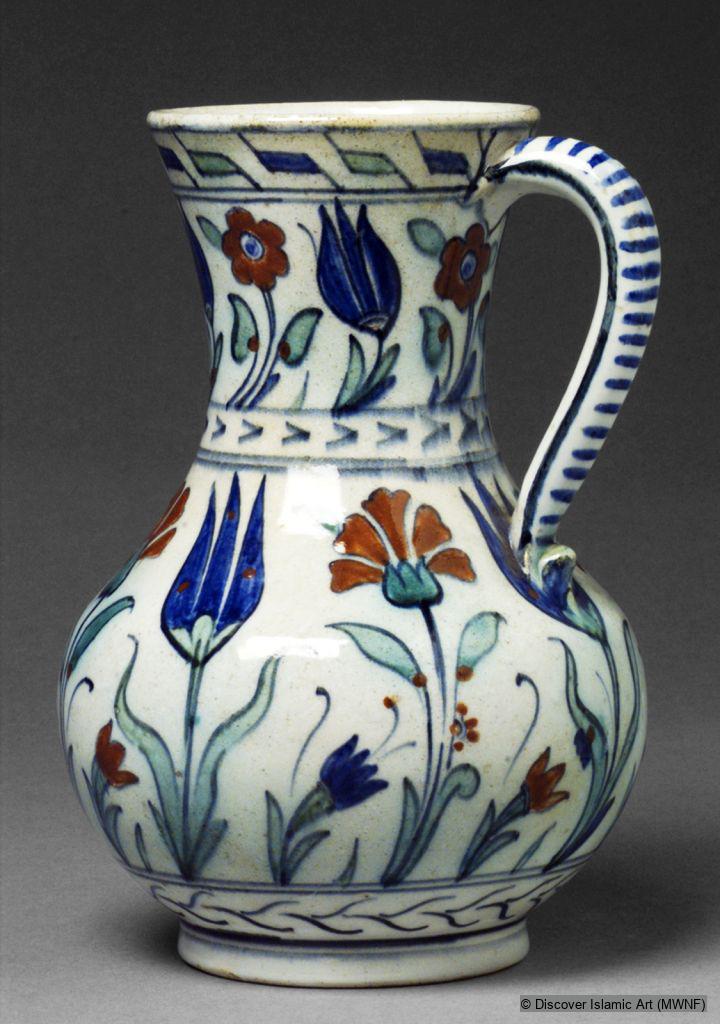
The jug has a squat globular body, a high concave neck with a flared rim and a low foot. It has underglaze painted in a bright blue, a thick opaque red and a diluted turquoise-green on a white slip. The design outlined in dark blue appears in two horizontal registers alternating tulips and carnations, referring to the floral style of the Iznik ceramics of the AH 10th–11th / AD 16th–17th centuries. However, as well as an obviously different kind of slip and glaze, the motifs are simplified and schematically executed. The handle and the narrow bands edging the floral depictions are ornamented with geometrical patterns. The jug is marked under the foot with a crescent and an asterisk.
View Short DescriptionJug of polychrome painted pottery. The motifs of the decoration – tulips and carnations – refer to the floral style of Iznik ceramics. The handle shows a geometrical pattern. The jug is marked under the foot with a crescent and an asterisk.
How date and origin were established:
Unlike Iznik wares of the 'quatre fleurs' style of the 10th–11th / 16th–17th centuries, this jug is marked under the foot. The object was dated according to similar marks, which are known from Ottoman ceramics of the 13th / 19th century, for example, from Istanbul.
How Object was obtained:
Purchased from the collection of F. R. Martin in 1898.
How provenance was established:
A vase housed in the Museum of Mediterranean and Near Eastern Antiquities has similar decoration and a mark which is signed 'Istanbul' within the crescent. However, it was not possible to identify the workshop to which the mark of a crescent and asterisk on the bottom belongs.
Selected bibliography:
Atasoy, N. and Raby, J., Iznik: The Pottery of Ottoman Turkey, London, 1989.
Carswell, J., Iznik Pottery, London, 1998.
Lane, A., Later Islamic Pottery, London, 1971.
Müller-Wiener, M., Türkisch-Osmanische Keramik, Traunstein, 2004.
Citation of this web page:
Friederike Voigt "Jug" in Discover Islamic Art, Museum With No Frontiers, 2026.
https://islamicart.museumwnf.org/database_item.php?id=object;ISL;se;Mus01;29;en
MWNF Working Number: SE 31
RELATED CONTENT
Related objects

Islamic Dynasties / Period
On display in
Exhibition(s)
MWNF Galleries
CeramicsDownload
As PDF (including images) As Word (text only)