

 Back
Back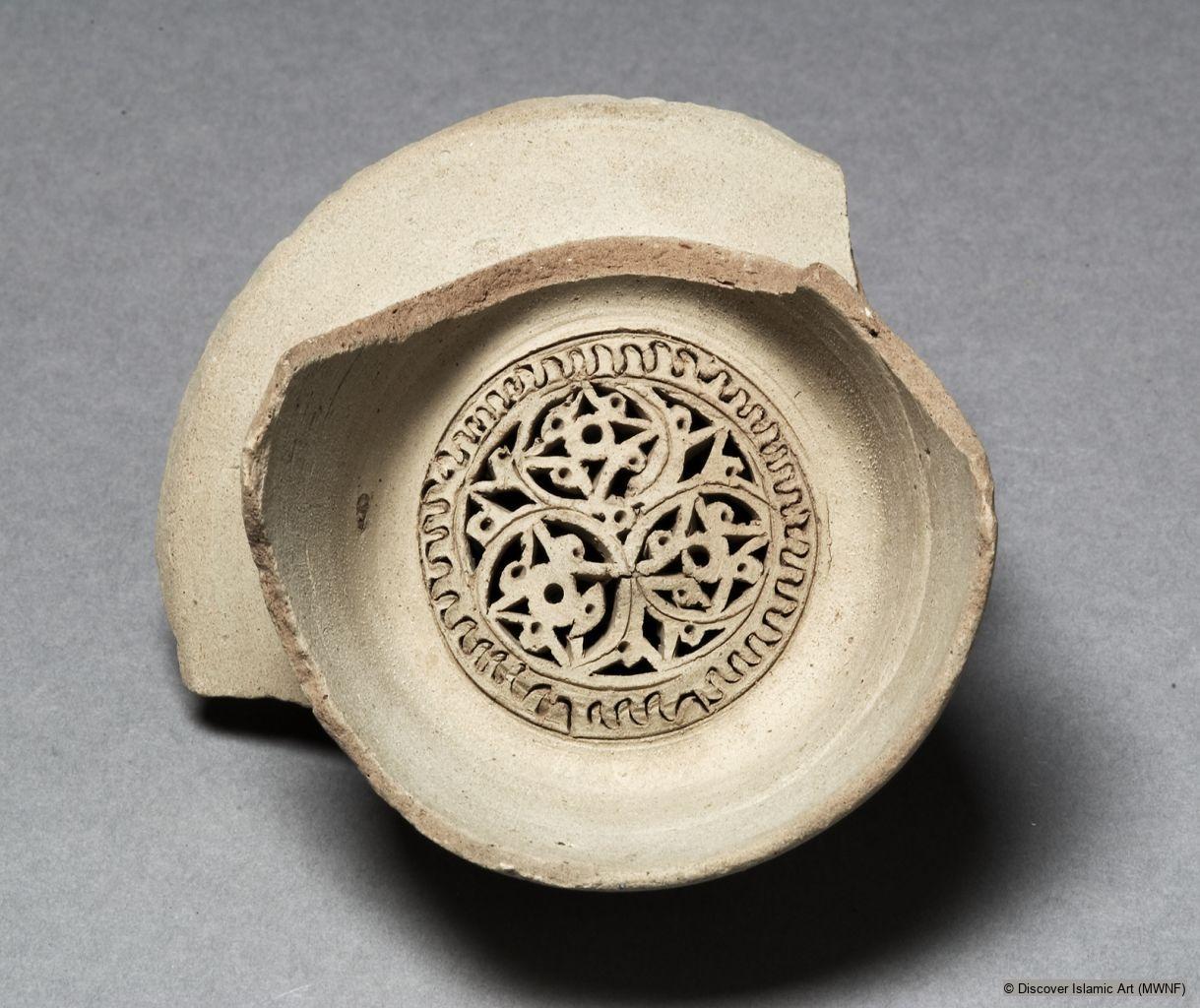
Name of Object:
Strainer
Location:
Stockholm, Sweden
Holding Museum:
Museum of Mediterranean and Near Eastern Antiquities (Medelhavsmuseet)
About Museum of Mediterranean and Near Eastern Antiquities (Medelhavsmuseet), Stockholm
Current Owner:
National Museum of Fine Arts, Stockholm. In order to reorganise the expanding collections, the main part of the Islamic collection has been on permanent loan to the Museum of Mediterranean and Near Eastern Antiquities since 1982
Date of Object:
Hegira 5th–6th centuries / AD 11th–12th centuries
Museum Inventory Number:
NM 0423/1921
Material(s) / Technique(s):
Earthenware; unglazed, incised.
Dimensions:
Diameter 6.5 cm
Period / Dynasty:
Fatimid
Provenance:
Al-Fustat, Egypt.
Description:
The reddish-grey earthenware fragment comes from a vessel that was provided with a slightly convex strainer. The lattice of this strainer is a geometrical design composed of circles and curved lines. The basic unit of the pattern is a circle filled with a four-sided border bent inwards to form a star with a holed circlet at the centre and four circles in the middle of the sides. The whole design is composed of three of these circles. The space between them is filled with a pointed motif flanked by two tiny holed circlets, which repeats a section of the basic pattern. An incised zigzag line bordered by two curved lines surrounds the openwork at the centre. The zigzag line is a characteristic element of Fatimid strainer designs.
The strainer was placed at the juncture of neck and shoulder of an earthenware vessel to protect the stored liquid from insects and pollution. Most strainer vessels of the Islamic period were manufactured of clay. The vessels remained unglazed in order to allow evaporation through the porous material, if it was wished to keep the stored liquid, mostly water, cool.
Designs put together on the basis of simple geometrical shapes such as circles, lines or triangles, the repetition of these elements and their rearrangement in new patterns are a feature of Fatimid strainers. Geometrical compositions are dominant among the strainer designs of this period followed by zoomorphic and epigraphic motifs. Decorative strainers are known from excavations from the AH 2nd / AD 8th century to the AH 9th / AD 15th century, but Fatimid period was the high point of their development.
Earthenware fragment which was integrated in a vessel as a strainer. The latticework is composed of a geometrical design of circles and curved lines. The strainer was placed at the juncture of neck and shoulder of the earthenware vessel to protect the stored liquid from insects and pollution.
How date and origin were established:
Strainers of this pattern excavated in undisturbed strata were dated to the 5th and 6th / 11th and 12th centuries.
How Object was obtained:
Purchased from the collection of the Swedish art dealer and art historian F. R. Martin in 1921.
How provenance was established:
Similar strainers were excavated at al-Fustat and their place of manufacture ascribed to the city. According to F. R. Martin, this strainer comes from excavations at al-Fustat.
Selected bibliography:
Olmer, P., Catalogue Général du Musée Arabe du Caire: Les Filtres de Gargoulettes, Cairo, 1932.
Scanlon, G. T., Fustat Expedition Final Report. Vol. 1: Catalogue of Filters, Winona Lake, 1986.
Wittkowski, G., “Arabic Filters from the Collection of the Cracow Archaeological Museum”, Materialy Archeologiczne XXX, 1997, 41–55.
Citation of this web page:
Friederike Voigt "Strainer" in Discover Islamic Art, Museum With No Frontiers, 2026.
https://islamicart.museumwnf.org/database_item.php?id=object;ISL;se;Mus01;49;en
MWNF Working Number: SE 59
RELATED CONTENT
Related objects
Related monuments
Islamic Dynasties / Period
On display in
Exhibition(s)
MWNF Galleries
CeramicsDownload
As PDF (including images) As Word (text only)