

 Back
Back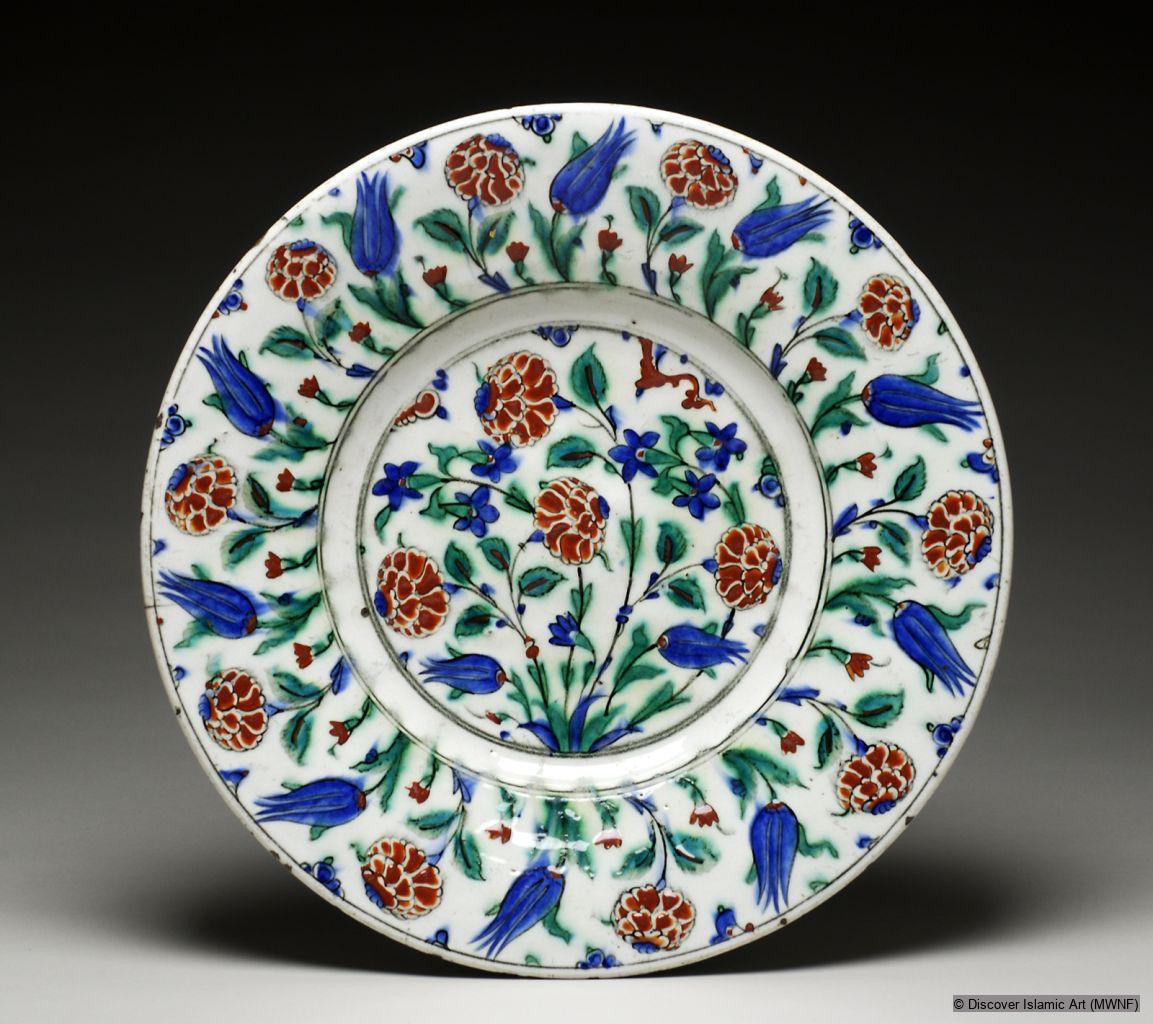
Name of Object:
Dish
Location:
Stockholm, Sweden
Holding Museum:
Museum of Mediterranean and Near Eastern Antiquities (Medelhavsmuseet)
About Museum of Mediterranean and Near Eastern Antiquities (Medelhavsmuseet), Stockholm
Current Owner:
National Museum of Fine Arts, Stockholm. In order to reorganise the expanding collections, the main part of the Islamic collection has been on permanent loan to the Museum of Mediterranean and Near Eastern Antiquities since 1982
Date of Object:
Hegira around 1009 / AD around 1600
Museum Inventory Number:
CXV/734
Material(s) / Technique(s):
Ceramic; painted and glazed.
Dimensions:
Height 6 cm, diameter 38 cm
Period / Dynasty:
Ottoman
Provenance:
Iznik, Turkey.
Description:
The polychrome underglaze painted dish, with a broad slightly curved rim and a small flattened well, shows European influence. In the first half of the AH 10th / AD 16th century, Iznik ware, in seeking new sources of inspiration for designs and forms, included the tondino, a shape of Italian origin. The striking form of the dish under discussion derives from this type of maiolica (tin-glazed earthenware) and its Turkish imitations.
The centre of the dish is decorated with a 'quatre fleurs' design of two tulips on short stalks, four roses on long curved stems and two sprays of other flowers, all springing from a leafy tuft. The roses with their large red blossoms dominate the centre of the dish and the decoration of the rim. The rim shows radiating floral stems of alternating tulips, roses and small flowers with red blossoms. Along the border of both rim and well, a red Chinese cloud and small forms derived from the motif of Chinese waves are set between the blossoms. The floral design with black outlines is coloured in a contrast of bright, slightly running blue and green with a thick raised applied opaque red on a white background. The outside of the dish is painted with ten blue flower-like motifs on white slip. The back and bottom of the dish, except for the foot-ring, are transparent glazed.
Polychrome underglaze painted dish with a broad rim and a small flattened well. Roses with large red blossoms dominate the pattern of the centre and the rim. Following the Iznik style other flowers and Chinese clouds are also included. The shape of the dish shows European influence.
How date and origin were established:
The 'quatre fleurs' style was a development of the second half of the 10th / 16th century. The slightly running colours suggest a dating at the end of the 10th / 16th century – beginning of the 11th / 17th century, but not much later because of the high quality of the glaze. Atasoy and Raby dated a plate of similar shape and decoration to 1009–19 / 1600–10.
How Object was obtained:
Bequest of King Charles XV.
How provenance was established:
The floral decoration and the shape are both specific to Iznik ceramics.
Selected bibliography:
Atasoy, N. and Raby, J., Iznik: The Pottery of Ottoman Turkey, London, 1989.
Carswell, J., Iznik Pottery, London, 1998.
Müller-Wiener, M., Türkisch-Osmanische Keramik, Traunstein, 2004.
Citation of this web page:
Friederike Voigt "Dish" in Discover Islamic Art, Museum With No Frontiers, 2026.
https://islamicart.museumwnf.org/database_item.php?id=object;ISL;se;Mus01;7;en
MWNF Working Number: SE 08
RELATED CONTENT
Related objects


Islamic Dynasties / Period
On display in
Exhibition(s)
Discover Islamic Art
Echoes of Paradise: the Garden and Flora in Islamic Art | The Role of Individual Plants and Flowers The Ottomans | Exporting LuxuryMWNF Galleries
CeramicsDownload
As PDF (including images) As Word (text only)