

 Back
Back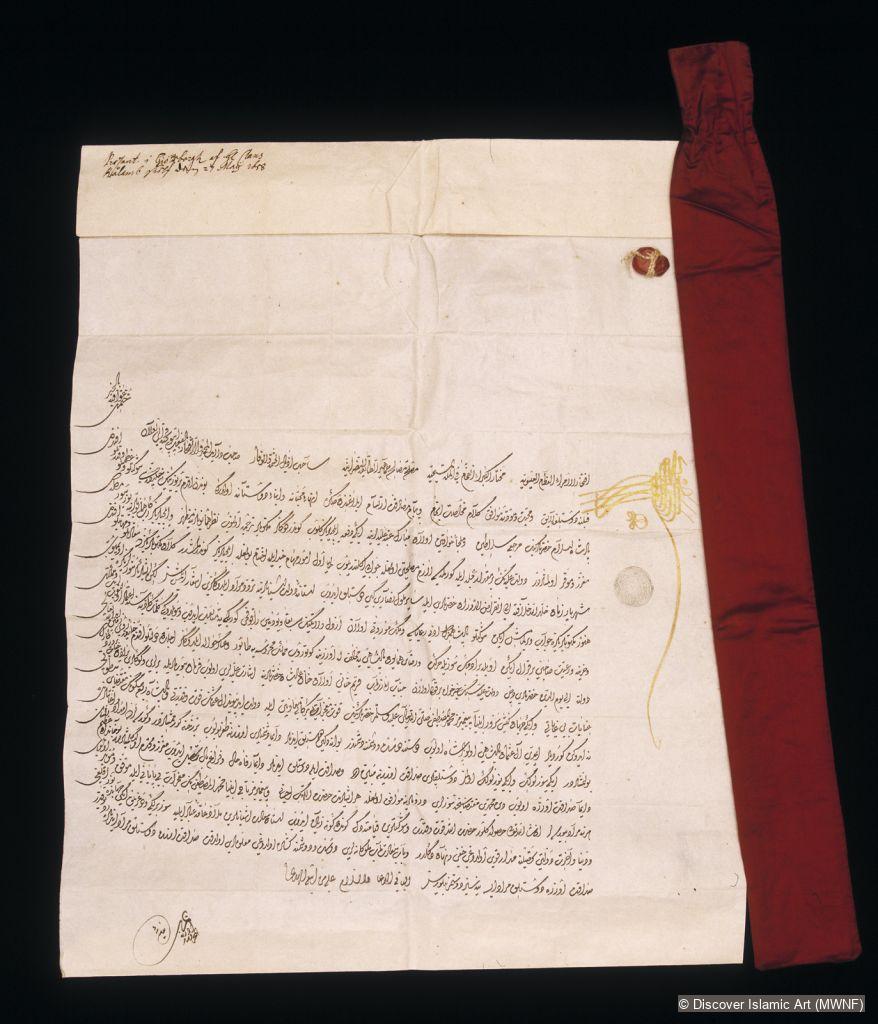
Name of Object:
Diplomatic document with case
Location:
Stockholm, Sweden
Holding Museum:
Swedish National Archives
Original Owner:
King Charles X Gustavus (r. 1654–60)
Date of Object:
Hegira 1067–8 / between May AD 1657 and January AD 1658
Museum Inventory Number:
Turcica 56
Material(s) / Technique(s):
Paper, ink, silk.
Dimensions:
Height 76 cm, width 50 cm
Period / Dynasty:
Ottoman
Provenance:
Ottoman encampment near Edirne, Turkey.
Description:
This document is one of more than 120 letters of diplomatic correspondence kept in the Swedish National Archives that testify to Swedish relations with the Ottomans. In 1657, the Swedish King Charles X Gustavus (r. 1654–60) sent Claes Ralamb and Gotthard Vellingk as his envoys to the Sublime Porte to achieve an alliance with the Ottoman Empire. The Grand Vizier Mehmed Köprülü who wrote this letter, acknowledges the receipt of two letters from the Swedish king and confirms that his envoys have been admitted to the presence of the sultan. He notifies that the Sublime Porte rejects his request to enter into an alliance with the Ottoman Empire because his actions do not correspond to his words. The grand vizier reproaches the king for his alliance with the former Voivode of Transylvania, Georg Rákóczy, and for his attack on Poland against the will of the sultan. In fact, after his accession to the throne, in 1655 Charles X Gustavus declared war against the Polish King Johann Kasimir because he would not allow his succession to the throne. One year later, in 1656, he gained a victory over Poland. However, the sultan took the Swedish attack on Poland as an attack on the Ottoman Empire. Georg II Rákóczy (1615–60), who had achieved sovereignty in Moldavia and Walachia with the aid of Sultan Mehmed IV, likewise reinforced Sweden's war against the sultan's will. In 1657, for that reason he suffered the loss of the Transylvanian throne at the instigation of the Ottomans. Claes Ralamb (1622–98), who stayed in Istanbul from May 1657 until January 1658, was the first Swedish envoy at the Sublime Porte. In these circumstances, his mission had to come to an end without success. According to the inscription in the left corner above, he presented this letter enveloped in the red silk case on 27 May 1658 to Charles X Gustavus in Gothenburg.
View Short DescriptionLetter written by the sultan’s Grand Vizier Mehmet Köprülü to the Swedish King Charles X Gustavus. Claes Ralamb, the first Swedish envoy at the Sublime Porte, asked, on behalf of his king, for an alliance with the Ottoman Empire. The sultan rejected this and Ralamb returned to Sweden without success.
How date and origin were established:
According to the date of C. Ralamb's stay in Istanbul. The letter itself is not dated.
How Object was obtained:
The object is part of the diplomatic correspondence regularly handed over to the National Archives by the Foreign Ministry.
How provenance was established:
This letter was sent by the Grand Vizier Mehmed Köprülü to King Charles X Gustavus written at an encampment near Edirne as mentioned in the letter.
Selected bibliography:
Björkman, W., “Die Schwedisch-Türkischen Beziehungen bis 1800”, in Festschrift für Georg Jacob zum 70. Geburtstag, Leipzig, 1932.
Zetterstéen, K. V., Türkische, Tatarische und Persische Urkunden im Schwedischen Reichsarchiv, 1945, pp.25–6, no. 56.
Citation of this web page:
Friederike Voigt "Diplomatic document with case" in Discover Islamic Art, Museum With No Frontiers, 2026.
https://islamicart.museumwnf.org/database_item.php?id=object;ISL;se;Mus01_A;43;en
MWNF Working Number: SE 47
RELATED CONTENT
Islamic Dynasties / Period
On display in
Exhibition(s)
Download
As PDF (including images) As Word (text only)