

 Back
Back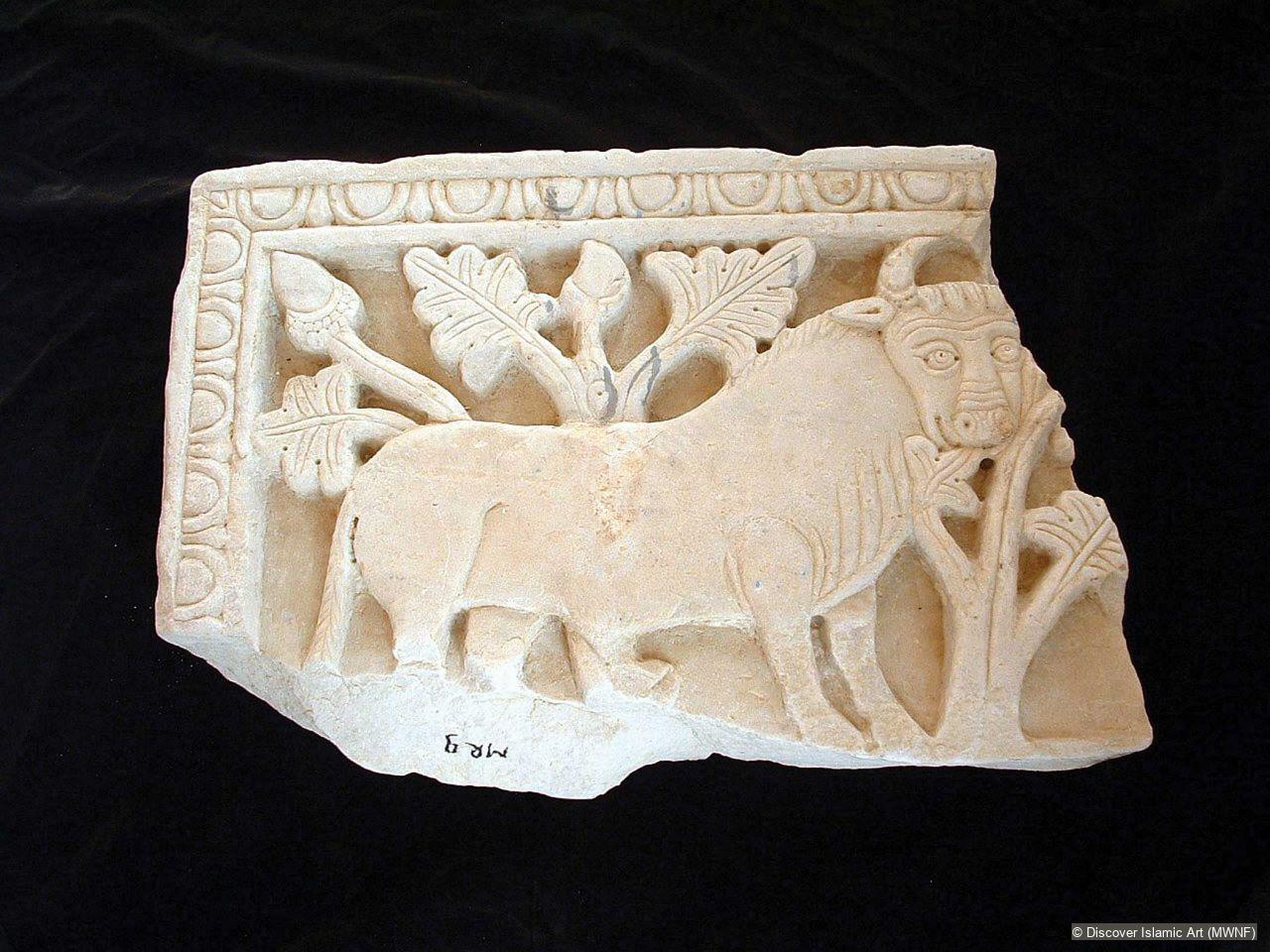
Name of Object:
Bas-relief with bull
Location:
Raqqada, Kairouan, Tunisia
Holding Museum:
Museum of Islamic Art
About Museum of Islamic Art, Raqqada.
Date of Object:
Hegira, second half of the 3rd century / AD 9th century
Museum Inventory Number:
MR 009
Material(s) / Technique(s):
Carved marble.
Dimensions:
Height 38 cm, length 57 cm, thickness 11 cm
Period / Dynasty:
Aghlabid
Provenance:
Very probably Raqqada.
Description:
A bas-relief of a bull carved in marble. The right-hand and lower parts of the carving are missing. The head of the bull is full-face and the body and the neck are in profile. The head looks, oddly, at a complete right angle to the neck. The features are strongly sculpted, with the nose suggested by folds ending in a cavity. The eyes are round, the iris well-carved and the lower eyelids stand out aggressively from the eyeballs. The forehead is two deep folds under a plaited mane.
Only one horn remains, next to the ear, the other having been broken off. The body of the animal is harmonious but gives no impression of robust strength. From the position of the legs, the bull seems to be rubbing up against a tree composed of a trunk and a few branches. Behind the animal's body two buds and three open vine-leaves emerge. Each element has several lobes and is sculpted in a naturalistic style. The carving is set within a frame decorated with grooved arcs and points similarly to an 'egg and dart' design. The naturalistic manner of the carving has led some historians to attribute a Byzantine origin to the piece and suggest that it was re-used in the Aghlabid era. But, in fact, several similar pieces exist in Muslim art and the frontal muzzle is very frequently found. Moreover, we should not forget that Byzantine and classical influences are characteristic of early Aghlabid art.
The decoration of this bas-relief is quite common in Islamic art, and is evidence of the survival of Byzantine and classical influences. The body of the animal, a bull, is sculpted harmoniously and the sculpture is framed by arcs and points similar to 'egg and dart' design.
How date and origin were established:
This piece decorated one of the walls in the state rooms of the as-Sahn Palace on the Raqqada site, which was excavated between 1961 and 1969. We know that this second Aghlabid capital was built in 263 / 876, which puts a terminus post quem date on the bas-relief. The chronological period covers two centuries, up until the desertion of Raqqada at the time of the Hilalian invasions in 449 / 1057. Not possessing an excavation file with information on the archaeological layer in which the object was found, we are unable to date it more precisely. However, the classical style of the decoration would suggest the second half of the 3rd / 9th century.
How Object was obtained:
After its discovery at the Raqqada excavations in 1960 the bas-relief was conserved at the site storehouse until 1993. It was then transferred to the Museum of Islamic Art at Raqqada and displayed there.
How provenance was established:
An architectural decoration found in situ, the piece was probably carved at Raqqada, re-using some old marble of Italian origin.
Selected bibliography:
Ifriqiya: Thirteen Centuries of Art and Architecture in Tunisia, pp.174–6.
Citation of this web page:
Mourad Rammah "Bas-relief with bull" in Discover Islamic Art, Museum With No Frontiers, 2026.
https://islamicart.museumwnf.org/database_item.php?id=object;ISL;tn;Mus01;34;en
Prepared by: Mourad RammahMourad Rammah
Né en 1953 à Kairouan, docteur en archéologie islamique, Mourad Rammah est le conservateur de la médina de Kairouan. Lauréat du prix Agha Khan d'architecture, il publie divers articles sur l'histoire de l'archéologie médiévale islamique en Tunisie et participe à différentes expositions sur l'architecture islamique. De 1982 à 1994, il est en charge du département de muséographie du Centre des arts et des civilisations islamiques. Mourad Rammah est également directeur du Centre des manuscrits de Kairouan.
Copyedited by: Margot Cortez
Translation by: David Ash
Translation copyedited by: Mandi GomezMandi Gomez
Amanda Gomez is a freelance copy-editor and proofreader working in London. She studied Art History and Literature at Essex University (1986–89) and received her MA (Area Studies Africa: Art, Literature, African Thought) from SOAS in 1990. She worked as an editorial assistant for the independent publisher Bellew Publishing (1991–94) and studied at Bookhouse and the London College of Printing on day release. She was publications officer at the Museum of London until 2000 and then took a role at Art Books International, where she worked on projects for independent publishers and arts institutions that included MWNF’s English-language editions of the books series Islamic Art in the Mediterranean. She was part of the editorial team for further MWNF iterations: Discover Islamic Art in the Mediterranean Virtual Museum and the illustrated volume Discover Islamic Art in the Mediterranean.
True to its ethos of connecting people through the arts, MWNF has provided Amanda with valuable opportunities for discovery and learning, increased her editorial experience, and connected her with publishers and institutions all over the world. More recently, the projects she has worked on include MWNF’s Sharing History Virtual Museum and Exhibition series, Vitra Design Museum’s Victor Papanek and Objects of Desire, and Haus der Kulturen der Welt’s online publication 2 or 3 Tigers and its volume Race, Nation, Class.
MWNF Working Number: TN 57
RELATED CONTENT
Related objects

Related monuments

Islamic Dynasties / Period
On display in
Exhibition(s)
Download
As PDF (including images) As Word (text only)