

 Back
Back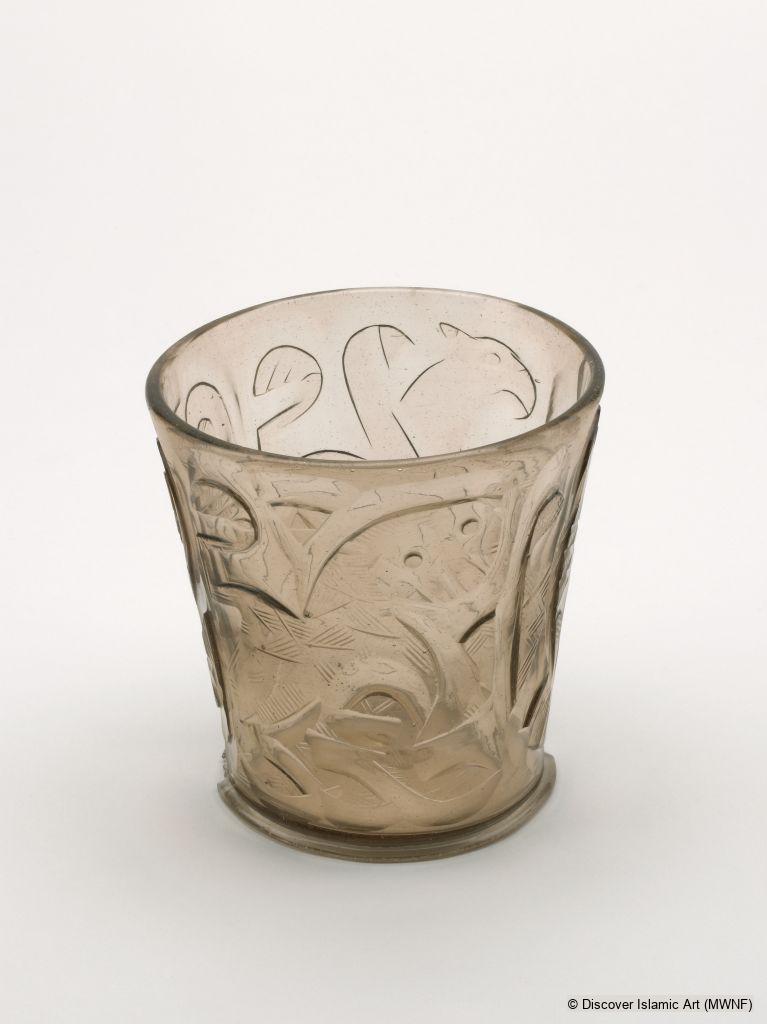
Name of Object:
Beaker
Location:
London, England, United Kingdom
Holding Museum:
The British Museum
About The British Museum, London
Date of Object:
Hegira 5th or 6th century / AD 11th or 12th century
Museum Inventory Number:
1959.4-14.1
Material(s) / Technique(s):
Relief cut-glass.
Dimensions:
Height 14 cm
Period / Dynasty:
Fatimid / Ayyubid
Description:
A glass beaker with thick walls and slanted relief cut decoration of figures and hatched detail. Covering the body of the beaker is a highly skilled rendering of an eagle, griffon and a lion against a background of palmettes. This is one of a group of relief cut-glass beakers known as the 'Hedwig' beakers. They range in height from 8.3 cm to 14.6 cm; this vase is one of the tallest. The name derives from the association of the beakers with Saint Hedwig of Silesia (AD 1174–1245). Henry I 'the Bearded' was alarmed at Hedwig's abstention from wine, believing it to be essential for maintaining good health. However, one day as she lifted her glass to drink he saw the water inside turn into wine. The story of Hedwig and her glasses became legendary in later centuries, causing a number of glass vessels in Germany to be associated with her, and have miraculous properties attributed to them.
View Short DescriptionOne of a distinctive group of thick-walled glass beakers with an intricate relief-cut decoration of figures. It is difficult to place the exact date and place of production. There are no equivalent dated or signed medieval cut-glass objects.
How date and origin were established:
It is difficult to provide a precise date for this group of beakers. However, two of them are recorded as gifts of Jacques de Vitry, who was Bishop of Acre from 1216 to 1226, to the Church of Saint Nicolas d'Oignies aux Soeurs de Notre-Dame in Namur, Belgium. Therefore, they must have been made before about 1200. It seems likely that they were produced under the Fatimids in the 5th or 6th / 11th or 12th century.
How Object was obtained:
Donated to the British Museum by P. T. Brooke Sewell in 1959.
How provenance was established:
The Hedwig glasses are a puzzling group because they are difficult to relate to any other type of medieval cut-glass. The Islamic world, Byzantium or southern Italy have all been conjectured by scholars as possible places of production. However, there was a strong tradition of relief-cutting in Egypt. The eagle, lion and griffon were frequently reproduced in Fatimid and Ayyubid art in various media; they also appear in Christian art.
Selected bibliography:
Brend, B., Islamic Art, London, 1991, p.61.
Tait, H., (ed.), Five Thousand Years of Glass, London, 1991, pp.126–8.
Whitehouse, D., "A Note on Hedwig Glasses", Cairo to Kabul (eds. W. Ball and L. Harrow), London, 2002, pp.255–9.
Citation of this web page:
Emily Shovelton "Beaker" in Discover Islamic Art, Museum With No Frontiers, 2026.
https://islamicart.museumwnf.org/database_item.php?id=object;ISL;uk;Mus01;9;en
Prepared by: Emily ShoveltonEmily Shovelton
Emily Shovelton is a historian of Islamic art. She studied history of art at Edinburgh University before completing an MA in Islamic and Indian art at the School of Oriental and African Studies (SOAS) in London. Since graduating she has worked on a number of projects at the British Museum. Other recent work includes editing and writing for a digital database of architectural photographs at the British Library. She is currently working on a Ph.D. on “Sultanate Painting in 15th-century India and its relationship to Persian, Mamluk and Indian Painting”, to be completed at SOAS in 2006. A paper on Sultanate painting given at the Conference of European Association of South Asian Archaeologists, held in the British Museum in July 2005, is due to be published next year.
Copyedited by: Mandi GomezMandi Gomez
Amanda Gomez is a freelance copy-editor and proofreader working in London. She studied Art History and Literature at Essex University (1986–89) and received her MA (Area Studies Africa: Art, Literature, African Thought) from SOAS in 1990. She worked as an editorial assistant for the independent publisher Bellew Publishing (1991–94) and studied at Bookhouse and the London College of Printing on day release. She was publications officer at the Museum of London until 2000 and then took a role at Art Books International, where she worked on projects for independent publishers and arts institutions that included MWNF’s English-language editions of the books series Islamic Art in the Mediterranean. She was part of the editorial team for further MWNF iterations: Discover Islamic Art in the Mediterranean Virtual Museum and the illustrated volume Discover Islamic Art in the Mediterranean.
True to its ethos of connecting people through the arts, MWNF has provided Amanda with valuable opportunities for discovery and learning, increased her editorial experience, and connected her with publishers and institutions all over the world. More recently, the projects she has worked on include MWNF’s Sharing History Virtual Museum and Exhibition series, Vitra Design Museum’s Victor Papanek and Objects of Desire, and Haus der Kulturen der Welt’s online publication 2 or 3 Tigers and its volume Race, Nation, Class.
MWNF Working Number: UK1 12
RELATED CONTENT
Related objects

On display in
Exhibition(s)
MWNF Galleries
GlassDownload
As PDF (including images) As Word (text only)