

 Back
Back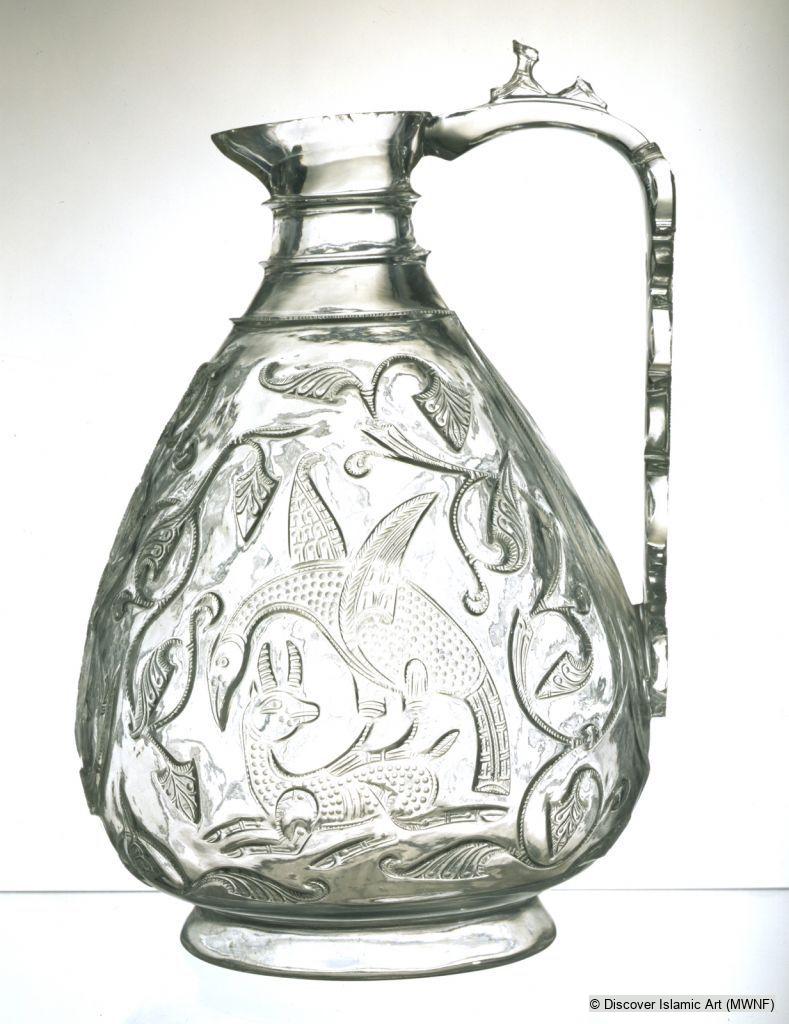
Name of Object:
Ewer
Location:
London, England, United Kingdom
Holding Museum:
Victoria and Albert Museum
About Victoria and Albert Museum, London
Date of Object:
About hegira 391–452 / AD 1000–1060
Museum Inventory Number:
7904–1862
Material(s) / Technique(s):
Carved rock-crystal.
Dimensions:
Height 19.4 cm, diameter (of base) 9 cm
Period / Dynasty:
Fatimid
Provenance:
Probably Cairo, Egypt.
Description:
A ewer carved from a single piece of rock-crystal. It has a pear-shaped body, beaked rim, and slightly splayed foot; a handle, which originally had a vertical thumb-piece at its apex, joins the rim to the lower part of the body. The body of the ewer is decorated on either side with identical scenes of a bird of prey attacking a four-legged animal with horns (a gazelle?). These vignettes are framed by large, leafy arabesque motifs. The whole design is contained within a delicate raised band which goes around the neck and down the body of the ewer on either side of the handle. This band acts as a frame and gives the design the feel of a textile wrapped around the ewer’s body. All of the details are drilled and cut with great skill, including the texturing in the form of lines and dots covering the bird and animal and the leaves of the arabesque patterns. Objects like this ewer were among the thousands of precious items looted from the Fatimid treasury during the unrest of 450 AH / AD 1060. A number of these made their way to Europe, where they were used as reliquaries in church treasuries.
View Short DescriptionA pear-shaped ewer carved from a single block of the clear, colourless quartz known as rock-crystal. It is one of a number of luxury wares carved from rock-crystal for the Fatimid court in Cairo. Many such objects made their way into European church treasuries, where they were used as reliquaries.
How date and origin were established:
There is a clear relationship between this ewer and a group of others in European collections, one of which has an inscription naming the Fatimid Caliph al-‘Aziz (r. AH 365–86 / AD 975–96). The decoration on the V&A ewer, including the arabesque pattern, is more complex and mature than is that on the others, suggesting a later date. Finally, Fatimid rock-crystal production was severely disrupted when violent social upheavals began in AH 452 / AD 1061.
How Object was obtained:
Purchased by the Museum in 1862.
How provenance was established:
Cairo was the Fatimid capital and thus the likeliest place that an object of such quality would have been made.
Selected bibliography:
Contadini, A., Fatimid Art at the Victoria and Albert Museum, London, 1998, pp.16–38.
Stanley, T., with Rosser-Owen, M. and Vernoit, S., Palace and Mosque: Islamic Art from the Middle East, London, 2004, pp.94–5.
Citation of this web page:
Barry Wood "Ewer" in Discover Islamic Art, Museum With No Frontiers, 2026.
https://islamicart.museumwnf.org/database_item.php?id=object;ISL;uk;Mus02;1;en
Prepared by: Barry WoodBarry Wood
Barry Wood is Curator (Islamic Gallery Project) in the Asian Department of the Victoria and Albert Museum in London. He studied history of art at Johns Hopkins University and history of Islamic art and architecture at Harvard University, from where he obtained his Ph.D. in 2002. He has taught at Harvard, Eastern Mediterranean University, the School of Oriental and African Studies, and the Courtauld Institute of Art. He has also worked at the Harvard University Art Museums and the Walters Art Museum in Baltimore. He has published on topics ranging from Persian manuscripts to the history of exhibitions.
Copyedited by: Mandi GomezMandi Gomez
Amanda Gomez is a freelance copy-editor and proofreader working in London. She studied Art History and Literature at Essex University (1986–89) and received her MA (Area Studies Africa: Art, Literature, African Thought) from SOAS in 1990. She worked as an editorial assistant for the independent publisher Bellew Publishing (1991–94) and studied at Bookhouse and the London College of Printing on day release. She was publications officer at the Museum of London until 2000 and then took a role at Art Books International, where she worked on projects for independent publishers and arts institutions that included MWNF’s English-language editions of the books series Islamic Art in the Mediterranean. She was part of the editorial team for further MWNF iterations: Discover Islamic Art in the Mediterranean Virtual Museum and the illustrated volume Discover Islamic Art in the Mediterranean.
True to its ethos of connecting people through the arts, MWNF has provided Amanda with valuable opportunities for discovery and learning, increased her editorial experience, and connected her with publishers and institutions all over the world. More recently, the projects she has worked on include MWNF’s Sharing History Virtual Museum and Exhibition series, Vitra Design Museum’s Victor Papanek and Objects of Desire, and Haus der Kulturen der Welt’s online publication 2 or 3 Tigers and its volume Race, Nation, Class.
MWNF Working Number: UK2 01
RELATED CONTENT
Related objects


Islamic Dynasties / Period
On display in
Exhibition(s)
Discover Islamic Art
Figurative Art | Animal Representation The Fatimids | Pleasures and Celebrations at CourtThe Table Is Set
Environment | The Diversity of the TablewareMWNF Galleries
GlassDownload
As PDF (including images) As Word (text only)