

 Back
Name of Object:
Half of the Holy Qur’an
Location:
Damascus, Syria
Holding Museum:
National Museum of Damascus
About National Museum of Damascus, Damascus
Original Owner:
Ibrahim bin Muhammad Ibrahim al-Saifi Manjak (d. AH 9th / AD 15th century), grandson of the Mamluk Ibrahim Manjak who was twice governor of Damascus during the second half of the AH 8th / AD 14th century
Date of Object:
Hegira 8th–9th century / AD 14th–15th century
Museum Inventory Number:
ع / 13615
Material(s) / Technique(s):
Ink on paper, gilded.
Dimensions:
Length 50 cm, width 35 cm, depth 7 cm
Period / Dynasty:
Mamluk
Provenance:
Damascus, Syria.
Description:
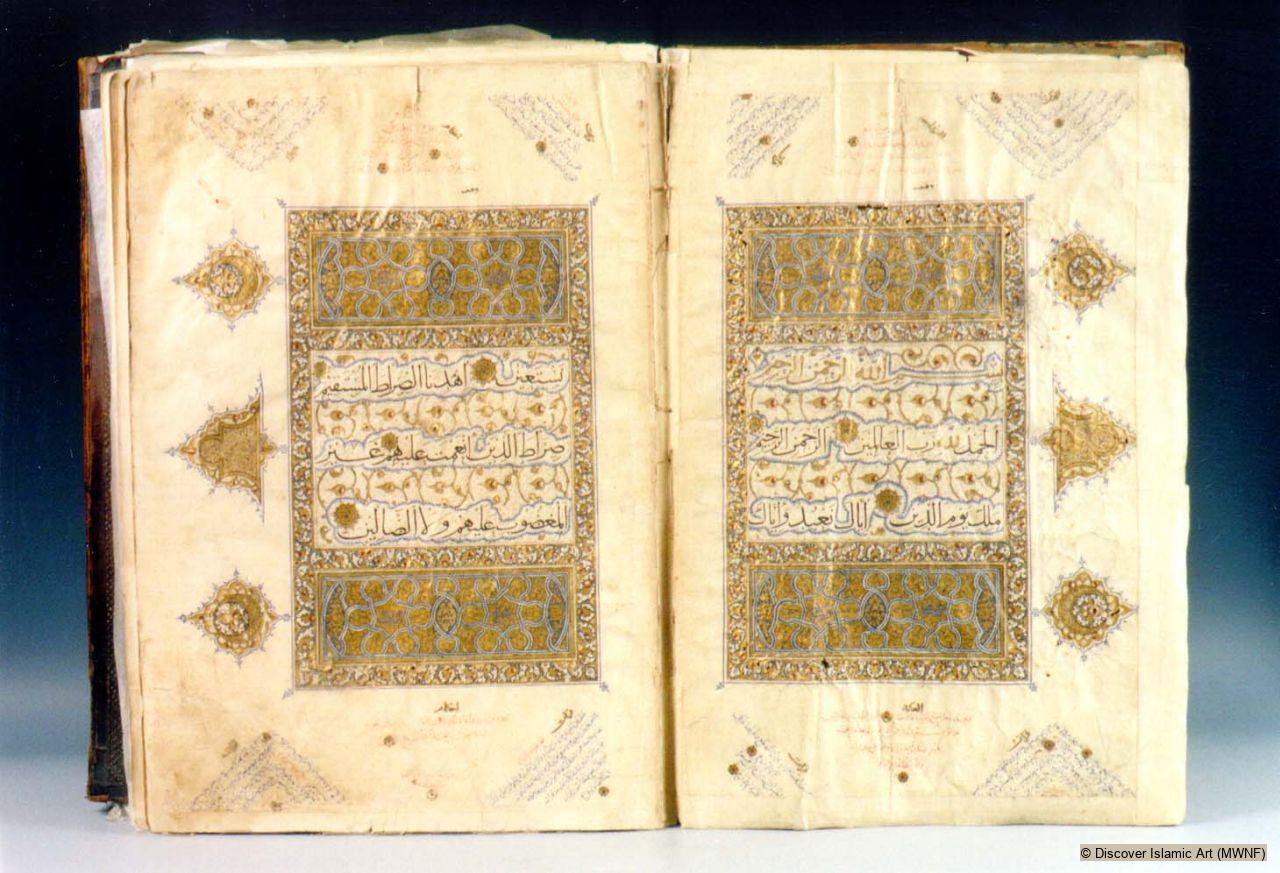
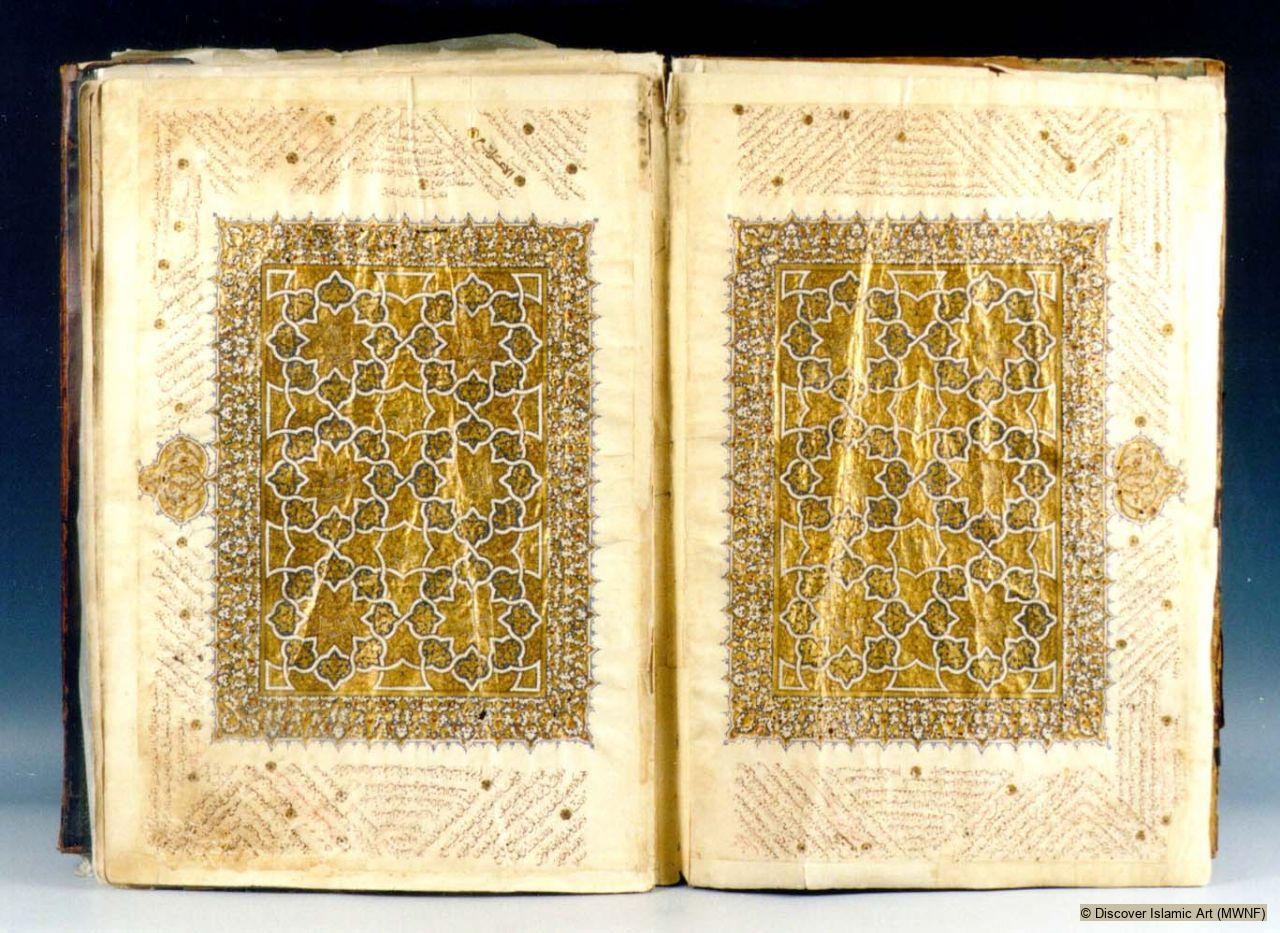
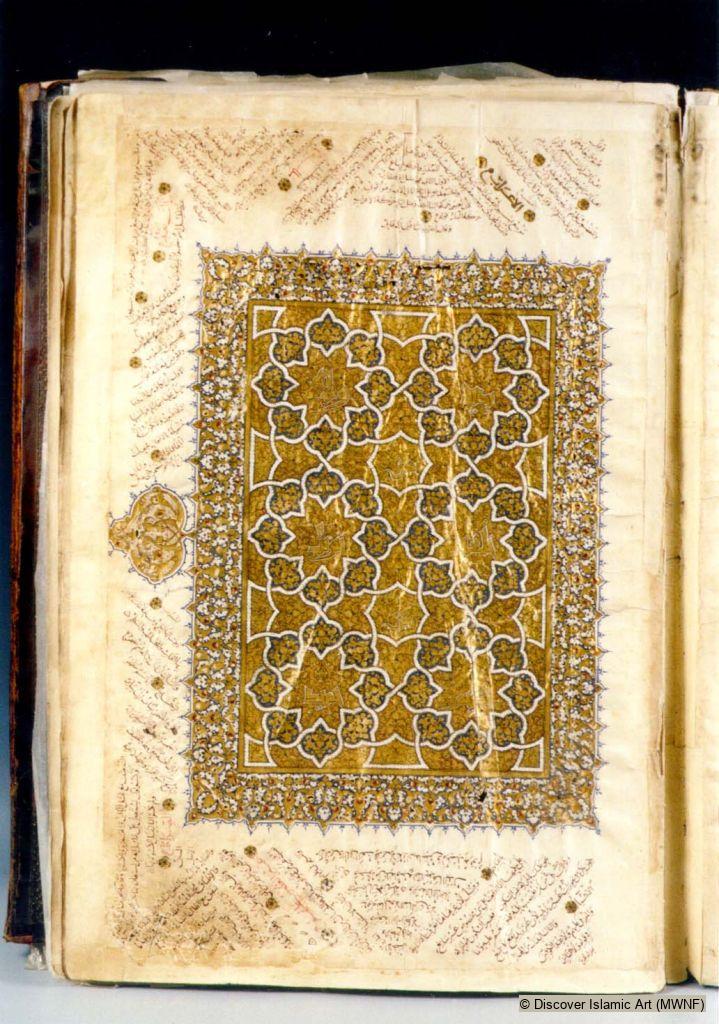
A large manuscript containing half of the Qur'an. It includes 325 pages written in thuluth script. The first page is decorated with coloured and gilded geometric and stylised vegetal motifs showing very high levels of precision and skill. Surrounding the basic text of the Qur'an are marginal notes recorded in blue, red, and black ink addressing Qur'anic recitation, interpretation, and grammar.
The verses of the Qur'an are underlined by threads of wavy blue and separated by small golden circles that number the holy phrases. The entire text is surrounded by a thick, opulent frame of geometric and astral tessellations outlined in blue and abundantly gilded. Three large gilded circular and triangular medallions branch out beyond the gilded frame towards the edge of the page.
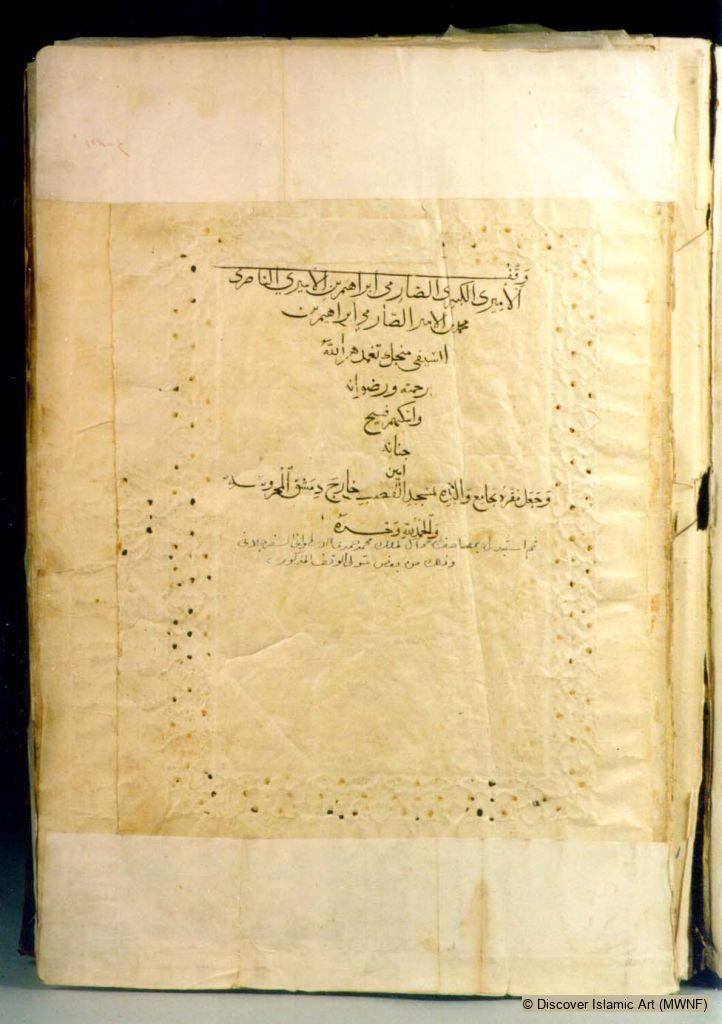
An Arabic text dealing with the dedication of this copy of the Qur'an is found on the third page. It may be translated as follows: “This is a waqf to al-Amir al-Kabir al-Sarim Ibrahim bin al-Amir al-Nasari Muhammad bin al-Amir al-Sarimi Ibrahim bin al-Sayfi Manjak, may God grant them shelter in his mercy and contentedness, and settle them in his paradises, Amen, and has made the dwelling of this Qur'an in the mosque of his father, the Aqsab Mosque, outside Damascus the Protected, praise be to God only”.
The text specifies that the person who established this Qur'an as a charitable endowment is the Mamluk Prince Ibrahim bin Muhammad bin Ibrahim al-Sayfi Manjak. He was one of the grandchildren of Prince Manjak, who twice served as the Mamluk governor of Damascus.
The abundance and intricacy of gold-leaf decoration found on this illuminated Qur'an is typical of the Mamluks' patronage of religious arts. The use of gold was also popular on Mamluk mosque lamps and was usually symbolic of 'divine light'.
How date and origin were established:
The donor is the grandson of the Mamluk Prince Manjak, who served his first term as ruler of Damascus in 759 / 1357, and his second in 770 / 1368. It is possible that this Qur'an dates generally to this period. However, his grandson Ibrahim may also have endowed the Qur'an to the mosque at a later date, during the 9th / 15th century.
How Object was obtained:
The piece was confiscated by security forces in the year 1959.
How provenance was established:
This Qur'an was dedicated to a mosque in Damascus, and was commissioned by the grandson of a Mamluk governor of Damascus. Though it was in all likelihood copied in Damascus, the text does not specifically state this, so it is possible that it was copied elsewhere, for example in Cairo.
Selected bibliography:
Abu al-Faraj al-Ush, M., A Concise Guide to the National Museum of Damascus, Damascus, 1969.
Cluzan, S. et al (eds), Syrie: Mémoire et Civilisation, Paris, 1994, pp.410–12.
Citation of this web page:
Mona al-Moadin "Half of the Holy Qur’an" in Discover Islamic Art, Museum With No Frontiers, 2026.
https://islamicart.museumwnf.org/database_item.php?id=object;ISL;sy;Mus01;35;en
MWNF Working Number: SY 51


