

 Back
Back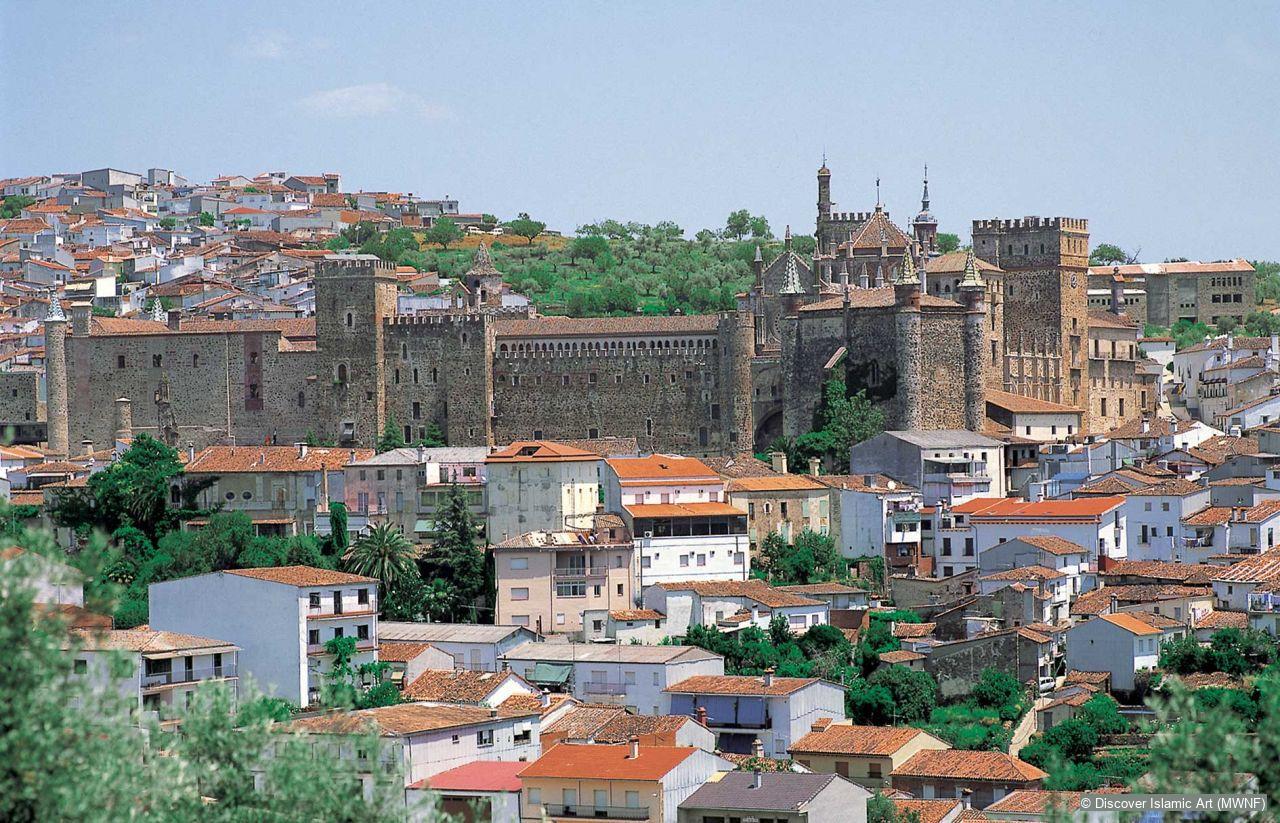
Name of Monument:
Guadalupe Monastery
Location:
Plaza Mayor de Guadalupe, Guadalupe, Caceres, Spain
Date of Monument:
Phase one started in 1340; phase two 1389–early 15th century
Period / Dynasty:
Mudéjar
Patron(s):
Alfonso XI (r. 1312–50); Juan I (r. 1379–90).
Description:
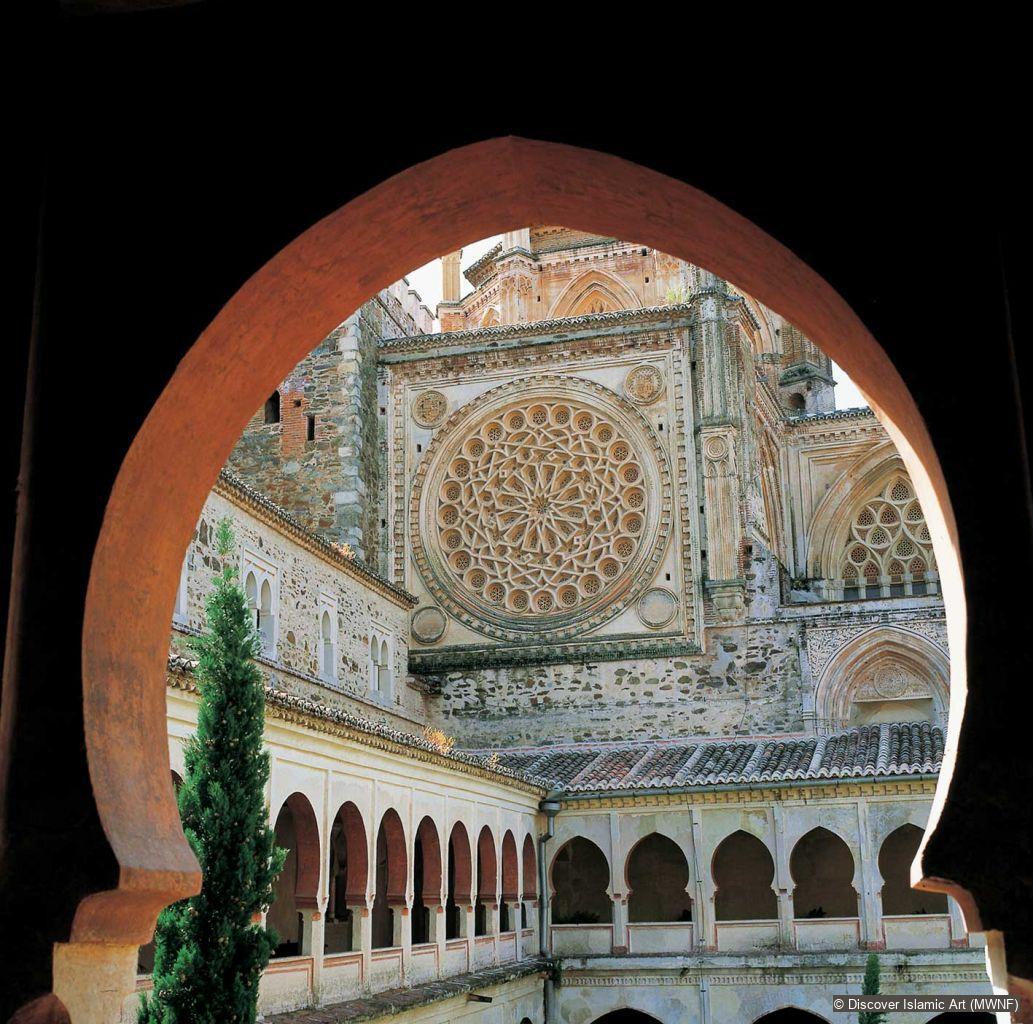
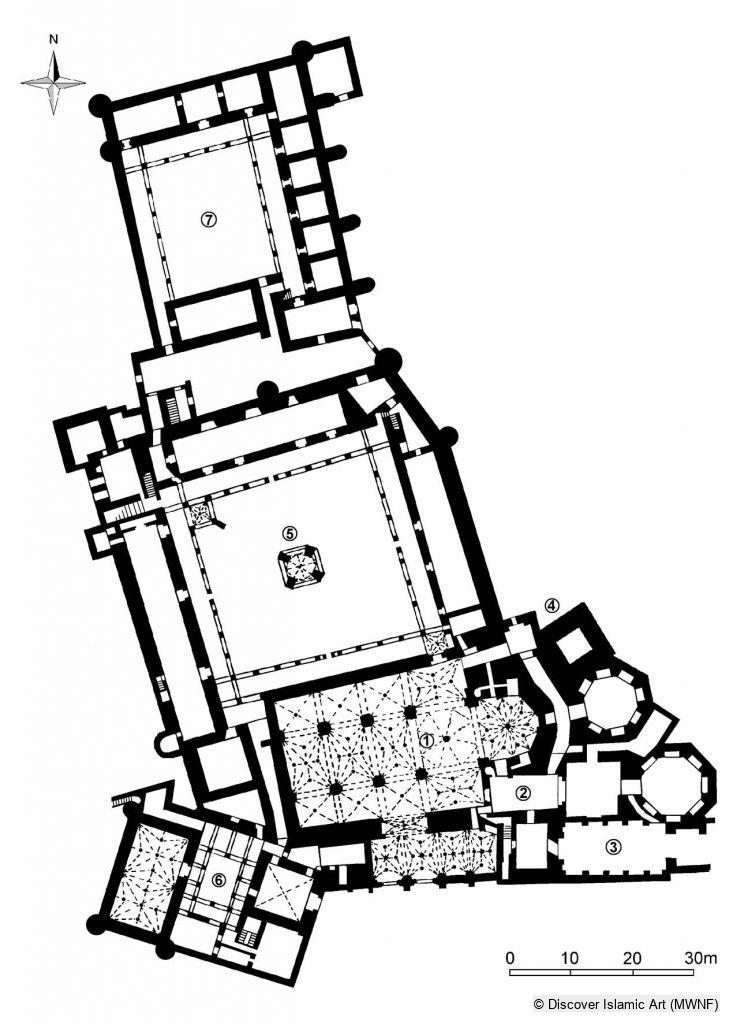
The history of the monastery, commissioned by King Alfonso XI as a result of the miraculous discovery of the Virgin of Guadalupe in the second half of the 13th century, is marked by great building activity. The work was so advanced within less than quarter of a century of its commencement that the Tower of San Gregorio and the Tower of the Bells were already being built in the second half of the 15th century, the latter on the north side of the presbytery in 1363. Houses for chaplains, hostels for pilgrims and a hospital for the sick were also erected. So, one century after the discovery of the image, Guadalupe had become the main religious focus of the region. The remains of these original constructions reveal two features: independence from contemporaneous Mudéjar models and links to Almohad forms, in particular military ones.
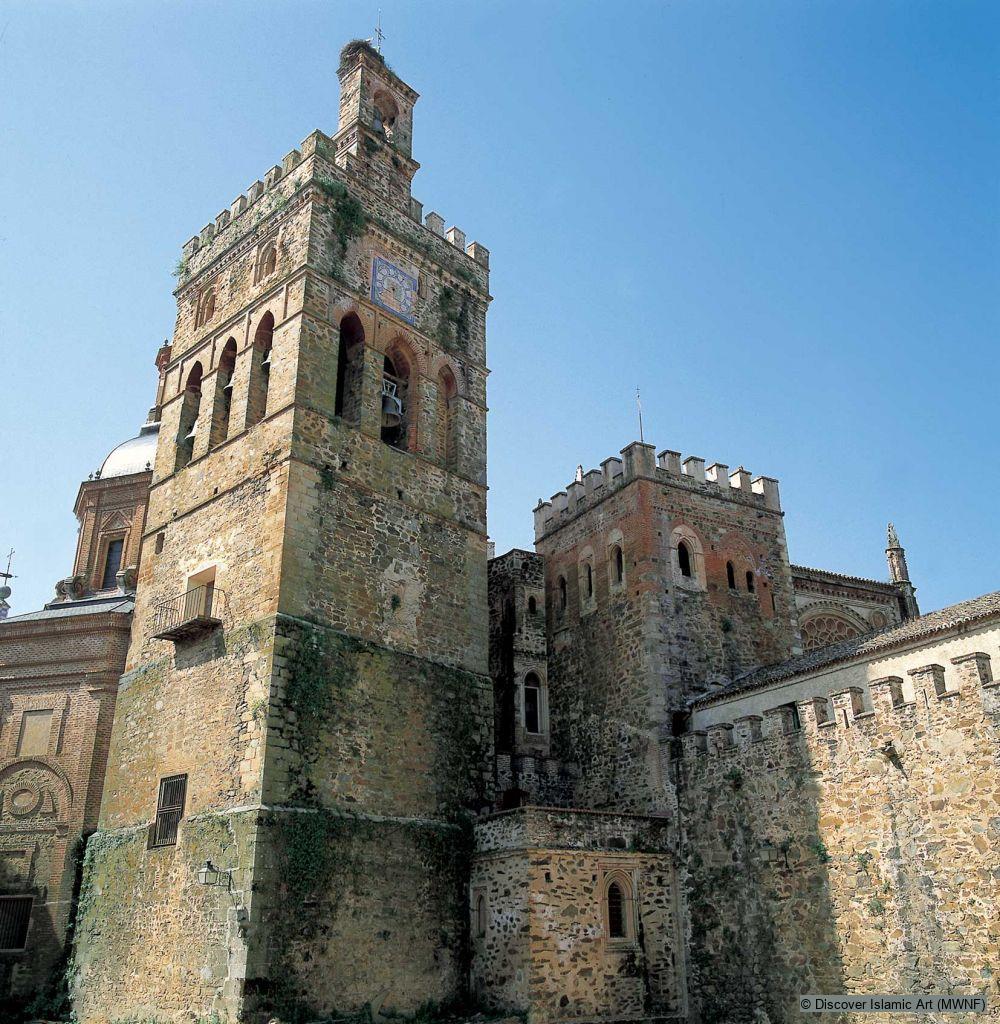
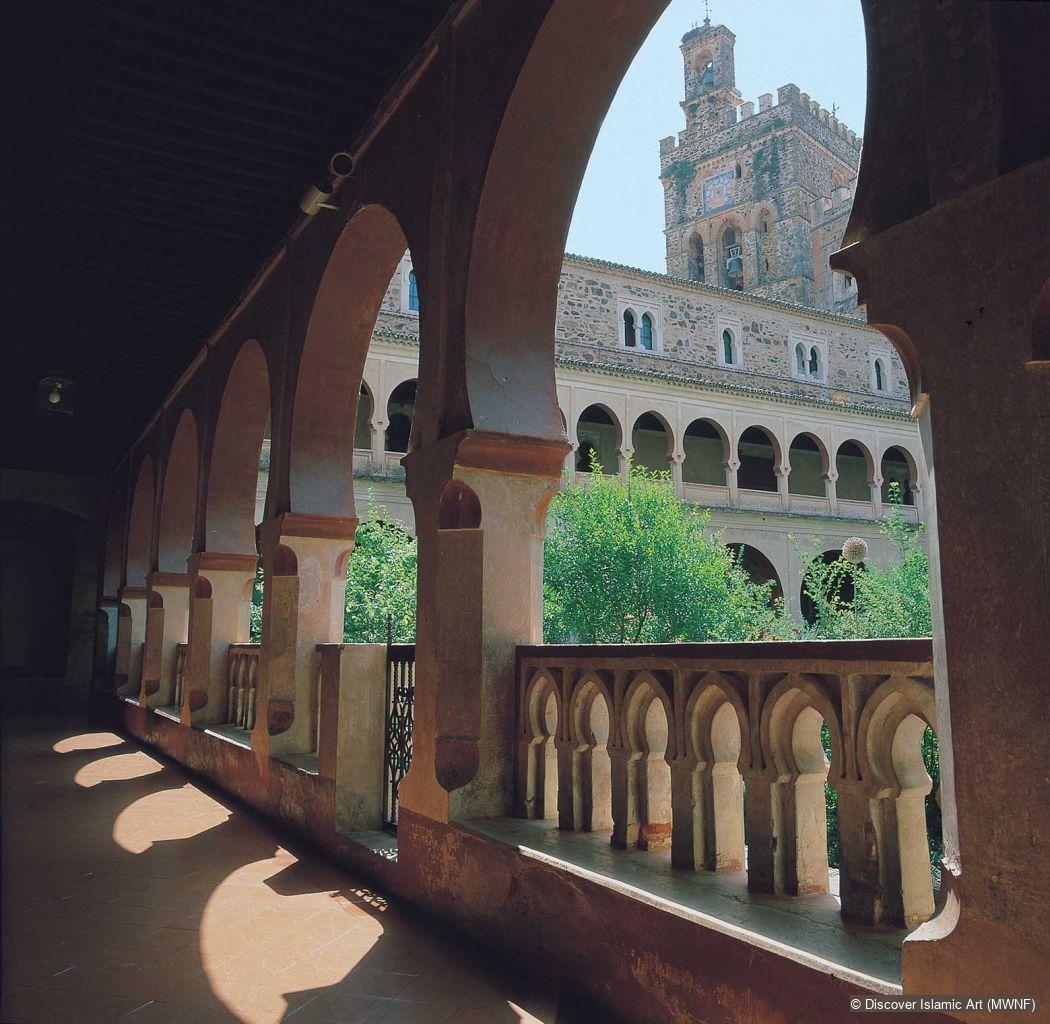
The Tower of the Bells, separated from the wall like a flanking tower and linked to it with an arched bridge, fits into this military design. The outside is split into five storeys separated by imposts. The fourth storey with the bells and three pointed windows with an alfiz panel on each side, is particularly noteworthy. It is crowned with battlements, like all of the towers in the fortification. The materials are mainly generic masonry, small ashlars in the corners and bricks framing the apertures as a decoration. The first period also produced the Gatehouse Tower, the inside of which has retained a triple aperture with engrailed, lobed and pointed horseshoe arches, and the Tower of San Gregorio.
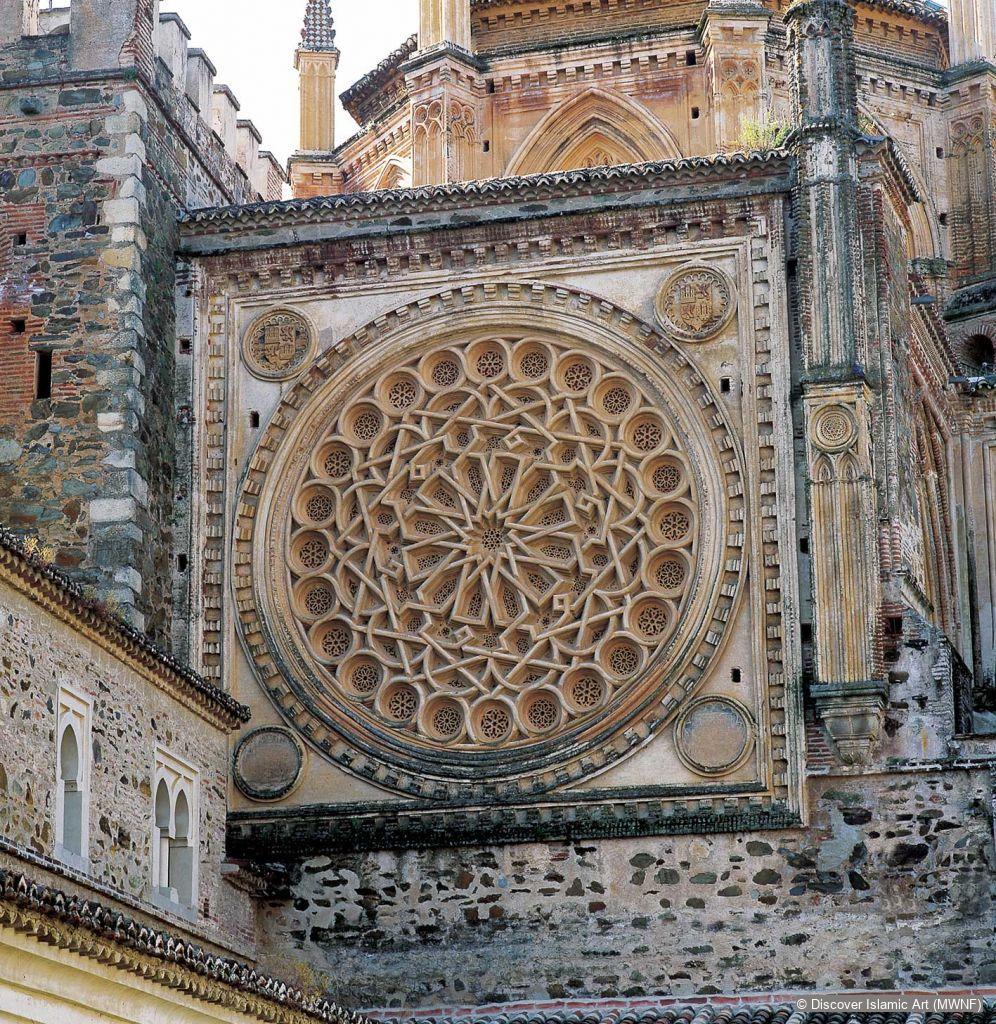
The apse of the original church is built entirely of brick and has four series of double-voussoired arches separated by pilasters and projecting imposts on each section, crowned with lobed modillions (ornamental brackets).
The structural characteristics of the buildings were original in Extremadura, but not so in other regions such as Castile and León, which demonstrates the craftsmen's awareness of other contemporaneous building projects. This does not detract from the overall feeling of the Iberian Mudéjar style overlapping with indigenous architecture.
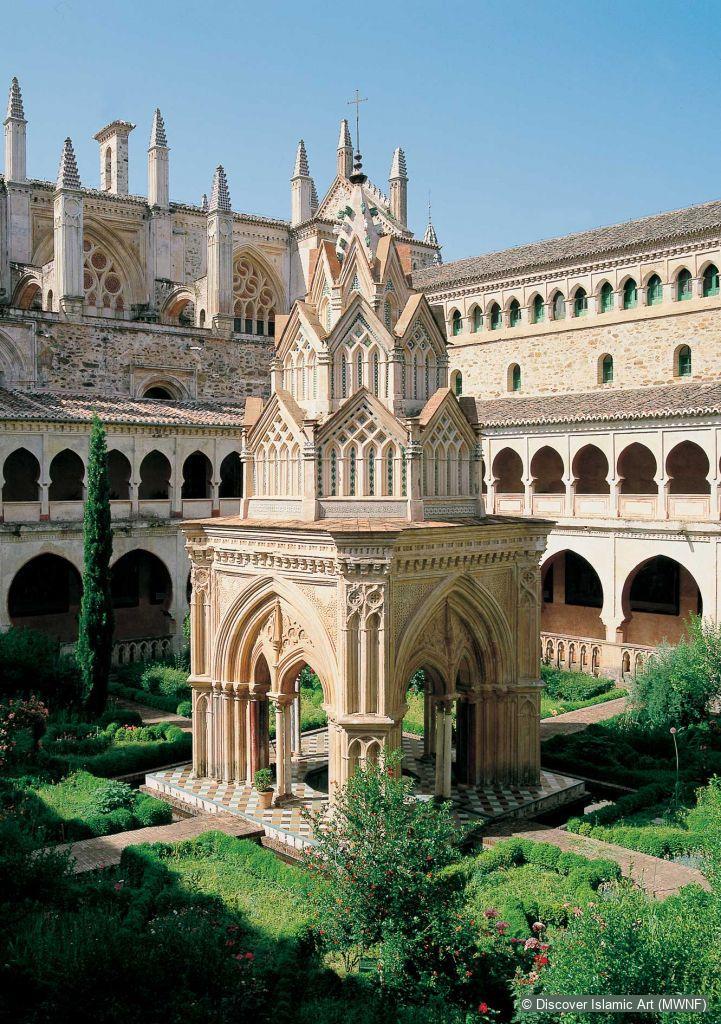
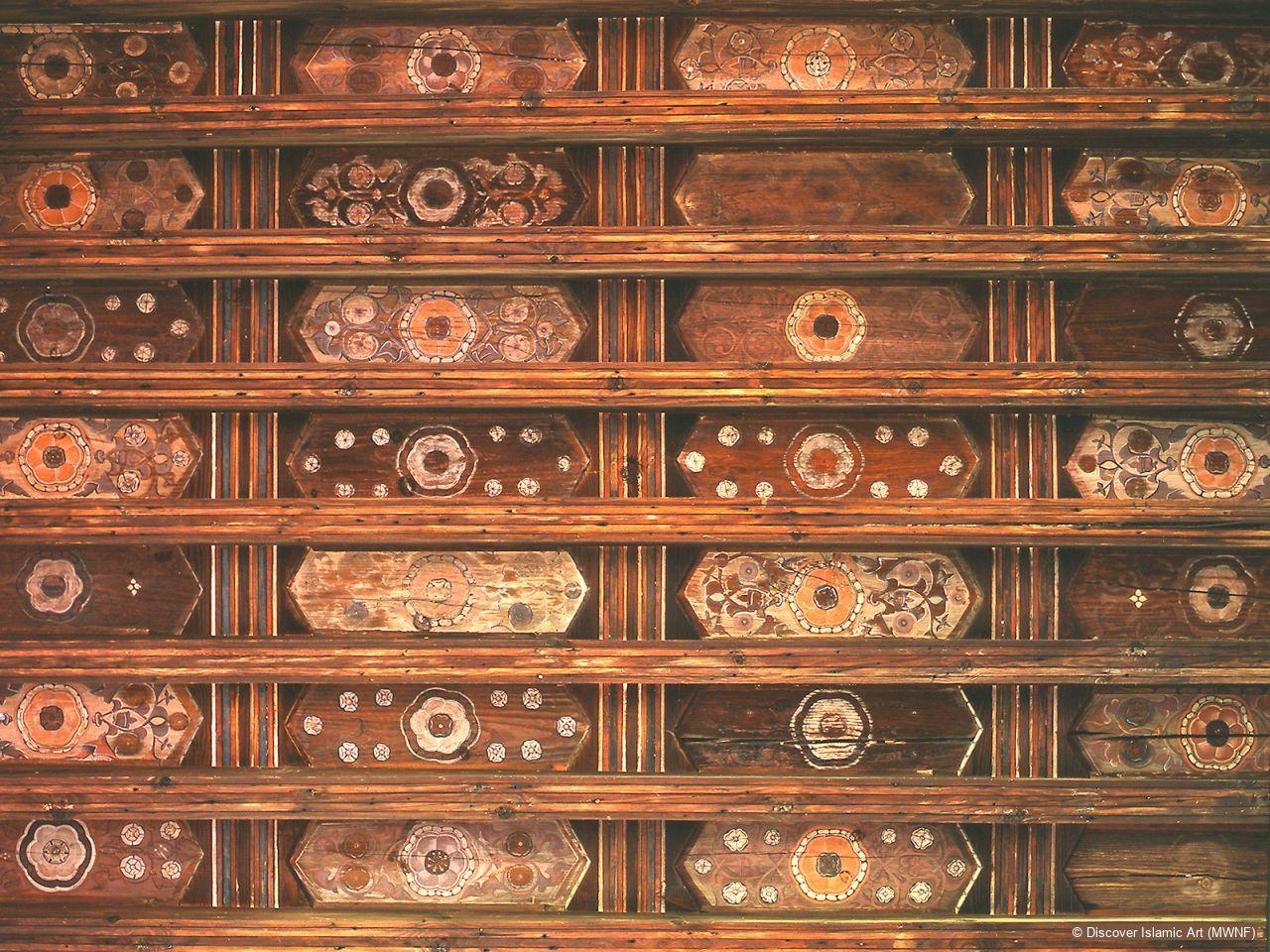
The second phase was started in 1389 when King Juan I converted the sanctuary into a monastery under the auspices of the Hieronymite Order, with Father Yáñez the first prior, and continued to the early 15th century. The existing architecture was adapted to the new requirements of the community, firstly with the construction of the Cloister of the Miracles, or the Mudéjar Cloister, built between 1389 and 1405. The galleries were covered with alfarje roofs painted with vegetal themes, castles and lions, all royal emblems. The centre is taken up by the famous shrine built by Brother Juan of Seville in 1405, which used to contain a fountain lost in the 18th century. The Gothic forms in this building are combined with decorative Mudéjar elements, very influential in Extremadura, which survived until the first third of the 16th century.
This complex building was constructed in different stages and is marked by contrasts: its defensive-looking exterior hides a palatial interior with spacious rooms and courtyards abounding in plant life and water.
The famous cloister is considered to be unique in Mudéjar art. An elegant shrine stands in its centre, the most outstanding Mudéjar piece in Extremadura, with Gothic forms in brick, plaster and tile.
How Monument was dated:
From documentation (there is a document from 1340 that states, among other things, that Alfonso XI ordered the construction of a new church in Guadalupe) and from its stylistic characteristics.
Selected bibliography:
López Guzmán, R., Arquitectura Mudéjar: Del Sincretismo Medieval a las Alternativas Hispanoamericanas, Madrid, 2000, p.359.
Mogollón Cano-Cortés, P., “El Mudéjar Guadalupense”, Norba-Arte, 6, Cáceres, 1985, pp.29–41.
Mogollón Cano-Cortés, P., “El Mudéjar en Extremadura”, in El Mudéjar Iberoamericano: Del Islam al Nuevo Mundo, Madrid, 1995, pp.99–109.
Mogollón Cano-Cortés, P., “El Mudéjar en Extremadura”, in El Arte Mudéjar, (c-oord. G. Borrás Gualís), Saragossa, 1996, pp.83–96.
Ruiz Hernando, J. A., “El Monasterio de Nuestra Señora de Guadalupe: Su Arquitectura Antigua. Siglos XIV y XV”, in Guadalupe de Extremadura: Dimensión Histórica y Proyección en el Nuevo Mundo, Madrid, 1993, pp.127–58.
Mudéjar Art: Islamic Aesthetics in Christian Art, pp.215–21.
Citation of this web page:
Ángela Franco "Guadalupe Monastery" in Discover Islamic Art, Museum With No Frontiers, 2026. 2026.
https://islamicart.museumwnf.org/database_item.php?id=monuments;ISL;es;Mon01;30;en
Prepared by: Ángela FrancoÁngela Franco
Ángela Franco es Jefa del Departamento de Antigüedades Medievales en el Museo Arqueológico Nacional.
Obtuvo el Grado de Doctor por la Universidad Complutense de Madrid con la tesis Escultura gótica en León y provincia, premiada y publicada parcialmente (Madrid, 1976; reed. León, 1998); y la Diplomatura en Paleografía y Archivística por la Scuola Vaticana di Paleografia, Diplomatica e Archivistica, con la tesis L'Archivio paleografico italiano: indici dei manoscritti, publicada en castellano (Madrid, 1985). Becas de investigación: beca posdoctoral del Ministerio de Asuntos Exteriores, Academia Española de Bellas Artes de Roma (1974-75); beca posdoctoral del Ministerio de Educación y Ciencia, Academia Española de Bellas Artes de Roma (1975-77); beca de la Fundación Juan March de Madrid (1978).
Tiene en su haber 202 publicaciones, fundamentalmente sobre arte medieval cristiano, en especial la iconografía: Crucifijo gótico doloroso, Doble Credo, Danzas de la Muerte, temática bíblica en relación con la liturgia (el Génesis y el Éxodo en relación con la vigilia Pascual) o con el teatro (Secundum legem debet mori, sobre el “pozo de Moisés” de la cartuja de Dijon). Es autora de cuatro catálogos monográficos del Museo Arqueológico Nacional, entre ellos el de Dedales islámicos (Madrid, 1993), y de publicaciones sobre escultura gótica y pintura en la catedral de León y sobre escultura gótica en Ávila, así como de numerosas fichas para catálogos de exposiciones.
Ha participado en innumerables congresos nacionales e internacionales, presentando ponencias y mesas redondas, y ha dirigido cursos y ciclos de conferencias. Es Secretaria de Publicaciones en el Museo Arqueológico Nacional desde 1989.
Copyedited by: Rosalía AllerRosalía Aller
Rosalía Aller Maisonnave, licenciada en Letras (Universidad Católica del Uruguay), y en Filología Hispánica y magíster en Gestión Cultural de Música, Teatro y Danza (Universidad Complutense de Madrid), ha obtenido becas de la Agencia Española de Cooperación Internacional y la Universidad Nacional de Educación a Distancia de Madrid, así como el Diplôme de Langue Française (Alliance Française), el Certificate of Proficiency in English (University of Cambridge) y el Certificado Superior en inglés y francés (Escuela Oficial de Idiomas de Madrid). Profesora de Estética de la Poesía y Teoría Literaria en la Universidad Católica del Uruguay, actualmente es docente de Lengua Castellana y Literatura en institutos de Enseñanza Secundaria y formación del profesorado en Madrid. Desde 1983, ha realizado traducción y edición de textos en Automated Training Systems, Applied Learning International, Videobanco Formación y El Derecho Editores. Integra el equipo de Museo Sin Fronteras desde 1999 y ha colaborado en la revisión de los catálogos de “El Arte Islámico en el Mediterráneo”. Así mismo, ha realizado publicaciones sobre temas literarios y didácticos, ha dictado conferencias y ha participado en recitales poéticos.
Translation by: Laurence Nunny
Translation copyedited by: Monica Allen
MWNF Working Number: SP 34
RELATED CONTENT
Related objects
Related monuments

Islamic Dynasties / Period
On display in
Exhibition(s)
Download
As PDF (including images) As Word (text only)