

 Back
Back
Name of Object:
Dish
Location:
Stockholm, Sweden
Holding Museum:
Museum of Mediterranean and Near Eastern Antiquities (Medelhavsmuseet)
About Museum of Mediterranean and Near Eastern Antiquities (Medelhavsmuseet), Stockholm
Date of Object:
Hegira first half of 11th century / AD first half of the 17th century
Museum Inventory Number:
1962:16
Material(s) / Technique(s):
Ceramic; underglaze painted.
Dimensions:
Height 5.5 cm, diameter 25.5 cm
Period / Dynasty:
Ottoman
Provenance:
Iznik, Turkey.
Description:
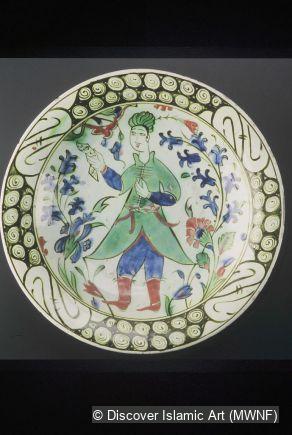
The polychrome underglaze painted dish with a sloping rim and a deep well shows a male human figure outlined in black on a white background. The man is dressed in uncoloured wide trousers, a pale blue jacket and a white blouse with green sleeves. His hat and shoes and the flower that he holds in his right hand are of thick pale red. Five flowers on thin curved stems – two red-dotted blue tulips and three smaller ones with red blossoms – fill the area around the man. The rim shows a zigzag pattern composed of almond-shaped leafs. The triangular areas are coloured alternately in light blue and a bright green and filled with half-rosettes, each with a red dot at the centre. On the back the dish is painted with three large blue dots under a transparent, light turquoise coloured glaze. The foot-ring is pierced once for suspension.
Figurative depictions on Iznik ceramics were inspired by the popular imagery of miniature costume albums, many of which were produced for sale to Europeans from the beginning of the AH 11th / AD 17th century. The standardised painting of the man and the formulaic character of the flower decoration are due to the mass production of the open market.
Polychrome painted dish with a deep well showing a human figure on a white background. The area around the man is filled with flowers. The rim shows a zigzag pattern. Figurative depictions on Iznik ceramics were inspired by the popular imagery of miniature costume albums.
How date and origin were established:
The object was dated from its decoration. Figurative depictions, frequently in combination with a zigzag pattern on the rim, occurred in great number on Iznik ceramics from the beginning of the 11th / 17th century. They were inspired by single-figure costume studies such as the Album of Sultan Ahmed I (r. 1011–25 / 1603–17) and its popular copies.
How Object was obtained:
Bequest of the Hungarian scientist, Nobel Prize winner and art collector, Georg von Békésy (1899–1972).
How provenance was established:
The zigzag pattern on the rim in combination with the human figure occurred in great number on Iznik ceramics from the beginning of the 11th / 17th century.
Selected bibliography:
Atasoy, N. and Raby, J., Iznik: The Pottery of Ottoman Turkey, London, 1989.
Carswell, J., Iznik Pottery, London, 1998.
Müller-Wiener, M., Türkisch-Osmanische Keramik, Traunstein, 2004.
Wirgin, J. (ed.), The Georg von Békésy Collection, Malmö, 1974.
Citation of this web page:
Friederike Voigt "Dish" in Discover Islamic Art, Museum With No Frontiers, 2026.
https://islamicart.museumwnf.org/database_item.php?id=object;ISL;se;Mus01;19;en
MWNF Working Number: SE 20
RELATED CONTENT
Related objects


Islamic Dynasties / Period
On display in
Exhibition(s)
MWNF Galleries
CeramicsDownload
As PDF (including images) As Word (text only)