

 Back
Back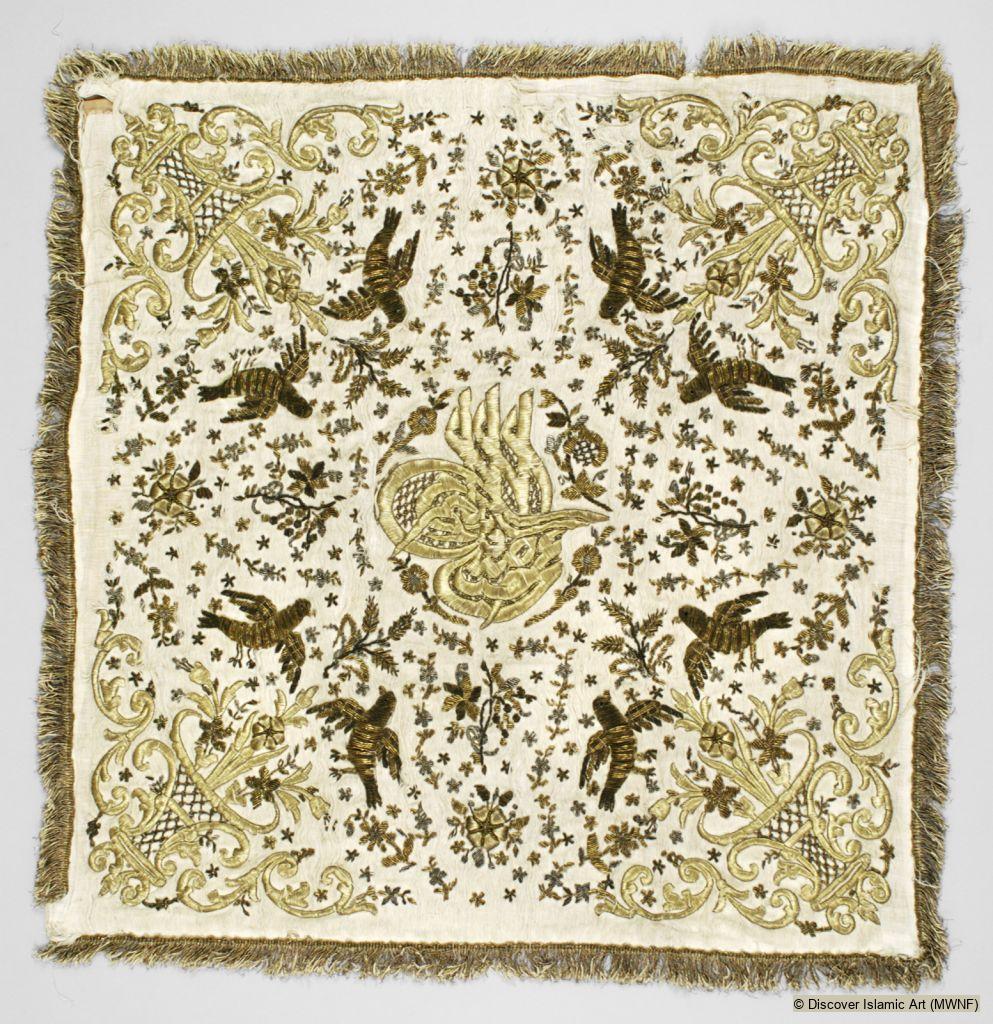
Name of Object:
Embroidery
Location:
Stockholm, Sweden
Holding Museum:
Museum of Mediterranean and Near Eastern Antiquities (Medelhavsmuseet)
About Museum of Mediterranean and Near Eastern Antiquities (Medelhavsmuseet), Stockholm
Original Owner:
Possibly Sultan ‘Abd al-‘Aziz (r. AH 1277–93 / AD 1861–76)
Date of Object:
Hegira 13th century / AD 19th century
Museum Inventory Number:
S.N.I. 049
Material(s) / Technique(s):
Wool, silk, metal thread, cotton; embroidered.
Dimensions:
Height 78.5 cm, width 81.5 cm
Period / Dynasty:
Ottoman
Provenance:
Turkey, possibly Istanbul or Bursa.
Description:
The nearly square textile with fringed ribbon shows all-over silver and gold embroidery. In spite of its complexity and density, the structure of the symmetrically composed design is evident. In the middle appears a tughra, the monogram of the Ottoman sultans, surrounded by four slightly curved flower sprays forming a small circle. The remaining area is dedicated to a motif repeated in the four corners. This motif shows a rococo-inspired basket edged with and flanked by scrolled leafy sprays on a small console and with a bouquet in it. Worked in a metal thread of a different hue, the pairs of birds beside the bouquets and all the large and small blossoms and flower sprays filling the area between are arranged in a circle.
To judge from the perfect composition of the design and the high technical quality it is professional embroidery by an urban workshop. But there is another clue too. This design composed of a small inner circle formed by the tughra and a large outer circle suggests that the textile was used as a turban cover. To keep dust off a turban a special, always square, cover was introduced indicating its particular purpose by a circle set in the middle. However, this cover differs from the usual scheme of an inner circle design repeated in the outer one because of its manufacture for Palace use. Pieces showing a tughra on them were primarily made for the Palace. The tughra in this embroidery has been simplified and distorted, but it might be that of Sultan 'Abd al-'Aziz (Abdülaziz in Turkish).
Nearly square textile with fringed ribbon and all-over silver and gold embroidery. In the middle appears a tughra, the monogram of the Ottoman sultans. The composition of the design with a smaller inner and a larger outer circle suggests the textile was used as a turban cover.
How date and origin were established:
The textile shows the influence of European rococo in design, which increased on urban embroidery at the beginning of the 13th / 19th century. The tughra in this embroidery, although simplified and distorted, might be that of Sultan 'Abd al-'Aziz ((r. 1277–93 / 1861–76). However, one should note that all tughras of the sultans in the 13th / 19th century show similar features.
How Object was obtained:
There is no information about acquisition.
How provenance was established:
The design and the tughra show that it is a Turkish embroidery. Embroideries of the professional workshops of Istanbul and Bursa were of high technical quality as seen in this fabric. Their patterns are characterised by fine gradation in colour and influenced by European rococo.
Selected bibliography:
Johnstone, P., Turkish Embroidery, Victoria and Albert Museum, London, 1985.
Taylor, R., Ottoman Embroidery, London, 1993.
Ther, U., Floral Messages: From Ottoman Court Embroideries to Anatolian Trousseau Chests, Bremen, 1993.
Citation of this web page:
Friederike Voigt "Embroidery" in Discover Islamic Art, Museum With No Frontiers, 2026.
https://islamicart.museumwnf.org/database_item.php?id=object;ISL;se;Mus01;47;en
MWNF Working Number: SE 56
RELATED CONTENT
Related objects


Islamic Dynasties / Period
On display in
Exhibition(s)
MWNF Galleries
TextilesDownload
As PDF (including images) As Word (text only)