

 Back
Back
Name of Object:
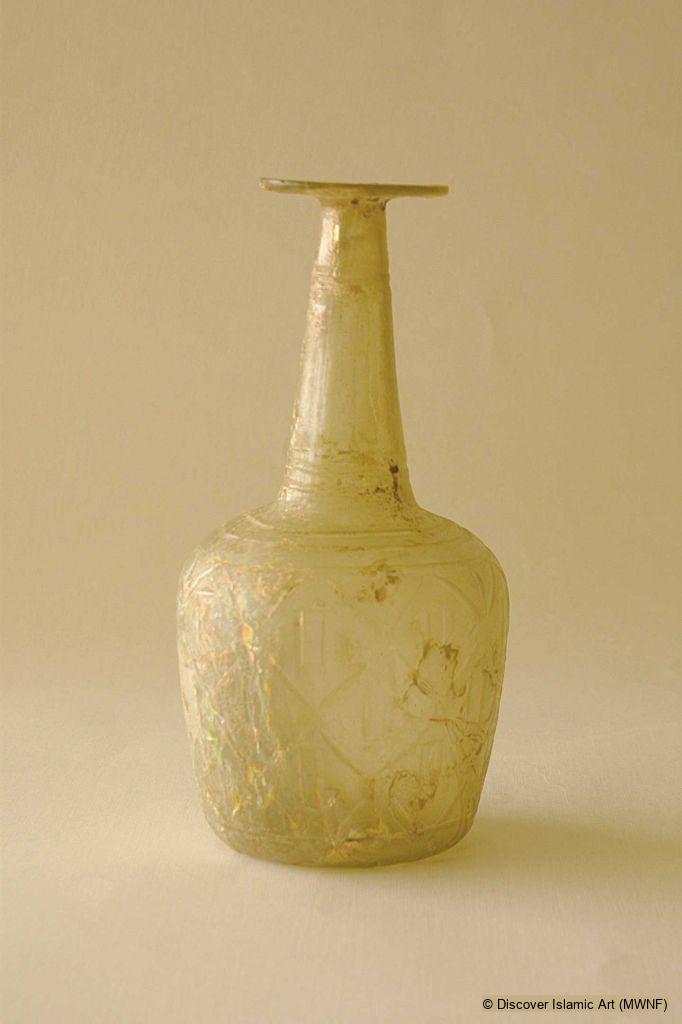
Carafe
Location:
Raqqada, Kairouan, Tunisia
Holding Museum:
Museum of Islamic Art
About Museum of Islamic Art, Raqqada.
Date of Object:
Hegira, end of the 4th–first half of the 5th centuries / AD 10th–11th centuries
Museum Inventory Number:
V. 5
Material(s) / Technique(s):
Engraved and gilded glass.
Dimensions:
Height 19 cm, diameter 7.8 to 9.7 cm
Period / Dynasty:
Fatimid–Zirid
Provenance:
Probably from the glass-works at Sabra al-Mansuriyya or from the glass-works at Kairouan.
Description:
The shape of this carafe is asymmetrical, like most glass objects, but particularly harmonious. The belly of the vessel is about the same height as the neck. The belly is slightly rounded, widening a little towards the top. The shoulders curve in sharply and the neck narrows towards the mouth which opens out to a flat collar.
The neck is decorated with vertical indentations. Two circular grooves surround the belly above a grid of diagonal lines. Each triangular or diamond-shaped section contains an indentation made with a barley-seed.
This type of decoration is used, to great effect, as a background pattern in some Kairouanese book bindings dating from the AH 3rd, 4th and 5th centuries (AD 9th, 10th and 11th). A similar pattern is seen in a painting of Jawsaq al-Khaqani (the Emperor's Pavilion) at Samarra. The form, style and manufacturing technique come probably from classical and Sassanid traditions, indeed from methods used since ancient times. However, this carafe has certain similarities to vases found at Fustat and Samarra during the excavations undertaken by the American Research Centre in Egypt in 1965 and 1981. It bears an even more striking resemblance to some of the objects (probably Fatimid) from the Serce Limani wreck found off the Turkish coast. The decoration on these was engraved using small grindstones. To cut the geometric shapes, the grooves and the scalloped, braided and floral decorations, elongated chisels were used, some tapering and some curved.
A kiln excavated on the site of this find at Sabra proves that glass-works in the Middle Ages were always relegated to the outskirts of the cities.
The shape, style and manufacturing technique of this well-proportioned glass carafe are borrowed from the classical and Sassanid traditions of Antiquity. There are, however, even clearer similarities with items amongst the cargo of a Fatimid wreck found off the Turkish coast.
How date and origin were established:
This carafe comes from Sabra al-Mansuriyya, built in 337 / 968. It bears a striking likeness to some of the objects found in the above-mentioned Serce Limani wreck cargo. We know that the ship sank in the second quarter of the 5th / 11th century and that the Sabra site was completely abandoned after the Hilalian invasions in 449 / 1057. We can, therefore, date this carafe with assurance to between the end of the 4th / 10th century and the first half of the 5th / 11th century.
How Object was obtained:
This piece was kept at the Bardo Museum. It was then acquired by the Museum of Islamic Art at Raqqada, on its inauguration. It is currently on display there.
How provenance was established:
This carafe was discovered by chance in 1992 at the Sabra al-Mansuriyya site. Brick pickers broke open a large jar with a pick-axe and found contents of priceless value: carafes, goblets, flasks and cups, each demonstrating the great skills of the artisan glass-blowers of Sabra.
Selected bibliography:
Marçais, G. and Poinssot, L., Objets kairouanais, XI, fasc. 2, Tunis, 1952, pp.388–9, cat. no. 8.
Omeyas (exhibition catalogue), Granada, 2001, p.83.
Citation of this web page:
Mourad Rammah "Carafe" in Discover Islamic Art, Museum With No Frontiers, 2026.
https://islamicart.museumwnf.org/database_item.php?id=object;ISL;tn;Mus01;42;en
Prepared by: Mourad RammahMourad Rammah
Né en 1953 à Kairouan, docteur en archéologie islamique, Mourad Rammah est le conservateur de la médina de Kairouan. Lauréat du prix Agha Khan d'architecture, il publie divers articles sur l'histoire de l'archéologie médiévale islamique en Tunisie et participe à différentes expositions sur l'architecture islamique. De 1982 à 1994, il est en charge du département de muséographie du Centre des arts et des civilisations islamiques. Mourad Rammah est également directeur du Centre des manuscrits de Kairouan.
Copyedited by: Margot Cortez
Translation by: David Ash
Translation copyedited by: Mandi GomezMandi Gomez
Amanda Gomez is a freelance copy-editor and proofreader working in London. She studied Art History and Literature at Essex University (1986–89) and received her MA (Area Studies Africa: Art, Literature, African Thought) from SOAS in 1990. She worked as an editorial assistant for the independent publisher Bellew Publishing (1991–94) and studied at Bookhouse and the London College of Printing on day release. She was publications officer at the Museum of London until 2000 and then took a role at Art Books International, where she worked on projects for independent publishers and arts institutions that included MWNF’s English-language editions of the books series Islamic Art in the Mediterranean. She was part of the editorial team for further MWNF iterations: Discover Islamic Art in the Mediterranean Virtual Museum and the illustrated volume Discover Islamic Art in the Mediterranean.
True to its ethos of connecting people through the arts, MWNF has provided Amanda with valuable opportunities for discovery and learning, increased her editorial experience, and connected her with publishers and institutions all over the world. More recently, the projects she has worked on include MWNF’s Sharing History Virtual Museum and Exhibition series, Vitra Design Museum’s Victor Papanek and Objects of Desire, and Haus der Kulturen der Welt’s online publication 2 or 3 Tigers and its volume Race, Nation, Class.
MWNF Working Number: TN 65
RELATED CONTENT
Related objects

On display in
Exhibition(s)
MWNF Galleries
GlassDownload
As PDF (including images) As Word (text only)