

 Back
Back

Name of Object:
Kütahya ceramics
Location:
Sultanahmet, Istanbul, Türkiye
Holding Museum:
Museum of Turkish and Islamic Arts
About Museum of Turkish and Islamic Arts, Sultanahmet
Date of Object:
Hegira 12th–13th century / AD 18th–19th century
Museum Inventory Number:
4083, 4092, 4151, 4215, 4216, 4231
Material(s) / Technique(s):
hard white clay with underglaze painting.
Dimensions:
4083: height 7 cm, diameter 8 cm; 4092: height 4.2 cm, diameter 7.3 cm; 4151: height 16.5 cm, diameter 5.6 cm; 4215: diameter 15 cm; 4216: diameter 18 cm; 4231: diameter 16 cm
Period / Dynasty:
Ottoman
Provenance:
Kütahya, Turkey.
Description:
Inv. no. 4083, a cup, is decorated with green and yellow radial designs with flowers in them.
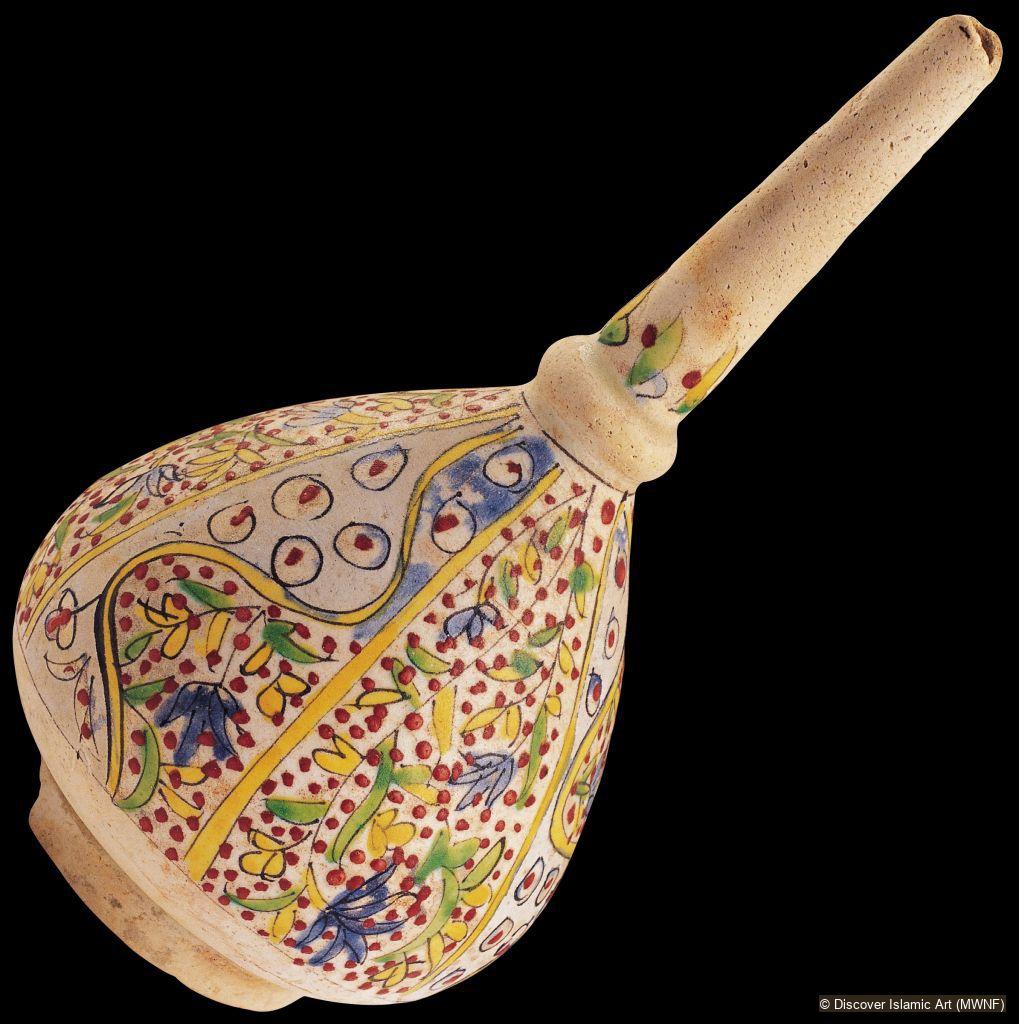
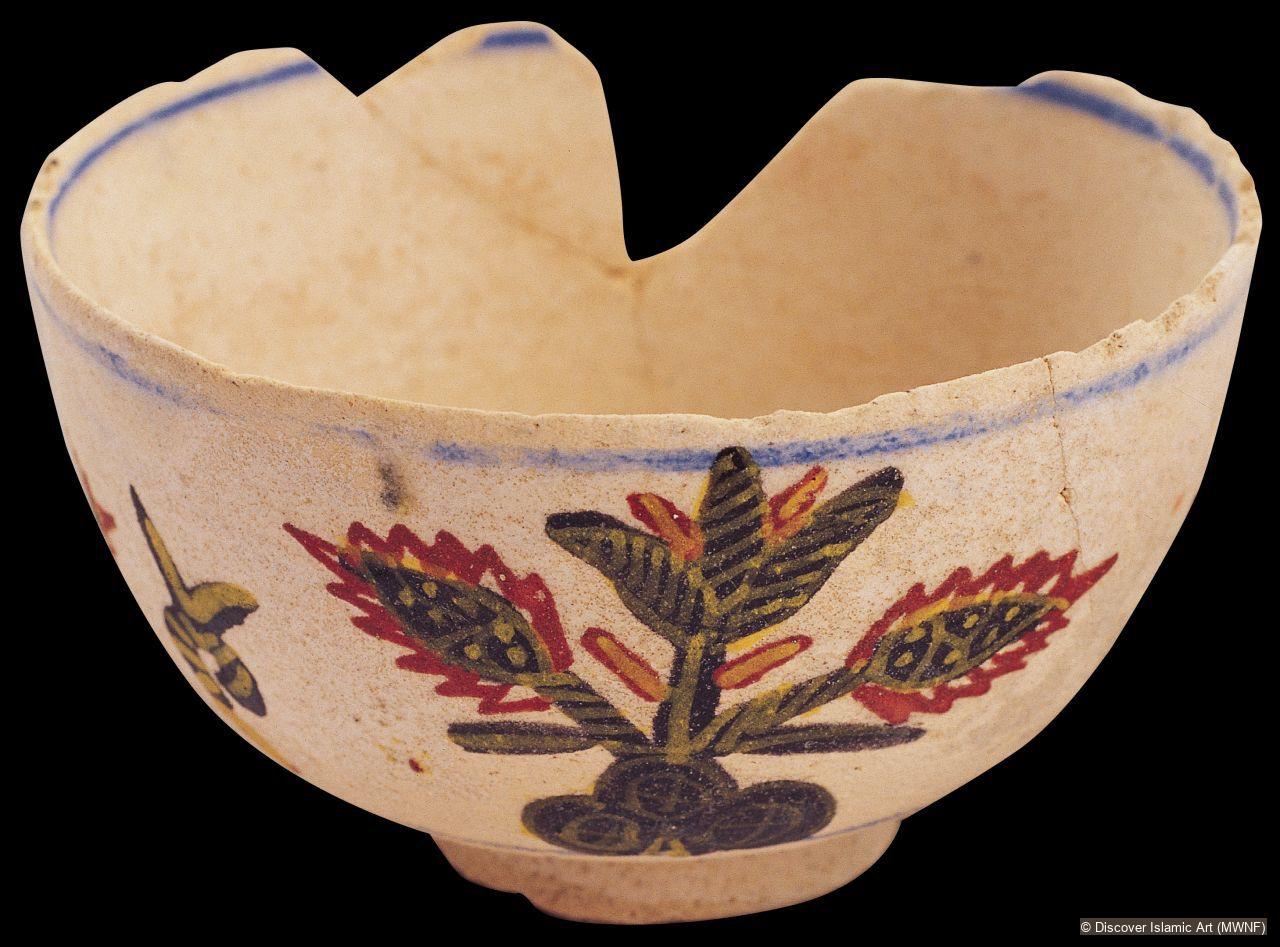
Inv. no. 4092, a cup, is decorated with a stylised tulip within a circle and a band around the rim. On the exterior a flower grows from a red and dark-green base. Inv. no. 4151, a rosewater sprinkler, has a pear-shaped body divided by yellow bands into sections with stylised arabesques and flowers.
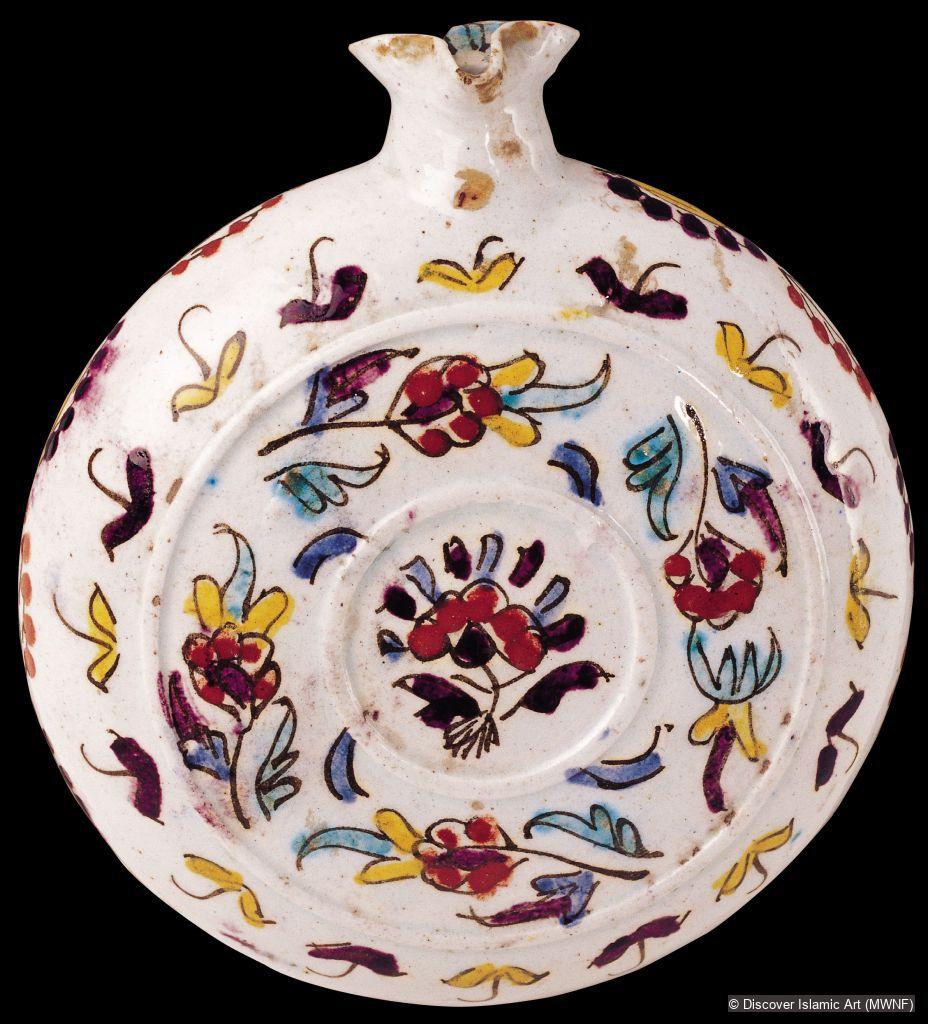
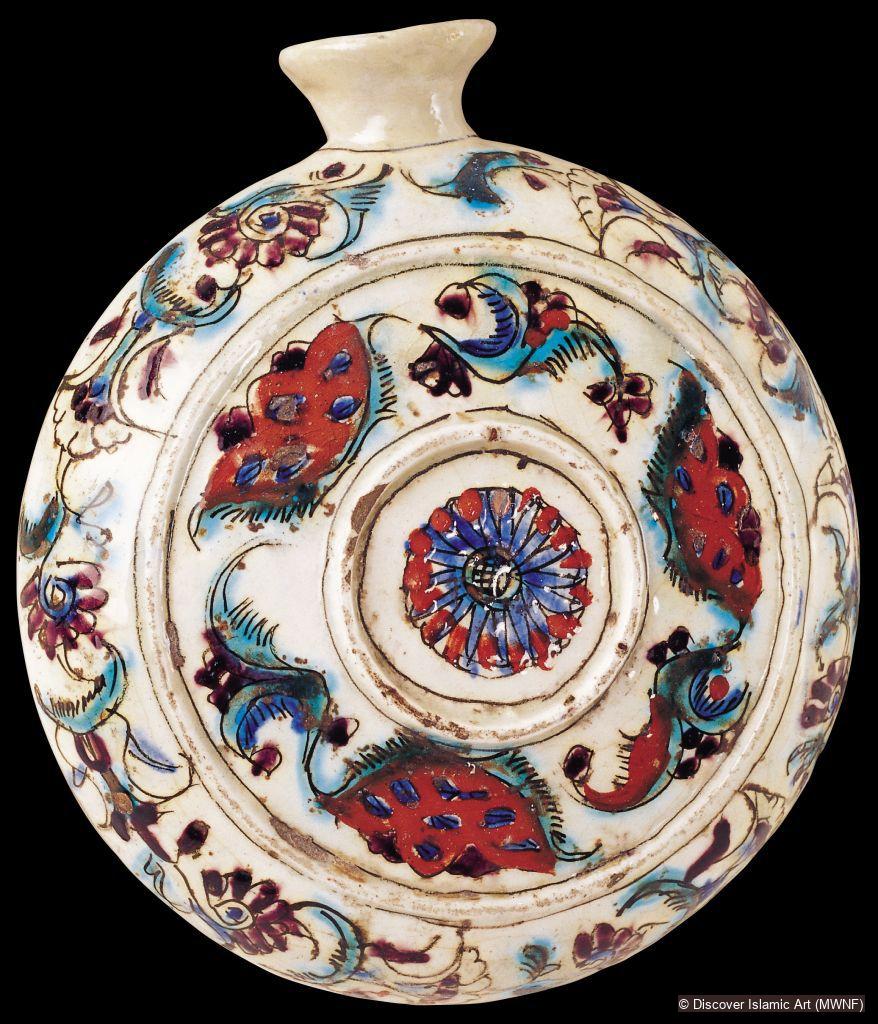
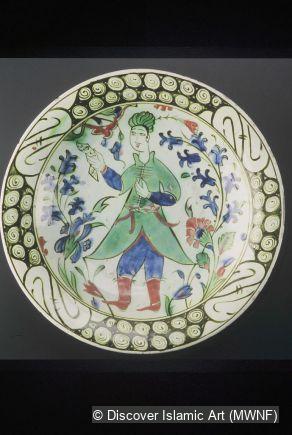
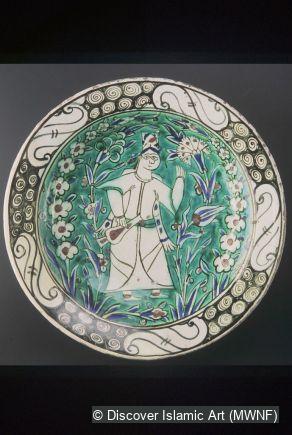
Inv. no. 4215, a plate, is decorated in purple, green and blue with a painting of a woman in local dress between two bouquets of flowers. Inv. no. 4216 is a canteen decorated with floral motifs in yellow, red, green and blue. Inv. no. 4231 is another canteen, the back and front of the round body decorated with raised circles. The front has a rosette surrounded by chain motifs. The other sides bear stylised flower and leaf motifs.
After the cessation of tile and ceramic production at Iznik, the ceramic workshops at Kütahya came to the fore. The most common products of these workshops are fine and delicate cups, bowls, ewers with lids, rosewater sprinklers, candlesticks, incense burners, small goblets, and canteens. They are made of hard white clay and have painted underglaze decorations of flowers, leaves, ivy, teardrops, birds, fish, and people in local dress. In the last years of the AH 12th / AD 18th century and the first years of the AH 13th / AD 19th century the quality of these wares is seen to decline. Forms are simplified and become rough; lilac and red disappear, and dark colours, including purple, dominate the decoration. During this period stylised leaves, lines, speckles, and zigzags appear, all painted with brushstrokes.
Kütahya replaced Iznik as an Ottoman ceramic and tile production centre in the AH 12th–13th / AD 18th–19th centuries. Like Iznik ceramics, Kütahya ceramics were also an important merchandise exported worldwide via land or sea.
How date and origin were established:
The style, designs and colours point to a date in the 12th–13th / 18th–19th centuries.
How Object was obtained:
All of the objects were recovered from a shipwreck in the Sea of Marmara and were purchased by the Museum in 1985.
How provenance was established:
The designs and colours indicate production in Kütahya. Today Kütahya is still one of Turkey's major centres of glazed-ceramic production.
Selected bibliography:
ölçer, N. et al, Museum of Turkish and Islamic Art, Istanbul, 2002, pp.332–3.
Citation of this web page:
Cihat Soyhan "Kütahya ceramics" in Discover Islamic Art, Museum With No Frontiers, 2026.
https://islamicart.museumwnf.org/database_item.php?id=object;ISL;tr;Mus01;44;en
Prepared by: Cihat SoyhanCihat Soyhan
Cihat Soyhan was born in 1940. He graduated from the Department of Art History of the Faculty of Letters, Istanbul University. He lectured at the 14th Art History Courses organised for teachers of art history at Haydarpaşa High School, Istanbul, in 1976. He was the ministerial commissar at the Tekfur Palace surveys in 1976 and the Iznik excavations in 1987. He published on Turkish tile art for the exhibition on 'Islamic Arts in the 15th Century of the Hijra' in 1983 and for other occasions. He retired from his post as an expert at the Museum of Turkish and Islamic Arts in Istanbul in 2005 and passed away in early 2006.
Translation by: Barry WoodBarry Wood
Barry Wood is Curator (Islamic Gallery Project) in the Asian Department of the Victoria and Albert Museum in London. He studied history of art at Johns Hopkins University and history of Islamic art and architecture at Harvard University, from where he obtained his Ph.D. in 2002. He has taught at Harvard, Eastern Mediterranean University, the School of Oriental and African Studies, and the Courtauld Institute of Art. He has also worked at the Harvard University Art Museums and the Walters Art Museum in Baltimore. He has published on topics ranging from Persian manuscripts to the history of exhibitions., İnci Türkoğluİnci Türkoğlu
İnci Türkoğlu has been working as a tourist guide and freelance consultant in tourism and publishing since 1993. She was born in Alaşehir, Turkey, in 1967. She graduated from the English Department of Bornova Anatolian High School in 1985 and lived in the USA for a year as an exchange student. She graduated from the Department of Electronic Engineering of the Faculty of Architecture and Engineering, Dokuz Eylül University, Izmir, and the professional tourist guide courses of the Ministry of Tourism in 1991. She worked as an engineer for a while. She graduated from the Department of Art History, Faculty of Letters, Ege University, Izmir, in 1997 with an undergraduate thesis entitled “Byzantine House Architecture in Western Anatolia”. She completed her Master's at the Byzantine Art branch of the same department in 2001 with a thesis entitled “Synagogue Architecture in Turkey from Antiquity to the Present”. She has published on art history and tourism.
Translation copyedited by: Mandi GomezMandi Gomez
Amanda Gomez is a freelance copy-editor and proofreader working in London. She studied Art History and Literature at Essex University (1986–89) and received her MA (Area Studies Africa: Art, Literature, African Thought) from SOAS in 1990. She worked as an editorial assistant for the independent publisher Bellew Publishing (1991–94) and studied at Bookhouse and the London College of Printing on day release. She was publications officer at the Museum of London until 2000 and then took a role at Art Books International, where she worked on projects for independent publishers and arts institutions that included MWNF’s English-language editions of the books series Islamic Art in the Mediterranean. She was part of the editorial team for further MWNF iterations: Discover Islamic Art in the Mediterranean Virtual Museum and the illustrated volume Discover Islamic Art in the Mediterranean.
True to its ethos of connecting people through the arts, MWNF has provided Amanda with valuable opportunities for discovery and learning, increased her editorial experience, and connected her with publishers and institutions all over the world. More recently, the projects she has worked on include MWNF’s Sharing History Virtual Museum and Exhibition series, Vitra Design Museum’s Victor Papanek and Objects of Desire, and Haus der Kulturen der Welt’s online publication 2 or 3 Tigers and its volume Race, Nation, Class.
MWNF Working Number: TR 73
RELATED CONTENT
Related objects

Islamic Dynasties / Period
On display in
Exhibition(s)
Discover Islamic Art
Women | Muslim Women’s Costume and Jewellery The Ottomans | Art outside the CapitalMWNF Galleries
CeramicsDownload
As PDF (including images) As Word (text only)