Back
Back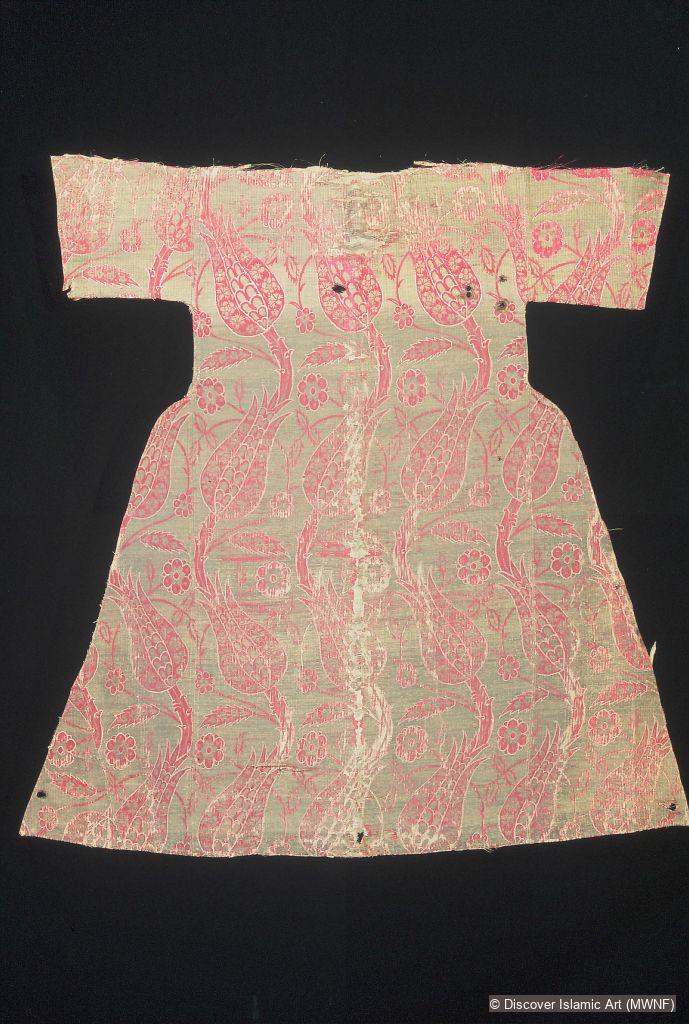
Name of Object:
Kaftan fragment
Location:
Edinburgh, Scotland, United Kingdom
Holding Museum:
National Museums of Scotland (NMS)
About National Museums of Scotland (NMS), Edinburgh
Date of Object:
Around hegira 1008 / AD 1600
Museum Inventory Number:
A. 1884.65.17
Material(s) / Technique(s):
Silk, cotton and silver brocade (kemha).
Dimensions:
Height 73.5, width 72 cm
Period / Dynasty:
Ottoman
Provenance:
Turkey.
Description:
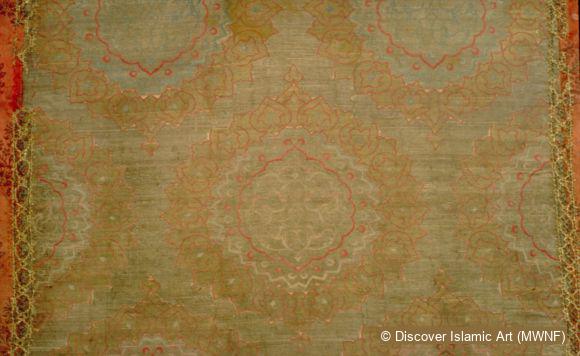
A silk brocade (kemha) fragment that originally formed the back of a child's collarless, short-sleeved kaftan, cut with a straight waist and bell-shaped skirt. The textile is woven with a dense, overall floral design consisting of vertically disposed, sinuous floral stems with large tulips set at regular intervals. The flowers are rendered in red against a silvery green background. This type of pattern was popular not only on kemha fabrics, but also on other media such as tile work.
The original museum record states that this piece represents a portion of a child's robe-of-honour from Constantinople or Bursa. Possibly arriving in Turkey via Syria, the complex weaving technique adopted on this textile, known as lampas weave, was used by Ottoman weavers in the late AH 9th–early 10th /AD late 15th–early 16th century. The most important Ottoman silk manufactory was at Bursa but in the AH 10th / AD 16th century, court workshops were also set up in Istanbul, the Ottoman capital. Kemha garments were designed to emphasise the imperial status of the sultan and his family even in death, when such garments were often draped over imperial cenotaphs or sandukas.
This fragment is part of a group of garments that was brought to Europe by an art dealer and cut up with some of the resulting front and back sections subsequently divided between the V&A in London and the Royal Museum in Edinburgh.
This fragment comes from a child's collarless and short-sleeved silk brocade kaftan worn by a junior member of the Ottoman court. The dense, overall floral design with its vertically disposed, sinuous floral stems and large tulip heads can also be found in other media such as contemporary tile work.
How date and origin were established:
Kemha textiles were popular in the Ottoman Empire between the late 10th–early 11th / late 16th–early 17th centuries.
How Object was obtained:
Purchased from Mr Tiano of Constantinople in 1884.
How provenance was established:
Items such as this kaftan are known to have been worked in the Ottoman silk-weaving workshops at Bursa or Istanbul during the late 10th–early 11th / late 16th–early 17th centuries.
Selected bibliography:
Atasoy, N., Denny, W. B., Mackie, L. W., and Tezcan, H., Ipek, the Crescent and the Rose: Imperial Ottoman Silks and Velvets, London, 2000, p.206, p.234, fig. 148 (for a tile panel with a very similar design); pp.282–3, fig. 240 (for a similar fragment at the V&A, London).
Citation of this web page:
Ulrike Al-Khamis "Kaftan fragment" in Discover Islamic Art, Museum With No Frontiers, 2026.
https://islamicart.museumwnf.org/database_item.php?id=object;ISL;uk;Mus03;41;en
Prepared by: Ulrike Al-KhamisUlrike Al-Khamis
Ulrike Al-Khamis is Principal Curator for the Middle East and South Asia at the National Museums of Scotland in Edinburgh. She began her academic career in Germany before completing her BA (1st class Hons) in Islamic Art and Archaeology at the School of Oriental and African Studies in London in 1987. The same year she moved to Edinburgh, where she completed her Ph.D. thesis on “Early Islamic Bronze and Brass Ewers from the 7th to the 13th Century AD” in 1994. From 1994 to 1999 she worked as Curator of Muslim Art and Culture for Glasgow Museums and, in 1997, was one of the main instigators of the first ever Scottish Festival of Muslim Culture, SALAAM. Since 1999 she has been based at the Royal Museum in Edinburgh, where she has curated several exhibitions and continues to publish aspects of the collections. In addition to her museum work she has contributed regularly to the teaching of the Fine Arts Department at the University of Edinburgh.
Copyedited by: Mandi GomezMandi Gomez
Amanda Gomez is a freelance copy-editor and proofreader working in London. She studied Art History and Literature at Essex University (1986–89) and received her MA (Area Studies Africa: Art, Literature, African Thought) from SOAS in 1990. She worked as an editorial assistant for the independent publisher Bellew Publishing (1991–94) and studied at Bookhouse and the London College of Printing on day release. She was publications officer at the Museum of London until 2000 and then took a role at Art Books International, where she worked on projects for independent publishers and arts institutions that included MWNF’s English-language editions of the books series Islamic Art in the Mediterranean. She was part of the editorial team for further MWNF iterations: Discover Islamic Art in the Mediterranean Virtual Museum and the illustrated volume Discover Islamic Art in the Mediterranean.
True to its ethos of connecting people through the arts, MWNF has provided Amanda with valuable opportunities for discovery and learning, increased her editorial experience, and connected her with publishers and institutions all over the world. More recently, the projects she has worked on include MWNF’s Sharing History Virtual Museum and Exhibition series, Vitra Design Museum’s Victor Papanek and Objects of Desire, and Haus der Kulturen der Welt’s online publication 2 or 3 Tigers and its volume Race, Nation, Class.
MWNF Working Number: UK3 41