

 Back
Back

Name of Monument:
Islamic wall
Location:
Silves, Faro, Portugal
Date of Monument:
Hegira second half of 6th / AD second half of 12th century
Period / Dynasty:
Almohad
Description:
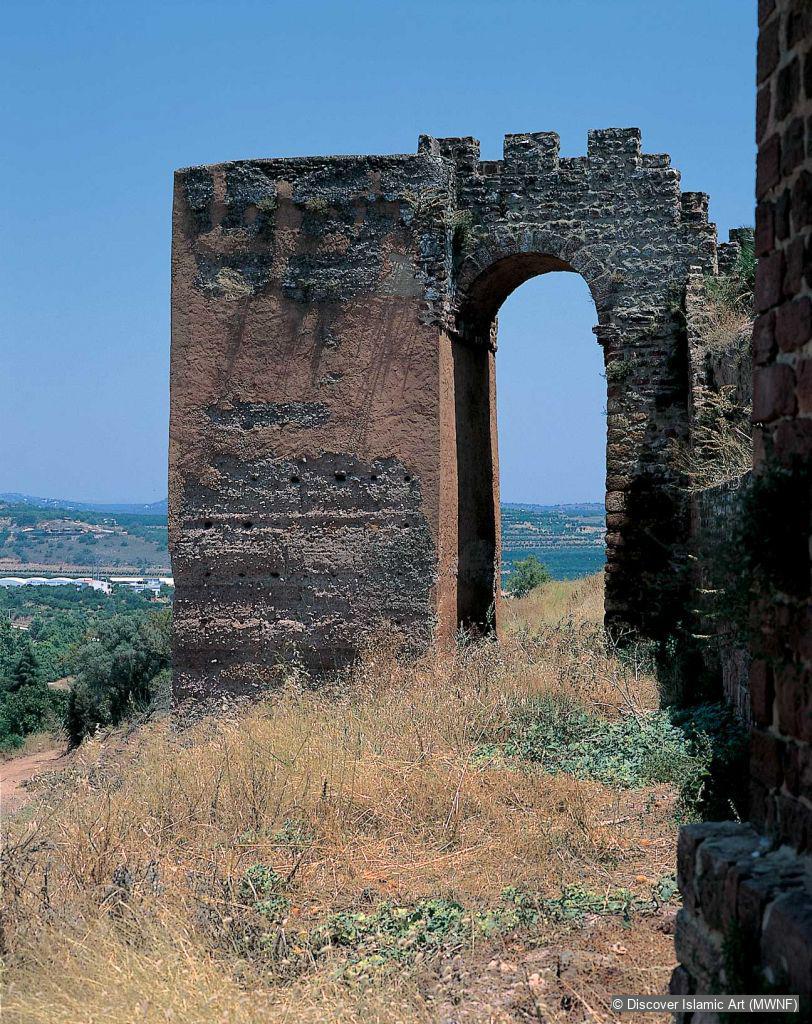
Consisting of extensive sections of wall built of tabiyya (compressed mud and stone), some of which are intact, towers built against the wall and square watchtowers built of red stone (Silves sandstone), the fortress of Silves has unique characteristics in the Islamic military context in Portugal, given the reasonably good state of preservation of these elements. Also still preserved from this defensive complex is the monumental Almohad entrance gate set at a right angle, the main entrance to the medina (town) of Xelb (Islamic Silves), known as the Porta de Loulé (Loulé Gate).
This gate was defended by an enormous watchtower from which, heading north, the road gave access to the medina and continued to the citadel and, in the opposite direction, led down to the Arade river. The Islamic town of the 12th century had three main entrance gates: Porta de Cidade (town gate) or de Loulé (Bab-al-Balad) in the south; the Porta do Sol (sun gate / Bab-al-Sârus) in the east and the Porta da Azóia (Bab-al-Zauiâ) in the west. All these gates were protected by watchtowers. There were another 20 or so towers built against the wall, many of which have disappeared.
The town walls of Silves enclose an area of 7 hectares and it is today undoubtedly the finest military monument in Portugal remaining from the Islamic period.
The Almohad wall of Silves (AH second half of 6th / AD second half of 12th century) was rebuilt on top of the remains of earlier walls, most of them Almoravid, which had to be extended and strengthened in face of the threat of the Christian military advance.
The whole area of the castle and all of the historic centre of Silves (the former medina within the walls) were the subject of continuous archaeological excavations nearly 20 years ago, and these have shown, either from the groups of dwellings found or from the objects unearthed, the existence of an Islamic town of great political, commercial and cultural importance in the AH 5th, 6th and 7th / AD 11th, 12th and 13th centuries.
The town wall at Silves surrounds some 7 hectares and is the most beautiful military monument from the Islamic period in Portugal. The Almohad wall (second half of the AH 6th / AD 12th century) was erected on the remains of existing walls that needed to be extended and reinforced to counter the Christian military advance.
The remains of this defensive structure include the Loulé Gate, a monumental chicane entrance that was the main route to the medina. Long sections of adobe wall have also survived, some intact, along with square freestanding (flanking) and adjoined towers in red brick.
How Monument was dated:
The wall and watchtower were mentioned in a document left by an anonymous crusader in 584 / 1189, the year of the first conquest of the town by Christians, Relação da Derrota Naval, Façanhas, e Sucessos dos Cruzados que Partirão do Escalda para a Terra Santa no Ano de 1189.
The archaeological excavations carried out close to the surface of the wall show evidence of groups of dwellings and artefacts of the period.
The style of construction (tabiyya) and the materials used in the wall and in its towers are clearly Islamic.
Selected bibliography:
Alegria, J. A., Itinerários da Terra: Inventariar o Património de Arquitectura em Terra: Contributo para um Inventário no Concelho de Silves, Faro, 2002.
Gomes, R. V., Palácio Almóada da Alcáçova de Silves, Lisbon, 2001.
Gomes, R. V., Silves (Xelb), Uma Cidade do Gharb Al-Andalus: Arqueologia e História (Séculos VIII–XIII), Faculty of Social Sciences, University of Lisbon, 1999.
Lopes, J. B. da S., Relação da Derrota Naval, Façanhas, e Sucessos dos Cruzados que Partirão do Escalda para a Terra Santa no ano de 1189 (Escrita em Latim por Hum dos mesmos Cruzados. Traduzida e anotada pelo autor), Lisbon, 1844.
Citation of this web page:
Maria da Conceição Amaral "Islamic wall" in Discover Islamic Art, Museum With No Frontiers, 2026. 2026.
https://islamicart.museumwnf.org/database_item.php?id=monument;ISL;pt;Mon01;15;en
MWNF Working Number: PT T
RELATED CONTENT
Islamic Dynasties / Period
On display in
Exhibition(s)
See also
Virtual Visit Exhibition Trail
In the Lands of the Enchanted Moorish Maiden. Islamic Art in Portugal
Download
As PDF (including images) As Word (text only)