

 Back
Back
Name of Object:
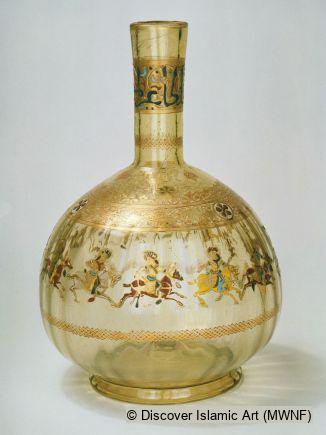
Glass carafe
Location:
Cairo, Egypt
Holding Museum:
Museum of Islamic Art
About Museum of Islamic Art, Cairo
Original Owner:
Ayyubid Sultan, al-Nasir Yusuf II
Date of Object:
Hegira 7th century / AD 13th century
Museum Inventory Number:
4261
Material(s) / Technique(s):
Glass, decorated with coloured enamel and gilding.
Dimensions:
Height 32 cm, diameter (of the body) 15 cm
Period / Dynasty:
Ayyubid
Provenance:
Egypt or Syria.
Description:
A glass carafe that is distinguished by its delicacy and beautiful proportions. It is composed of a conical-shaped base, the bottom of which is a prominent circle. The body is characterised by sloping shoulders, the lower portion of which slopes into a round bowl. Its long, elegant neck terminates with a slightly undulating mouth. The body is decorated with arabesque vegetal motifs executed in enamel and gilding inside three simple roundels; one of which holds a stylised lotus blossom depicted in white against a background of blue enamel. The neck of the vessel bears a gilded inscription in small letters on which the name Sultan al-Nasir Salah al-Din Yusuf appears. The mouth of the vessel is embellished with simple decorative bands.
It is clear from the inscription that the vessel was designated to the Ayyubid Sultan, al-Nasir Yusuf II, the ruler of Aleppo and Damascus in the period AH 634–58 / AD 1237–60. Enamel-painting on glass is considered to be a popular decorative style of the Ayyubid period, which became widespread in the Mamluk period. A considerable number of these vessels with enamel decoration are found in various museums worldwide. A similar vessel in the Museum of Islamic Art in Berlin is decorated with a painting of two horsemen playing polo. It dates to the Ayyubid period in the AH 7th / AD 13th century and originated in Syria.
The production of glass reached its peak of excellence in Egypt and Syria in the AH 6th–9th / AD 12th–15th centuries under the patronage of the Ayyubid and Mamluk Sultans. Many glass pieces were decorated with gilding and enamel, of which this is fine example.
How date and origin were established:
The vessel is dated based on the fact that it bears the name of the last Ayyubid Sultan al-Nasir Yusuf II, ruler of Aleppo and Damascus in the period 634–58 / 1237–60.
How Object was obtained:
The vessel was donated to the museum in 1915 by Amir Yusuf Kamal, who was one of the princes of the family of Muhammad Ali who ruled Egypt from 1805–1952.
How provenance was established:
The production and use of enamelled glass vessels was widespread in Egypt and Syria during the Ayyubid period (7th / 13th century).
Selected bibliography:
Hamdi, A., et al, Katalog Ma'rid al-fan al-islāmi fi misr [Catalogue of the Islamic Art Exhibition in Egypt], Cairo, 1969.
Hamid, A. A., et al, Al-Funun al-Zukhrufiya al-Islamiya [Islamic Decorative Arts], Baghdad, 1965.
Marzuq, Muhammad Abd al-Aziz, Al-Fan al-Islami fi al-'asr al-Ayyubi [Islamic Art in the Ayyubid period], Cairo, 1963.
Ward, R., (ed) Gilded and Enamelled Glass from the Middle East: Origins, Innovations and Influences, London, 1998.
Yasin, Abd al-Nasir, Al-Funun al-Zukhrufiya al-Islamiya fi al-'asr al-Ayyubi [Islamic Decorative Arts in the Ayyubid period], Alexandria, 2002.
Citation of this web page:
Salah Sayour "Glass carafe" in Discover Islamic Art, Museum With No Frontiers, 2026.
https://islamicart.museumwnf.org/database_item.php?id=object;ISL;eg;Mus01;43;de
Prepared by: Salah SayourSalah Sayour
Salah Ahmad Sayour holds a BA in Islamic Antiquities, Faculty of Arts, Cairo University (1973) and is currently studying for an MA in the same field. In 1979 he had a four-month scholarship at Austrian museums to study museology. Preparing exhibitions for the Museum of Islamic Art's collections in the Arab World Institute, Paris and curating exhibitions held in host museums in the USA and Paris augmented his experience leading to his appointment as head of several sections at the Museum. He has written several articles on Islamic painting and arts for Prism Magazine published by the Ministry in different languages and has participated in preparing scientific texts for the catalogues for the Museum's exhibitions at home and abroad.
Copyedited by: Majd Musa
Translation by: Amal Sachedina (from the Arabic).
Translation copyedited by: Mandi GomezMandi Gomez
Amanda Gomez is a freelance copy-editor and proofreader working in London. She studied Art History and Literature at Essex University (1986–89) and received her MA (Area Studies Africa: Art, Literature, African Thought) from SOAS in 1990. She worked as an editorial assistant for the independent publisher Bellew Publishing (1991–94) and studied at Bookhouse and the London College of Printing on day release. She was publications officer at the Museum of London until 2000 and then took a role at Art Books International, where she worked on projects for independent publishers and arts institutions that included MWNF’s English-language editions of the books series Islamic Art in the Mediterranean. She was part of the editorial team for further MWNF iterations: Discover Islamic Art in the Mediterranean Virtual Museum and the illustrated volume Discover Islamic Art in the Mediterranean.
True to its ethos of connecting people through the arts, MWNF has provided Amanda with valuable opportunities for discovery and learning, increased her editorial experience, and connected her with publishers and institutions all over the world. More recently, the projects she has worked on include MWNF’s Sharing History Virtual Museum and Exhibition series, Vitra Design Museum’s Victor Papanek and Objects of Desire, and Haus der Kulturen der Welt’s online publication 2 or 3 Tigers and its volume Race, Nation, Class.
MWNF Working Number: ET 75
RELATED CONTENT
Related objects


Islamic Dynasties / Period
On display in
Exhibition(s)
MWNF Galleries
GlassDownload
As PDF (including images) As Word (text only)