

 Back
Back

Name of Object:
Aigrette-holders
Location:
Sultanahmet, Istanbul, Türkiye
Holding Museum:
Museum of Turkish and Islamic Arts
About Museum of Turkish and Islamic Arts, Sultanahmet
Original Owner:
419: Haseki Hürrem Sultan (d. AH 965 / AH 1558)
Date of Object:
421 and 419: Hegira 10th century / AD 16th century; 438: Hegira last quarter of the 10th century / AD 16th century; 447: Hegira last quarter of the 11th century / 17th century
Museum Inventory Number:
421, 438, 447, 419
Material(s) / Technique(s):
421: gold; 438: gold; 447: gold and enamel; 419: gold.
Dimensions:
421: height 16 cm; 438: maximum height 30.5 cm, height of holder 14 cm; 447: maximum height 13 cm, height of holder 7 cm; 419: height 12 cm
Period / Dynasty:
Ottoman
Provenance:
Istanbul, Turkey.
Description:
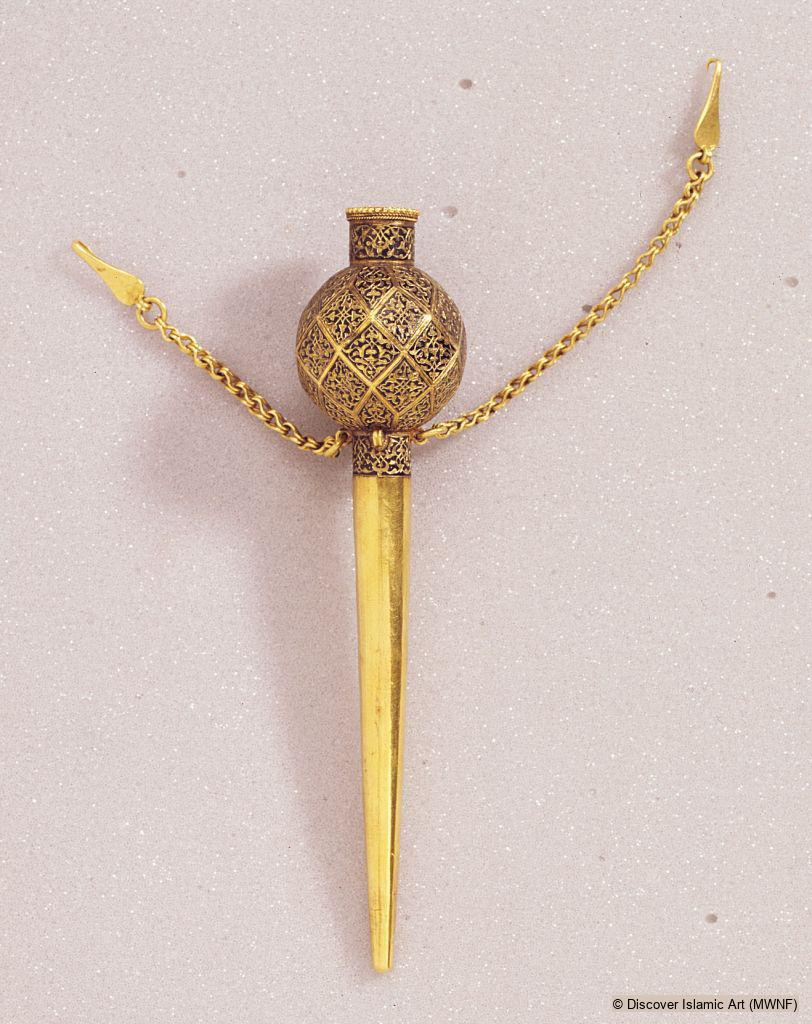
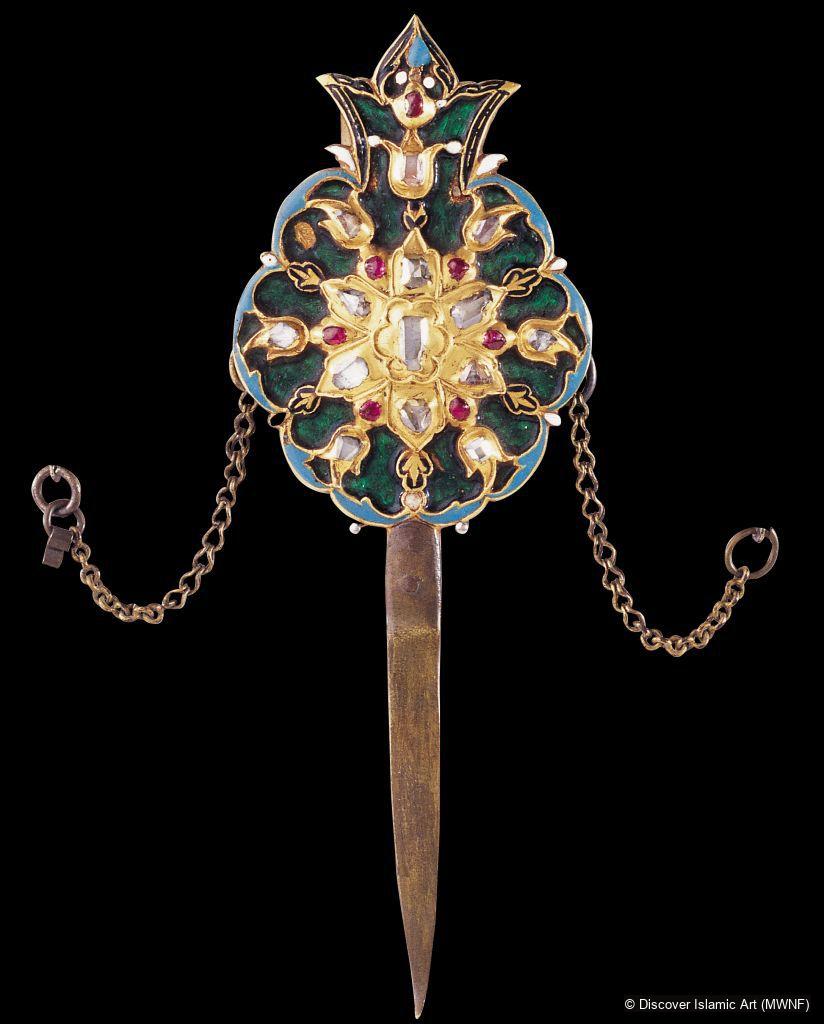
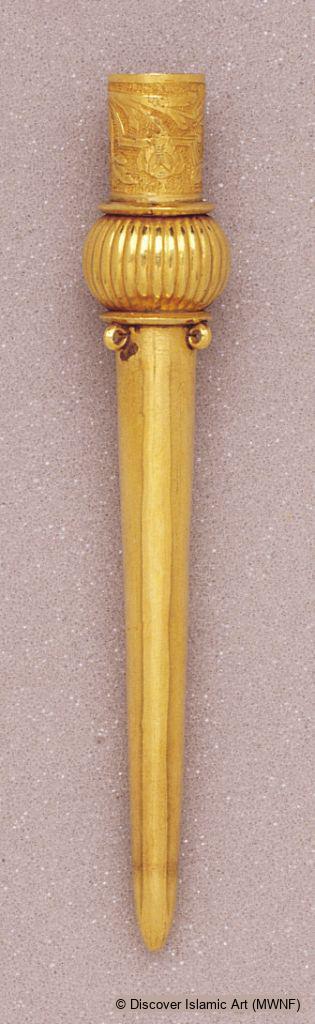
An aigrette is a bundle of ornamental feathers placed in a holder and attached to headgear such as a turban. The upper part of the aigrette-holder is wide, while the bottom end is narrow, similar to the form of a fan. Sultans used to wear such ornaments, placed in golden holders decorated with precious stones, in the middle of their turbans to symbolise their authority. Aigrette-holders were sometimes bestowed by the sultan upon his officials as a sign of privilege. Janissary officers would also wear them in their headgear to indicate their rank.
421: A round aigrette-holder with a straight stem. The surface of the holder is divided into lozenges whose edges are defined by bands and the background of which is decorated in niello with scrolling tendrils and palmette leaves. The holder for the aigrette feathers is cylindrical and has two chains with hooks for attaching it to a turban.
438: A slightly oval, flat and wide aigrette-holder the front part of which is covered by Chinese-inspired floral decoration in relief, with a medallion at the centre. In addition, the whole surface is decorated with small flowers and leaves in high relief. At the apex is the aigrette-holder proper, a wide, flat cup at the centre to which peacock feathers are affixed, with narrow tubes at either side. The back has a surface design of engraved leaves. The chains for attaching it to a turban are made of gold.
447: An aigrette-holder in the form of a medallion, flat and wide, with strips at the sides. The top has a tulip-shaped ornament. The decoration at the centre, adorned with diamonds and rubies, is a moulded flower with golden leaves; the background is enamelled in green, the border in turquoise.
419: An aigrette-holder, the stem of which is straight. The opening of the aigrette-holder socket is decorated with Chinese-inspired floral motifs. The aigrette-holder cup is in the form of a grooved ball, with rings at the bottom for the attachment-chains. The chains are missing. It was made for Hürrem Sultan.
An aigrette is a cluster of ornamental feathers in a holder and attached to headgear such as a turban. Aigrette holders were produced by master jewellers and were attached to the turbans placed in the sultans' mausolea after death to give continuity to their power and grandeur.
How date and origin were established:
419, 421, and 438 have form and decoration typical of the 10th / 16th century; 447 has form and decoration typical of the 11th / 17th century.
How Object was obtained:
421: Brought to the Museum from the tomb of Sultan Selim II, Istanbul, on 26 November 1914.
438: Brought to the Museum from the tomb of Ibrahim Pasha in Istanbul in 1914.
447: Found in the tomb of Nakşıdil Valide Sultan at the Yeni Cami in Istanbul.
419: Brought to the Museum from the tomb of Haseki Hürrem Sultan at the Süleymaniye complex on 23 November 1911.
How provenance was established:
The craftsmanship of these aigrette-holders testifies to the quality of court jewellery. Thus it is thought that they were made in the workshops of the Topkapı Palace.
Selected bibliography:
Art Treasures of Turkey, (with essays by M. Mellink et al), Washington, D.C, 1966, p.105.
ölçer, N. et al, Museum of Turkish and Islamic Art, Istanbul, 2002, p.306 (for 447).
ölçer, N., et al, In Pursuit of Excellence: The Museum of Turkish and Islamic Arts, Istanbul, 1993, p.100, p.123 (for 419).
Citation of this web page:
Alev Özay "Aigrette-holders" in Discover Islamic Art, Museum With No Frontiers, 2026.
https://islamicart.museumwnf.org/database_item.php?id=object;ISL;tr;Mus01;28;en
Prepared by: Alev ÖzayAlev Özay
Alev Özay is an expert at the Museum of Turkish and Islamic Arts in Istanbul. She was born in Ankara, Turkey in 1942. She graduated from the Department of Ancient Near Eastern Languages and Cultures of the Faculty of Letters, Istanbul University. She first worked at the museums of Tekirdağ and Kayseri. She attended Ottoman language courses in 1976–7 and restoration and conservation courses in 1982 organised by the Ministry of Culture and Tourism. She published an article on the “Turbe of Sultan Ahmet” in 1979 and in 1983 prepared the catalogue for the Exhibition on Islamic Arts in the 15th Century of the Hijra.
Translation by: Barry WoodBarry Wood
Barry Wood is Curator (Islamic Gallery Project) in the Asian Department of the Victoria and Albert Museum in London. He studied history of art at Johns Hopkins University and history of Islamic art and architecture at Harvard University, from where he obtained his Ph.D. in 2002. He has taught at Harvard, Eastern Mediterranean University, the School of Oriental and African Studies, and the Courtauld Institute of Art. He has also worked at the Harvard University Art Museums and the Walters Art Museum in Baltimore. He has published on topics ranging from Persian manuscripts to the history of exhibitions., İnci Türkoğluİnci Türkoğlu
İnci Türkoğlu has been working as a tourist guide and freelance consultant in tourism and publishing since 1993. She was born in Alaşehir, Turkey, in 1967. She graduated from the English Department of Bornova Anatolian High School in 1985 and lived in the USA for a year as an exchange student. She graduated from the Department of Electronic Engineering of the Faculty of Architecture and Engineering, Dokuz Eylül University, Izmir, and the professional tourist guide courses of the Ministry of Tourism in 1991. She worked as an engineer for a while. She graduated from the Department of Art History, Faculty of Letters, Ege University, Izmir, in 1997 with an undergraduate thesis entitled “Byzantine House Architecture in Western Anatolia”. She completed her Master's at the Byzantine Art branch of the same department in 2001 with a thesis entitled “Synagogue Architecture in Turkey from Antiquity to the Present”. She has published on art history and tourism.
Translation copyedited by: Mandi GomezMandi Gomez
Amanda Gomez is a freelance copy-editor and proofreader working in London. She studied Art History and Literature at Essex University (1986–89) and received her MA (Area Studies Africa: Art, Literature, African Thought) from SOAS in 1990. She worked as an editorial assistant for the independent publisher Bellew Publishing (1991–94) and studied at Bookhouse and the London College of Printing on day release. She was publications officer at the Museum of London until 2000 and then took a role at Art Books International, where she worked on projects for independent publishers and arts institutions that included MWNF’s English-language editions of the books series Islamic Art in the Mediterranean. She was part of the editorial team for further MWNF iterations: Discover Islamic Art in the Mediterranean Virtual Museum and the illustrated volume Discover Islamic Art in the Mediterranean.
True to its ethos of connecting people through the arts, MWNF has provided Amanda with valuable opportunities for discovery and learning, increased her editorial experience, and connected her with publishers and institutions all over the world. More recently, the projects she has worked on include MWNF’s Sharing History Virtual Museum and Exhibition series, Vitra Design Museum’s Victor Papanek and Objects of Desire, and Haus der Kulturen der Welt’s online publication 2 or 3 Tigers and its volume Race, Nation, Class.
MWNF Working Number: TR 52
RELATED CONTENT
Related objects


Related monuments

Islamic Dynasties / Period
On display in
Exhibition(s)
MWNF Galleries
JewelleryDownload
As PDF (including images) As Word (text only)